
Blog by Modulus

READ OUR BLOG

Electric Vehicles: Are They All They’re Amped Up To Be?

Guest Blog

Written by Phil Murphy; Trainee Chartered Accountant & Claire Stewart (Partner) at Cartmill Stewart & Co.  You can contact them directly on 028 9252 8710 or email philip@cartmillstewart.co.uk / claire@cartmillstewart.co.uk for more information or advice.

Claire & Phil

As tax advisors and accountants, we are always doing our best to keep our clients informed about changes in tax legislation. Top of the list is how we keep our client’s tax to a minimum… legally, of course!

When it comes to company vehicles, this has been an ever-changing landscape for many years.  If you keep up to date with the news at all, you will know that the government is strongly encouraging the move towards electric vehicles. This is all down to a massive drive towards global climate change and improving things for future generations.  Now for those of you who are petrolheads, would the possibility of saving thousands of pounds in tax help the switch to electric a little easier?

In order to make sure there is a tax saving, we need to look at the circumstances individually.  We would like to note that these are just some key points to think about if you are considering the change to EV (what the cool kids call electric cars)

Benefit in Kind for employees/directors

Let’s run through a couple of examples to paint the picture and see how this benefits you as an employee of the company.


Petrol vehicles 

If you were to buy a BMW 4 series Gran Coupe for £60k list price, then the Benefit in Kind (BiK) due on your tax return would be based on the Co2 emissions of the car.

The emissions on the BMW 4 series would be 178 g/km which equates to a BiK rate of the maximum 37% of the price of the car (diesel cars even incur an extra 4% on top of the petrol rates). If you currently pay tax at the basic rate of 20%, you will have a personal tax liability of £4,440; £8,880 if you are in the higher tax band!

These figures are substantial… and this is before we even consider the fuel BiK for personal use (if your company pays for your fuel).  For the private fuel element, we use the same Co2 emission rate of 37% against a fixed amount £24,600 (21/22 figure). This adds £1,820 to the basic rate taxpayer and £3,640 to the higher rate taxpayer. The fuel portion can be reduced if you make payments back to the business for your private use of the vehicle.

But as a 40% tax payer, this can mean you are paying c. £12,500 in tax for a company car and fuel.  Crazy!


Electric Vehicles

The totals for petrol and diesel cars can start to mount up which is where the tax savings for electric vehicle start to become more appealing.

Using the electric version of the example above. Lets look at the BMW i4 eDrive with a list price of approximately £60k. As this vehicle is fully electric the Co2 emission rate used to calculate the BiK on this vehicle is 1% for the 21/22 tax year rising to 2% for the 2022-23 tax year.

This reduces the tax liability from a petrol car of £4,440 down to £120 for simply switching to the electric model. And since electric charging is not classified as fuel in the regulations, the fuel BiK is not added for personal use. Win win!

So not only are you saving from paying big sums on your tax bill, you are also saving money on the rising prices of fuel.


What about the company – how does it benefit?

The company can take advantage of the deposit and monthly payments through the business to reduce profits by the net amount (excluding VAT). Therefore, reducing the corporation tax by 19% of the total net figure for the year. (in the 2021/22 tax year).

VAT for the purchase or lease can be reclaimable off your VAT return too. 100% of the VAT can be reclaimed if the car is used 100% for business use (must be demonstrated) and 50% if private usage.

First year capital allowance can also be claimable for qualifying new electric vehicles. Hence, your business can claim 100% tax relief for the cost of the vehicle. This deduction was recently extended until 31 March 2025.

Businesses can benefit from the current super deduction for the cost of installing and purchasing a fixed electric charger, which gives 130% first year allowance on qualifying electric charging points used for business use. I.e. better than 100% tax relief!


Other advantages of electric vehicles are: they are exempt from road tax, cleaner for the environment than petrol/diesel cars with lower running costs, a lot quieter reducing noise pollution.


Things to consider…

  • Charging point locations are increasing rapidly although are not everywhere yet. This means journeys will have to planned, if running low on charge
  • Charging points at business premises or at home are easy to install
  • The range of electric vehicles are increasing every year and as technology advances, yet currently (in most cases) the range of a full tank of petrol or diesel will get you further than electric
  • Some new models of cars are on back order for multiple months due to supply chain issues and shortage of chips for the cars, so may have to wait a little longer for certain models


Are Hybrids an option?

They are calculated a little differently. If the Co2 emissions are less than 50g/km the electric range is taken into consideration. If the electric range is above 130 miles, they have the same BiK of electric vehicles of 1% (2021-22 figure) increasing to 2% in 2022-23 tax year. This percentage is increased gradually up to the lowest range of ‘less than 30 miles’ with a BIK of 13%.

With Hybrids you will still have to pay road tax, albeit reduced. And you will lose some of the environmental/green benefits of driving an electric.


Salary Sacrifice

Interestingly, there is a salary sacrifice scheme which enables employees to ‘sacrifice’ some of their gross salary to receive the benefit of driving a fully electric vehicle. As the salary is taken before PAYE tax and National Insurance contributions are applied, the employee effectively saves costs on the acquisition of the vehicle.

The employee pays the monthly fee out of their salary before tax (with no up-front costs for the vehicle) and the only extra they pay is the BIK tax. Which as we saw above, if they chose electric, might only be a couple of hundred pounds a year.

How does this benefit the company?

The scheme provides an opportunity to provide employees a new electric car at a reduced cost (than in the retail market) in a tax efficient manner. The employee receives the car, tax, insurance, maintenance and more which can help improve employee motivation, leading to improved productivity and retention.

The company also benefits with reduced National Insurance contributions payments from the scheme.


There are many other points and areas to consider, so we would suggest you seeking the advice of your accountant / tax advisor, before making the decision.  The advice should be tailored to your own individual circumstances.



There’s Tax Increases and Then There’s Tax Increases

The new tax year is approaching quickly and whilst most businesses tax years are not aligned to the 6th April start date the effect of changes kicks in at this date.  So what changes are coming in the new tax year and what will be the impact for business?  Given the fact that allowances for income have been frozen, it will come as no surprise to learn that in general business owners, the self-employed and indeed employees are being hit in terms of what ends up in their back pockets.  Note – the personal allowance will not change from £12,570 until 2025 / 26, along with the introduction of other forms of stealth tax i.e. no increase to IHT threshold. So you will pay more tax, but it isn’t labelled as a tax increase.


Dividend Tax

There will be a 1.25% increase to dividend tax rates (on all bands) from 6th April.  This means that any dividend income in excess of the personal dividend allowance (£2,000) will be taxed at the following rates –

Income tax band Dividend tax rate 2021-22 Dividend tax rate 2022-23
Basic rate 7.5% 8.75%
Higher rate 32.5% 33.75%
Additional rate 38.1% 39.35%


In real terms this flat 1.25% increase equates to an increase (in real terms) of 16.67% for basic rate taxpayers (1.25% / 7.5% = 16.67% increase), a 3.84% increase for Higher Rate Taxpayers and a 3.18% increase for Additional Rate Taxpayers.

The dividend tax allowance in 2016 / 17 & 2017 / 18 was £5,000 and since 2018 / 19 it has been reduced to £2,000.  Before 2016 any dividend received was deemed to have had a notional 10% tax credit (which meant that there was no further liability for a basic rate taxpayer and an effectively reduced rate for higher and additional rate taxpayers).

For business owners the question of Dividend income Vs Salary raises its head again.  This is certainly one for discussing with your accountant.  One point to note is that a dividend could be refused by a company owner and a pension contribution made instead, the benefit being of course that this would attract Corporation Tax Relief (which is due to potentially increase from April 2023!

The dividend tax increase not only affects business owners but also anyone with dividend bearing investments.

It is more important than ever for investors to try and utilise their ISA allowances moving forward.  Any gains (dividends included) made in an ISA are not subject to further taxation.  Even if you decided not to invest the funds in dividend bearing assets now, you could still transfer your cash ISA into a Stocks and Shares ISA in the future.


National Insurance

National Insurance rates are increasing for everyone by 1.25%.  Again, this flat rate clouds the increase in real terms.  For an employer this means that the rate increases from 13.8% to 15.05% of employee earnings in excess of the Secondary Threshold (£9,100 in 2022 / 23).  This equates to an increase in real terms of 9.06% for employers.  Please note that the Secondary Threshold has increased from £8,840 to £9,100 meaning that employees will earn more before employers pay National Insurance contributions (but the rate has increased as noted above).

The only good news is that should a business owner elect to permit salary sacrifice for employees (including themselves) then there is essentially an increase of £150.50 for every £1,000 of salary sacrificed into a pension.

For employees the changes to National Insurance look like this –


2021-22 2022-23
Earnings threshold Class 1 rate Earnings threshold Class 1 rate
Less than £9,568 0% Less than £9,880 0%
£9,568-£50,270 12% £9,880-£50,270 13.25%
More than £50,270 2% More than £50,270 3.25%


Again the real rates of the increase for employees earning between £9,880 and £50,270 is 10.41% (1.25% / 12.0% = 10.41%) and from £50,270 the real rate of increase is 62.5%.

For those self employed or in a partnership then National Insurance will look like this –

2021-22 2022-23
Profits threshold Class 2 & 4 rates Profits threshold Class 2 & 4 rates
Less than £6,515 0% Less than £6,725 0%
£6,515-£9,568 £3.05 per week (Class 2) £6,725-£9,880 £3.15 per week (Class 2)
£9,568-£50,270 9% + £3.05 per week £9,880-£50,270 10.25% + £3.15 per week
More than £50,270 2% + £3.05 per week More than £50,270 3.25% + £3.15 per week


For the self employed the real rates of tax increase between £9,880 to £50,270 is 13.89% (1.25% / 9.0% = 13.89%) and from £50,270 the real rate of increase is 62.5%!

Voluntary Class 3 National Insurance contributions will increase from £15.40 to £15.85 per week.


Summary

With changes in tax and National Insurance rates (as well as the frozen allowances and thresholds which increases your tax further) and a planned increase to Corporation Tax from (April 2023), there has potentially never been a more important time to review the financial planning for you and your business.

Should you have any questions then please contact Dale or myself and we will be happy to work with you and your other professional advisers to ensure that you are on track to prepare for the future.


^^This communication is for general information only and is not intended to be individual advice. References to Tax Relief & Allowances, and National Insurance rate figures correct at time of issue.

7 Tips For The End Of Tax Year

Phew, January’s over – we made it! We’ve had a busy month, not helped by Covid knocking on the door and inviting itself in. But we’re over that now and things are looking up. As we approach the end of the tax year, here’s 7 things you should think about to improve your personal finances.

  1. Income Tax and Personal Allowance for High Earners

Has your income crept above the £100k mark – whether that’s because of a bonus, or a new job or significant pay rise? Do you know you start losing your personal allowance now?

For every £2 you earn over £100k, you lose £1 of your personal allowance. And so if you earn over £125,140 you don’t earn any money tax free.

Not only that, but if you have children, once you earn over £100k, you no longer qualify for the 20% help from the childcare account. Even if you earn £100,001 and your partner is unemployed. It’s gone – tough. But your next door neighbours could both be earning £99,999 and they still qualify. Seem unfair, doesn’t it – but what can you do?

You have two main options:

Option One – make a personal pension contribution. The gross amount of your personal pension contribution is taken off your earnings total.

Option Two – make a charitable donation.

Example: If your total earnings are £110,000, your personal allowance will be reduced by £5,000 and you won’t qualify for help with childcare. If you make a personal pension contribution of £8,000, your pension will claim back a further £2,000 of tax relief. This brings your gross pension contribution up to £10,000. This is then taken off your earnings, bringing your adjusted earnings back to £100k – so you keep your full personal allowance and tax free child care help.

The added benefit is when you complete your self assessment, you will get a further £2,000 of tax relief and so the £10k pension contribution will effectively cost you £6,000, as you have received tax relief at your highest rate of 40%.

A charitable donation works in the same way, but without the additional tax relief. You would need to pay £10k out of your pocket, to a charity of your choice.

  1. Use Your ISA Allowances

You have until 5th April to use up as much of your £20,000 ISA allowance as possible. If you don’t use it, you lose it. This simply shelters the money from tax. If you have plans for the money in the next couple of years, you should consider holding it in a cash ISA. If not, however, why not consider a stocks and shares ISA?*

It can go up and down in value, but by investing for a long time (at least 5 years minimum) you should have a really good chance of beating both cash returns and inflation. If you fancy it, get in touch.

If you already have an ISA open, you can top it up (subject to your £20,000 annual allowance). Realistically, this should be done – at  the latest – a  few days before the end of tax year to be sure it is in your account in time.

If you have a Lifetime ISA – your allowance for it is £4k, which the government tops up to £5k. It’s too good to miss out on. Remember, if you use your full LISA allowance, you only have £16k remaining for your Stocks & Shares or Cash ISA.

If you’re saving for your children in a Junior ISA, you can contribute up to £9k in this tax year.

These are all “Use it or Lose It” allowances.

  1. Review Your Cash ISA

If you’re saving for something which you plan to buy in the next few years – like a house move – you should be keeping your money in cash. But is a Cash ISA the way to go? What interest rate is your Cash ISA paying you?

Chances are it isn’t keeping up with savings accounts even though they are only typically paying a maximum of 0.7% for an easy access account right now. Especially if it’s an old cash ISA, you probably had a bonus rate which is now gone. You might not even be making 0.2%!

Consider this: You have a Personal Savings Allowance of £1,000 which can be earned from interest if you are a non or basic rate tax payer before tax is payable. This decreases to £500 if you are a higher rate tax payer. If your savings account pays interest of 0.7%, you would need to have £142,857 in the cash savings account already before you had any benefit of tax-free interest in a Cash ISA. If you are a higher rate tax payer, you need £71,428 in a cash savings account before the Cash ISA has any tax benefit.

  1. Review your Pension Contributions

According to this report, pension tax relief cost HMRC £41,3 billion in 2019-20. Make sure you are getting your fair slice of it. If you haven’t already done so, review your pension contributions. The minimum contributions through auto enrolment probably won’t be enough to provide the retirement lifestyle you are looking for. If you can afford to do more, do it! You are the one who will benefit in the long run, and the minimum contributions really aren’t going to provide for the comfortable retirement you probably want.

Make sure you are getting the full matching contribution from your employer if they offer it. Increase your contribution if you can afford to and explore the option of doing it through your workplace scheme via salary sacrifice to get an added bonus.

  1. Beware of the High Income Child Benefit Tax Charge

If you, or your partner, earn over £50k and are claiming Child Benefit, you need to be careful. There is something called the High Income Child Benefit Tax Charge, where those who earn over £50,000 per annum lose their child benefit. For every £100 you earn over £50k, you pay a charge equal to 1% of your child benefit received. Once you earn over £60k, you aren’t entitled to child benefit. This is equally true if mum earns £60,000 and dad earns nothing, they will lose all child benefit, whereas if mum and dad both earn £49,000 each, they can still claim full Child Benefit. It’s a completely fair system – isn’t it?

Consider making an additional pension contribution to get around this. For example, if you are set to earn £52,000 this year, you could make a gross pension contribution of £2,000 to bring your Adjusted Net Income below the threshold, and then you won’t lose any.

  1. Review Your Monthly Savings

Something I always talk about is to “Pay Yourself First.” This means that as soon as you get paid, you set up a transfer to pay £500 per month into cash savings account or your stocks and shares ISA. If you’ve been doing this, brilliant. But how often do you review how much you pay yourself? Are you worth a pay rise?

I believe that if you are saving money, for it to be as effective as possible, it should hurt you a little bit. After all, no pain no gain! What I mean by this is if you are comfortable saving £500pm to the point you don’t even notice it, increase your payment to £750. Keep increasing until you start to notice the money missing from your account. If it makes you think twice about buying something you don’t need, you have your monthly pay just right!

  1. Review your back up plan

Maybe you’ve moved house this year, or maybe you’ve had children, or maybe you’ve changed job. Any little change in your circumstances should make you review your back up plan. Three protection policies almost everyone should consider are

  • Mortgage Protection – a policy which will pay out enough to pay off your mortgage on your death or diagnosis of a critical illness
  • Life & Critical Illness Cover – a policy which will pay out a lump sum, hopefully in trust, for your husband/wife/children on death or diagnosis of a critical illness
  • Income Protection – a policy which will pay you out a tax free income after you’ve been unable to work for a certain time frame (normally 3 or 6 months).

I hope these will all be the worst investment you ever make. By that I mean, you pay all the premiums but they never pay anything out. However, if anything happens to you where they would pay out, they very quickly become the best investment you ever made.

It isn’t good enough to just put them in place and forget about them. You should regularly keep them under review to ensure they are sufficient, and make sure they are in trust. If you haven’t a clue what a trust is or why you need your life cover in one, call us now!


Your One Page Financial Health Check

We have created a One Page Financial Healthcheck which might be useful for you (or your family and friends) to start to keep this under control.

If you have given these areas of your finances a spring clean, you shouldn’t have too many worries until something changes and you need another regular check up!

*Please note that past performance is not a guide to the future, the value of an investment and the income from it could go down as well as up. You may not get back what you invest.

^^This communication is for general information only and is not intended to be individual advice.

Look Who’s Talking Now!

Dale and myself are part of a professional group called Next Gen Planners.  It has proven to be a great community and resource for us as we started Modulus. Next Gen Planners (NGP) provides support and development opportunities for its members.


Last year Dale took part in the NGP Blast Off Program – aimed at helping people who are starting new businesses.  The program was incredibly successful, and the insight Dale gained really helped us broaden our thinking when it came to both launching and running Modulus.  It provided us with access to new tools and experience from mentors who have ‘been there and done that’.  I saw first-hand how the program helped Dale over the period of the course as he honed existing and developed new skills (another benefit was that this rubbed off on me as well).


When it comes to business, when it comes to life in general, self-development is important.  It is how we grow.  We talk to clients all the time and we encourage them to tell us about what they want to do. We spend time working out how they are going to get there to do it.  I have a client and they told me that they have signed up to a personal goal – something that they have a real interest in and have thought about for some time.  The course that they are doing is completely outside their comfort zone and has absolutely nothing whatsoever to do with their business.  They are planning for life after they finish working.  When I spoke to said client, they told me that it was tough and that it was all my fault for talking them into doing it (they were joking of course).  I have to say that it was one of the most rewarding moments of my working life.  Knowing that someone leaned on our experience, on the work we do, to make a huge decision to do something completely out there because they had a passion for it, was pretty damm cool.

In the spirit of self-development and practising what I preach I am one of 30 people selected to be part of the Next Gen Planners Speaker & Influencer program 2022.  The program runs over the next few months with various training courses and culminates in a 10 minute Ted-talk style presentation at the Virtual Global Conference in May (broadcast to financial planners in the UK, South Africa and the USA – so no pressure there).  Should people like my talk then I might well be selected to speak at the annual conference in June (under the wings of a Concorde plane in Manchester).


Why am I doing this you probably ask? Well, it is because I honestly find public speaking at times quite exciting but difficult.  I don’t have a lot of confidence in that arena, and it is something that I would really like to be better at (even though I am absolutely bricking it).  So, you might see more of my head popping up in videos or on our social channels over the next few months.  If you see something that we put out there that you like then please let us know (if you don’t like something then let us know why – all feedback is welcomed).


Anyway, I am off to find a mirror to practice talking!


PS – I am now expecting many messages to come in about how I definitely don’t need to learn how to talk any more – and yes, they’re probably justified.

PPS – Dale just told me that he has never heard of the movie “Look Who’s Talking” – I officially feel old and realise that my efforts in doctoring the poster may well have been wasted on many of you!


And for any of you wondering – this is what John actually looked like as a baby / toddler!

Modulus In The Media

John was recently featured in New Model Adviser Magazine speaking about the financial planning and was asked the question – “Do client’s children ever cause problems?”.  Here is his piece from the article which can be read in full by clicking here.

In my experience so far, clients’ children don’t tend to cause hassle. Sometimes I see children sneaking around to see who that man is talking to mum and dad. Invariably they are told “that’s the man who is here to help us with / talk to us about our money”. And yes, I understand that this isn’t really answering the question being asked, but I am mentioning it for a reason. Children who are used to seeing their parents seeking help around money and personal finance are more likely to embrace an open attitude around such matters in the future.

Most of our clients with older, grown up children have a very open and positive relationship with money. As part of our ongoing financial planning service, we talk about helping children, both now and in the future, about how to help and if our clients should help.

Positive financial planning helps alleviate any awkward discussions because our clients have the context to make decisions as to when they can, whether they can, or if they even want to give money to their children. They are then more proactive about taking action and talking about this. I believe it is because of this that we haven’t had much grief, if any, from the children of clients (yet). In fact, often our main discussions with children are in relation to getting their parents to spend more money on themselves!

A New Year’s Good Habit Worth Keeping

New Year, New You! That’s what we’re about to be inundated with. Whether its for the latest exercise workout (Peloton and Hydrow – I’m looking at you) or the latest diet and turn to veganism fad. Dry January will kick off again to help us start the year healthy. Is there anything we can do with our finances?

I’m a big fan of regularly reviewing your finances. January is as good a time as any to start new habits, but there needs to be a reason behind it, otherwise you’ll never keep it up. If you’re already saving regularly (whether that’s into your ISA, Pension or other account) then maybe you can review it and increase the amount? All too often, we set the amount as an arbitrary figure (£100, £250 and £500pm seems common) but we never change it. Even though we get pay raises, change jobs and get pay jumps, bonuses, or we finish paying down debts. If you’re serious about making meaningful savings, you should always review your saving rate – the amount of your income you are saving.

Some Motivation to Kick Start The Habit

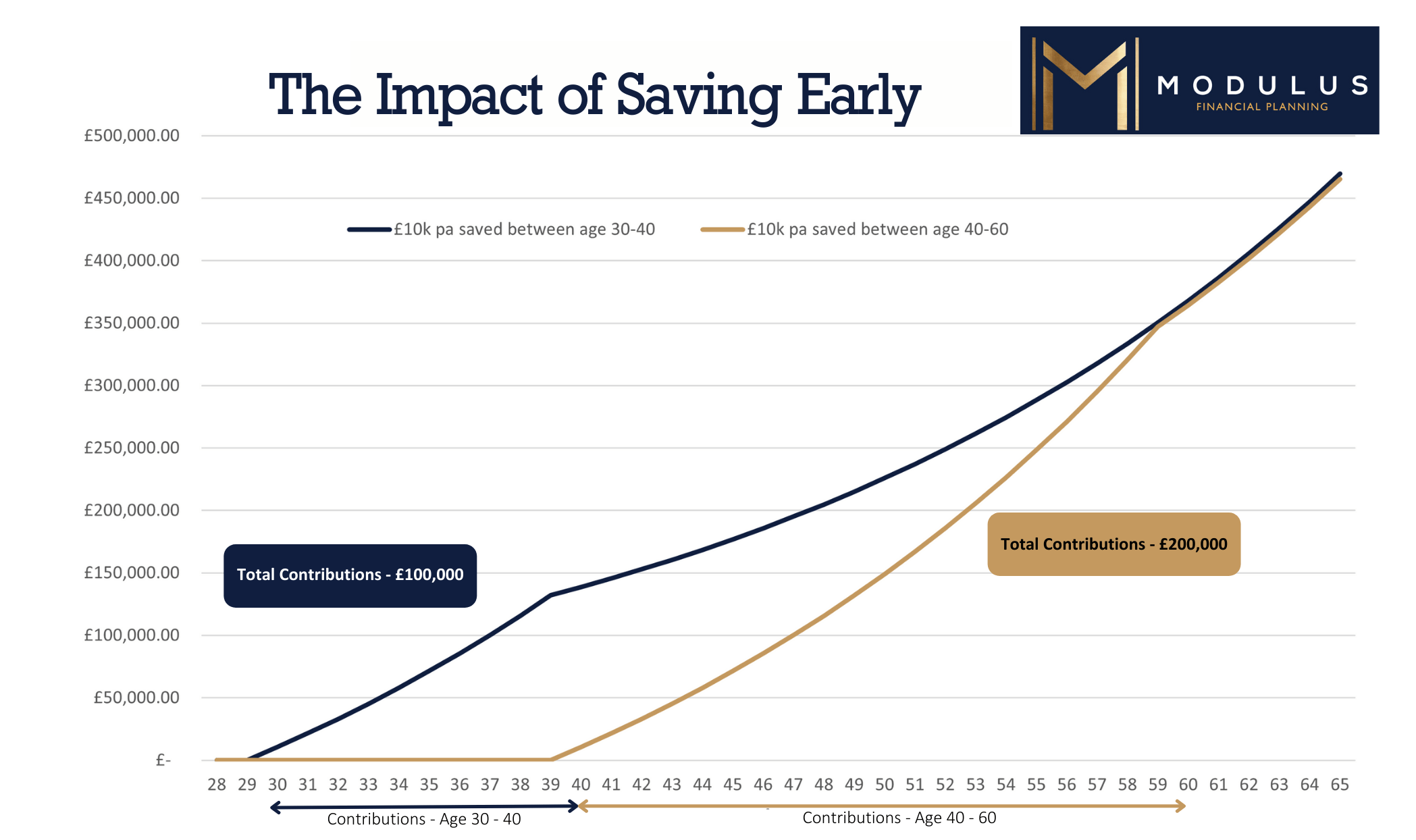
Here’s an example of two savers.

Henry begins to save £10k per annum when he turns 30 and saves it every year until he turns 40. Then he stops saving. In total he saved £100k out of his pocket.

Henrietta waits until she is 40 and begins to save £10k per annum. She, however saves for 20 years, until she is 60 and so she saves £200k out of her pocket.

Both have saved in an account where they are making an annual return of 5%

Who ends up better off?

Compound Interest

Henry started 10 years earlier, and so he has 10 years additional growth. This means he benefits more from compound interest.

Einstein “Compound Interest is the eight wonder of the world. He who understands it, earns it… He who doesn’t, pays it…”

Compound interest is essentially earning interest (growth) on already earned interest (growth). That is why all projections are generally a curved line rather than a straight line. The earlier you can invest, and the longer you leave it, the more you will benefit from compound interest.

This is why we always like our clients (and their children) to start saving early and let compound interest do the heavy lifting.

Henry vs Henrietta

So, let’s get back to Henry vs Henrietta. Who is better off when Henry started earlier, but Henrietta saved twice as much in total?


Well, in this example, I’ve built in such a way that they are almost equal at age 60. The figures show relatively little difference. When Henry is aged 60, he has £350,000 whereas when Henriette is 60, she has £347,000.

Growth on Growth

But to prove compound interest and show how growth on a big number can have a huge impact, over the next five years, neither contribute any further money. If they earn 5% each year, their approximate £350k grows to £469,500 and £465,000 respectively – another £115-120k.

There is a guy called Charlie Munger, who is the vice chairman of Berkshire Hathaway and the right hand man to Warren Buffett, who has a famous quote “The first $100k is a bitch.” He said this because the initial growth or interest on a smaller amount doesn’t amount to much, but once you already have a healthy amount saved, then the interest does amount to something. And so he is of the belief you should always aim for your first $100k, but the next goal shouldn’t be $200k, it should be more like $1 million, because natural growth will do the heavy lifting to get you there.

Start a Good Habit

So set yourself up with a good habit by starting to save now. Or if you’re already saving, increase the amount. As we’ve shown, the earlier you start, the less you need to save. If you leave it too late, you’ll need to save more to get to the same place.


Remember, investments can go down as well as up, and you may not get back the full amount you originally invested.

Be SMART At This Time Of The Year

As we hurtle towards the end of another year (seriously – where are they going?), now is traditionally a good time to take stock of what has happened over the past 12 months.  It is at times like this that I always think of a line that features on our website from the indomitable Ferris Bueller – “Life moves pretty fast. If you don’t stop and look around once in a while, you could miss it.”*

It’s true.  Everyday life takes over, time can pass by quickly and the next thing you know it we are looking at Christmas 2022! So, it’s important to sit down and look at what has happened and to also enjoy what is currently happening.  This is true in all aspects of life, including business.  Think of what your business has done and what you wanted to achieve over the past year. Did you do everything you wanted? Did you hit those targets? Did you even write them down (if you didn’t then there isn’t much you can do about it now so don’t worry)?

And even if you wrote down your goals and didn’t hit them then don’t worry, there’s always next year!

But whilst it is a good time of the year to reflect on what has gone, it is also a great time to plan ahead and write down some goals. Remember that a goal that isn’t written down is simply a dream.  By writing down your goals you make them tangible and importantly you make yourself accountable! Sharing your goals with others in your organisation will help ensure that everyone will want to come along for the journey and be held accountable!

Be SMART

When we talk about goals (both with clients and when running Modulus) we think they should be SMART in that they are –

  • Specific For example building a business up for a sale
  • MeasurableHow much do you want / need to sell the business for (a financial plan is essential in this regard)?
  • AchievableIs the goal attainable and not impossible to achieve?
  • RealisticIs it within reach and relevant to your life / business / financial plan?
  • TimeboundWhen do we need / want to achieve this goal?

This method will help set a goal, keep it on track and make sure that it is achievable (over time).

Hairy and Scary

Dale and I wrote down some hairy, scary goals for our first year in business.  We hit some of them and we missed a few as well. But that’s life and that’s business. By writing them down we held each other accountable, and we pulled in the same direction to try and meet them.  Goal setting doesn’t always have to be about the financial side of the business. One example is our Marketing strategy. Dale is Marketing Boy – he always has plenty of ideas. And whilst I might not be as good at it, I realise how important it is that we are on the same page and dedicate time to it. Our goal was to dedicate time each week to our marketing and social media.  There is a clear strategy towards achieving our goal of being consistent in our approach. We didn’t go viral on our social media channels but that doesn’t matter because some day we will (hopefully).

Not all goals have to be big and hairy and scary though (but those are usually the exciting ones).  A few small goals throughout the year, which will help with overall progress are also good to have. Hitting these goals can give a sense of achievement and build some momentum for the rest of the year and ultimately could help you achieve the big hairy, scary ones!

As always, if you have any questions or want to talk through anything in any of our blogs then please feel free to make contact with Dale or myself!

Take care, keep safe, Merry Christmas & Happy New Year!

*I’m now off to watch Ferris Bueller’s Day Off with Dale as he hasn’t seen it yet! That’s my goal for this week!

‘Tis The Season To Be Jolly

This is a guest blog written by Ursula McKay of Ursula McKay Fitness and Nutrition.


Turkey, tinsel, treats. Presents, prosecco, pigs in blankets. Lazy days, late nights, and lots of laughs. The most wonderful time of the year……..

But if you have been acing your health and fitness goals all year this could also be the time you panic about undoing all that hard work. Very often during this festive season I get people asking me “how can I stay on track over Christmas?”

And my answer is, there are 3 scenarios you can choose from

  • Treat this period as you would any other week of the year
  • Relax all your protocols and take the time off
  • Plan ahead, know that you will have some days off, but you will also train on some days and calorie count on some days as well

Having these options allows for flexibility and for you to relax your current training and eating habits

  • You can still get your steps in
  • You can still be mindful of your choices
  • You can still exercise

You can also

  • Take your foot off the gas
  • Reflect on your achievements so far and realise that rest is needed
  • Do a mixture of both, rest days and active days


One Piece of Advice

My one piece of advice would be to do what makes you feel like you are enjoying this time of year, make memories and give yourself credit for all your hard work during the year that has passed.

Looking after your mental and physical wellbeing is an investment you will never regret. Making memories with loved ones and family is an investment you will never regret.

So, at this time of year, as we celebrate Christmas and the new prospects and adventures of 2022, decide what is best for you and do that.


Ursula McKay

I qualified as a L2 fitness instructor in 2014 & a PT in 2015. I became and MNU Nutritionist in 2019 & qualified in EIQ Nutrition in 2020.

My passion is seeing people achieve their goals, empowering them in relation to their nutrition and fitness, and helping to build habits that enable them to sustain a healthy body, mind and lifestyle.


Socials:

Facebook: Ursula McKay Fitness and Nutrition

Instagram: @ursulamckayfitnessandnutrition

Email: ursulamckay@outlook.com

Financial Planning is a Journey. Enjoy it. Do A Cartwheel

Something that has struck me is a question nobody is asking. “At what age do we stop living in the moment?” At least nobody has been brave enough to admit to asking it.

When you’re walking in the park, there’s children running around playing, using their imagination,  jumping in muddy puddles (if you know, you know) or cartwheeling. Just because it’s fun. There’s nothing wrong with just walking or running; it’s just more fun. How come I am yet to see anyone over the age of 18 cartwheel in the park? Or jump in a puddle? At what age are we so caught up in things, that we stop the fun? The carefree attitude? Being ourselves?

We get so focused on the big picture and what others might think, that we can forget to live in the moment. This applies to everything in life.

Hold Back The Balloons

Modulus FP has officially been incorporated one year. Hold back the balloons, we’re not celebrating it as a birthday. We’d rather celebrate one year of opening the doors and trading, so we’ve still a few months yet to go until our first birthday. It would be easy for us to look at our plans for the future and think we’ve still so much to do. But equally, we must not forget to stand and look back.  Consider the distance we have come from one year ago, when it was all basically just a dream. We didn’t know how it was going to go. Thankfully, it’s gone well enough that we are stepping up some plans sooner than expected, and we’re still loving it.

We’ve achieved some of our goals, we’ve smashed a few, and we’ve come up short in others. And that’s OK. That’s life. The key is, we are taking the time to stop, reflect, and appreciate where we’ve come from. Taking the time to celebrate the little wins. Ultimately, this is going to be a long journey, but one we intend to enjoy.

A Lesson in 9.58 seconds

If sport has taught us one thing, it’s to break things down. Take each game as it comes. “The most important match is your next one.” You don’t set out to win the league by examining a league table. You just try to win your next match, and the one after that, and the one after that… and then at the end, if you’ve done that more than everyone else, you’ll achieve the goal. “One Game At A Time.”

Imagine you’re Usain Bolt. You currently hold the record for 100m at 9.58 seconds. If your entire life was devoted to achieving that, imagine the slog of the training, the injuries, the races, the tournaments. And then (literally) all of a sudden, your entire life’s work was achieved and finished in 9.58 seconds. Then you retire and won’t do that again. Everything you’ve worked for and achieved, as amazing as that feat is, in the grand scheme things is a tiny, tiny period of your life. 9.58 seconds to be precise. There’s 86,400 seconds in one day, so it took just over 0.01% of one day, never mind your life. You must enjoy the journey to reach the goal. Otherwise, you’d have given up long ago.

Financial Planning is a Journey

So what has this to do with Financial Planning? When we first talk to you about what it is you want to achieve, the most common answer is that you want to retire early. We’ve spoken before about retiring early, but if we’re talking to a client who might be in their 30s or 40s – retirement is a long way off! We’ll set short term goals, and every time we meet, we’ll reassess and adjust.

If you only focus on the end goal, then it’s going to be a long journey. We must celebrate the achievements and the wins along the way. Whether that’s setting up that first direct debit into an investment; paying off the car loan; or going on the holiday you’ve been planning since the first lockdown. Break it into small steps, and it’s more achievable. And more fun. I’ll admit, transferring money into a pension isn’t very fun.

Life moves pretty fast. If you don’t stop and look around once in a while, you could miss it.

We have this quote (from the movie Ferris Bueller’s Day Off) on our homepage. At our meetings we’re going to make a point of celebrating what has happened, before we plan for the future. We’re going to try to make sure we all enjoy the journey. Take the good with the bad. Because there’s one thing, we can be certain about. You aren’t going to get a second chance to go and relive it and enjoy it again!

So don’t get stuck on the big goal or the big idea. Have fun, celebrate the small wins, and sure why not do a cartwheel…

If you think it’s time you started your journey, get in touch and book in for a free 20 minute call to see if we can help.

Join Our Team

Modulus Financial Planning are looking for a new Team Member!


If you are an experienced Client Services Manager who is passionate about financial planning, who is ready to be part of something different, something special & unique then we want to hear from you.


If you think that working with us here at Modulus Financial Planning is for you then please e-mail your CV and a covering letter to hello@modulusfp.com to be considered for the role of Client Services Manager.


For full job description please see Client Services Manager – Modulus Financial Planning (Nov 2021)


Closing date for applications is 26/11/2021.


Modulus Financial Planning is an Equal Opportunities Employer

Contact

Get Connected.

Contact Us

Modulus Financial Planning look forward for you to contact us for more information about any of our products or services.

Modulus Financial Planning

Suite 12, Avonmore House,
15 Church Square, Banbridge,
BT32 4AP, Co.Down, Northern Ireland

Let’s Talk About Your Finances

Here for all your saving & investment, pension & retirement planning, tax & estate preservation and insurances.

CALL: 028 40 33 68 67

Modulus Financial Planning Ltd is authorised and regulated by the Financial Conduct Authority. We are entered on the FCA Register under reference 965916. Registered in Northern Ireland, Company Number NI673772.
The guidance and/or advice contained within this website are subject to the UK regulatory regime and are therefore targeted at consumers based in the UK.

The Financial Ombudsman Service is available to sort out individual complaints that clients and financial services businesses aren’t able to resolve themselves. To contact the Financial Ombudsman Service, please visit www.financial-ombudsman.org.uk.

Privacy Policy

Contact