
Blog by Modulus

READ OUR BLOG

How Might The “Mini Budget” Affect Your Budget?

So Friday (23rd September) turned into a big day …

Liz Truss and Kwasi Kwarteng, the “current” Chancellor of The Exchequer (I’m saying current because there’s been so many changes recently it’s getting harder to keep up) promised to pull a rabbit out of the hat.  I think it’s fair to say nobody predicted what they did.

Here’s a quick low down.


Reduction In Income Tax….

The additional rate of tax, payable at 45% on income over £150,000 has been removed completely. The highest rate of tax you will pay now is 40%, on anything over £50,270.  Admittedly, I don’t think this will have much of an impact on many of our clients.

If you were thinking, “Good for the rich,” then they also announced that the basic rate of income tax will drop from 20% down to 19% in April 2023. A 1% drop in income tax is a big headline, but in reality, it won’t be that different. It will likely only be a difference of up to £500 more in your pocket next year.

… And the knock on affect to pensions?

We were all getting too comfortable with our mental maths anyway. Whether that was calculating 20% of income or grossing up your personal pension contributions. Now, we need to learn how to gross up your contribution by 19%.

For example, if you’re paying £800pm personally into your pension, the pension reclaimed the income tax and this grossed up to £1,000pm. Now, to get £1,000pm into your pension, you’ll need to pay £810pm. If you don’t change, you’ll only get £987.65 into your pension.

This leads to an interesting question for anyone with a Lifetime ISA. It benefits from a flat bonus of 20%, compared to your pension getting relief at 19%.


National Insurance Contributions

Removing the 1.25% levy added on to National Insurance Contributions in April – this will come into effect on 6th November 2022. Good news for you personally, and if you’re a business owner paying team members. Bad news if you’re John, who has now wasted his time updating our tax calculator spreadsheet to take account of increased NICs in July ….

Dividend Tax

The additional 1.25% added on to Dividend Tax in April 2022 will now be scrapped in April 2023. So Dividend tax rates will return to 7.5% for basic rate tax payers and 32.5% for higher rate tax payers. That’s good news for business owners!


Stamp Duty Land Tax

The minimum threshold for paying Stamp Duty on property purchases has been increased from £125k to £250k. For first time buyers, this has been increased from £300k to £425k. This is effective immediately.

It’s a nice nod to anyone in the property market (buy to let investors or those buying second properties will still have the SDLT surcharge however), but I’m not convinced it will soften the blow enough considering the interest rate rises by the Bank of England over the last few months. If you’re in a fixed deal, enjoy it while it lasts. If it’s coming to an end, prepare for your monthly mortgage repayments to increase.


Corporation Tax

The planned increases have been scrapped, so this will remain at 19% for the foreseeable future. No more sliding scale from 20-25% to try to get your head around.

They are also going to simplify IR35 rules for people who operate as contractors/self-employed under a personal company. Full details on this will unravel in the next few weeks ahead of the changes in April 2023.


Energy Prices

Caps are in place in England and Wales to keep annual average bills at £2,500, with every household receiving £400.

Meanwhile, here in Northern Ireland, watch this space. Our energy market is different, so there’s nothing confirmed with us yet (as far as I know). Our domestic bills aren’t nearly as high (yet) so we’ll have to wait and see. I’d imagine the lack of a functioning executive at Stormont won’t help our cause.

Gift Aid – although the basic rate falls to 19% from next year, there will be a four year transitional period for Gift Aid, maintaining income tax basic rate relief at 20% until April 2027

More good news – The planned increase in alcohol duty has been cancelled.


How will all of this affect you?

You might notice a few extra pounds in your pocket when the NIC increase is removed in November. Apart from that, there’s not much to it.

We are all waiting to see how winter goes (have you noticed the price of a bag of coal!!!)

The bigger effect will be on your investments.

Initial reaction in the investment and currency markets was shock, surprise, concern…. The FTSE closed down 1.97% on Friday. Nothing new here as the daily market volatility we have been experiencing this year continues. Just another day of an almost 2% swing across global markets.

Markets were down around 20% year to date from January to June. Then they pretty much made back most of the ground over the summer. And then, in September, we’re almost back to where we were in June.

It’s not nice if you need the money out of your investments, but our clients are invested for the long term and so this shouldn’t be much of an issue.

It’s great news if you are investing, because you are getting more units of investment funds now for your money than you were at the beginning of the year.  For all our clients who are investing monthly, whether that’s through your ISA or Pensions, it’s good news for you.

So what’s the outlook?

Who knows. We don’t guess what happens in the markets in the short term.

Remember, nobody knows if markets are going to continue to decline and if so, for how long. The key is to remain invested, don’t panic, and stay the course.

In the long run, this will be another blip in your very long investment journey.

So, do you need to go and adjust your budget as a direct result of this mini budget? I’m not so sure…


Top Tips for Interrailing Europe

Guest Blog From Kirsty Burrows


If you are planning a trip around Europe, hopefully this will offer you some top tips and advice.

Here is the route that my sister and I took. We went for 2 weeks and spent roughly 2 nights in each location. We definitely could have stayed a lot longer.

Munich – Pleasantly Surprised

If you ever find yourself in Munich, I recommend taking yourself to St Peters Church and climbing the many, many stairs to the viewpoint for 5pm to watch the clock performance on the Marienplatz Plaza. After what will feel like a trek of Mount Everest, take yourself for a well-deserved drink and pretzel in Hofbräuhaus beer hall – the orchestra isn’t too bad either.


Prague – AMAZING! Highly recommend

My favourite part of Prague was most definitely the variation of buildings and cobble roads throughout the city. These were amazing to see both in daylight as well as lit up at night-time. The food was also top notch and fairly cheap and by far the best kept city we visited.


Vienna – Nice but a lot of walking, would have been my least favourite of all

Budapest – Unreal sights although the streets were slightly filthy

Budapest was also a lovely city in terms of buildings. My favourites would have to be The Hungarian Parliament Building and Fisherman’s Bastion. Whilst here, Szechenyi Thermal Bath is a must. However, an obvious yet overlooked factor, Thermal = heat. I was greatly surprised whilst sitting in 28-degree heat, thinking I was going to the baths to cool off when in fact I was actually sitting baking in water warmer the current temperature.


Zagreb – Again pleasantly surprised, compact city and plenty to see

Split – Your typical costal town with the cleanest water

Hvar Island – A knock-off Split but much quieter (less tourists), definitely my preferred location of the two.

If you are looking for friendly locals, get yourself to Croatia.  By far the cleanest most blue water I have seen, however the beaches consisted of small stones as opposed to sand (bit of advice, bring your Modulus beach towel which is thick enough to absorb the rough stones poking into your back).


My Top Tips

  1. Bum bag’s are COOL. This is an essential piece of apparatus that will make travelling run smoothly. Passport, money, plasters, cable ties (don’t ask) all handy.
  2. The distance between countries may seem a skip and jump away. Spoiler alert….they aren’t! Bring snacks. Many, many snacks. – Bonus tip: don’t eat them all within the first hour, it’s a long journey.
  3. Take multiple pairs of shoes (within reason)! These backup shoes are for when your blisters blister. You will have to resort to walking on parts of your feet that you didn’t know existed. My rotating trio consisted of flip flops, sandals and trainers.
  4. Stay in hostels!! I cannot recommend doing this enough. This is a hot spot for meeting new people from all over the world and hearing their travel experiences.
  5. When taking money out of cash machines, make sure you take 2 minutes to run the exchange rate through your phone. Instead of withdrawing £40 (19,000 Hungarian Forint) I managed to lift out 200,000 HUF which came to the larger than expected sum of £400 (if anyone needs a list of cash exchange shops throughout Croatia, I have a list).


Well, that is all from me folks, I hope this small insight has been helpful.

If you have a holiday in mind then my advice is to get it booked, take your towel and send us a post card.

Your Personal Family Business

“I don’t need a financial plan. I just want to save tax”

We hear this all the time when we speak to people for the first time. It doesn’t matter whether you’re a business owner or employed and earning good money, the initial reason is the same.  Often, you’ve been recommended to speak with us by your accountant, solicitor or your friend and you come in with that one thought in your head. Save tax.

It doesn’t surprise us. Nobody queues at the door demanding a financial plan. More likely, nobody even knows what a financial plan is. And how can we blame you? Financial planners haven’t been very good at demonstrating what it is. Partly because it’s a relatively new thing (the software providers have only been around for maybe 10 – 20 years). Partly because we hide behind the fact that our regulator has tight restrictions on what is seen as marketing and financial promotions. But mostly, it’s because what we try to help one client achieve, isn’t what anyone else would want.

What is Financial Planning?

Financial Planning, rather than a financial plan, is an activity. It is not a thing or a product. Yes, we will build a financial plan (aka a Cashflow Model) but it’s not much use just building it and walking away. It needs regular attention and updating. It needs action points. It needs tasks completed and things to aim for. Things happen which completely changes the direction, and it needs ripped up and started again.  And that is life.  The thing about financial planning is that it is literally a living thing and because of this it needs regular attention.

It probably doesn’t sound very exciting when I tell you we use software –

  • to forecast how your finances could look for the rest of your life
  • to help you see if you can afford the life you want
  • to help you make decisions about your future
  • to show you simulations of what might or could happen

If I told you, I’m going to work with you to help you decide what it is you want to do and then help you get there, it sounds a bit more exciting – if a bit vague.

We help you take stock of where you are now and how you stand.  We work with you to identify and set some goals for the future. We set out a plan of things you can do to help you meet your goals. And then we keep track of how things are going. It’s starting to sound like a business plan, isn’t it?

Except it’s for your personal life. It’s for your family.

Business Owners are Unique

Most business owners have a fair idea of how much is in their business bank accounts at any time. They have a decent handle on monthly income and are tight on monthly expenditure. They have weekly goals, 1 month goals, quarterly goals, annual goals, 3-5 year goals, and quite often 10+ year goals. They look at these regularly and update them. They know almost exactly where they stand.

Imagine your personal or family finances are a second business. Quite often, we don’t know any of the above. And yet, the finances of the “family business” are either entirely or about 50% dependent on cashflow coming from the main business. And at some point, when you stop working, there will no longer be any cash coming from the main business. What then?

Your Personal Family Business

Business owners need to treat their personal family life like a second business. They need to know where they stand. The directors and shareholders (read husband, wife, partner etc) need to be on the same page, knowing what they are aiming for. They need sufficient cashflow to provide the lifestyle they want both now and in the future. And they need to know how much they need so that when, cash from the main business stops, they have enough to do the things they want to. Whether the doors are shut and the business closes, or if you sell and get a big payday, you need to know.

What if something happens and cashflow slows, or stops? What if expenses increase? What if there’s a sudden need for a large lump sum.

You need to make sure you can get as much value as possible moved from your main business to your personal family business. And you have so many more options because you are the decision maker. Someone who is employed doesn’t have this luxury. They are given their salary and benefits and need to work with what they get.

Introducing Your Financial Planner

All these things (and more) can be brought to life through financial planning. You maybe just don’t have the time or inclination to run both your main business and your personal family business as closely. So, what would you do if it was your main business? You’d bring someone in to help you do it.

And yes, you’ve guessed it, that’s where your financial planner comes in. We do all of this fun stuff. We pull it all together and then present it to you, giving you context to help you make the decisions which make most sense. We keep it under review, and we take care of the action points. We do all the hard stuff for you to make sure everything happens so both your main business and your personal family business can flourish.

If you’re intrigued and want to hear and see more, join us on Wednesday 21st September for our webinar, “My Business is my Pension.”

Call us your finance department, your CFO, your fixer, whatever you like, but the main thing is, you call us. It’s what we do best.

And yes, we’ll help you save tax too….


Remember, everyone’s situation is different, so please seek individual professional advice.

I’m At A Loss (For A Witty Title)

Capacity for Loss is the amount your investment portfolio can fall without having a material impact on your lifestyle.
 
Sounds technical doesn’t it. It is meant to be about risk, the amount of risk that people can live with, not what they think they can stomach. There have been cases where clients (when completing their risk profile questionnaires), have said they could stand seeing a portfolio falling in value by 35 – 40%. When it does happens it can often be a different story. It is important to remember that a drop in the value of a portfolio is not a loss, it is a temporary decline. It is only when an investment is sold that a temporary decline is crystallised into a permanent loss.
 
This is risk. It is the chance of investments declining in value. That is why we always advise that clients invest for a period of at least 5 years. In fact, most of our clients will likely be invested for anywhere is excess of 25 years plus, some until the time of their death.
 
Volatility can be best described as the ups and downs in the market. Everyone has seen images of the stock market (it doesn’t matter which index – the FTSE100, S&P 500, Nasdaq etc) – the general trend is the same. From left to right there is a squiggly line going up and down. If we look at the line over a short time horizon it may seem that it is going down or just standing still. If we look at the same squiggly line over the long term, we generally find that the trend is that the line moves from the bottom left to the top right of the chart – it is growing over time.
 
Investment risk and volatility are not the same. Therefore, capacity for loss is the amount of investment risk that someone can live with. Can the question of capacity for loss ever really be answered then? Probably not because life gets in the way and plans change. In truth most people want to know that they will be ok. They don’t give a jot about capacity for loss in the grand scheme of things. The only way to consider how much a portfolio can fall by (and for the client to be ok) is to have a financial plan which lays bare the truth about their money.

As financial planners it is our job to always tell the truth about money.

It is no secret, markets have been more volatile this year than in recent years. Some daily market movements have been by more than 2% in a day, which is something we haven’t often seen in recent years. Those who are putting money into cryptocurrencies are seeing daily movements in double digits. Definitely not for the faint-hearted.
 
We can’t control how the markets work. We can only really help to advise on how much volatility is in an investment portfolio (based on the balance between growth and defensive assets) and how people react to volatility. We can build the financial plan to uncover the truth about money and what might happen in the future. When talking about risk, volatility, capacity for loss etc, a financial plan is essential. It provides context as to how life might look if something happens or doesn’t happen. It allows us the scope to say that “if markets suffer a temporary decline of x% then it might mean you run out of money when you are aged whatever.”
 
A financial plan gives us the ability to help ensure that a client is always aware of what is going on with their money – be it good or bad.

Your Biggest Threat

The biggest threat to the success of any financial plan however is inflation. This is especially true at the time of writing this when inflation is in double digits (a high not experienced since the 1980’s when I was slightly younger and still in nappies!). For the value of money to have any chance of retaining its purchasing power then it needs to be invested (because it just won’t get there with cash as we have especially seen in the past 15 years!).
 
When I had my first pint of beer, way back in 1998, it likely cost around £1.90*. Now it would cost about £4.50 (and that is cheap – certainly not Belfast prices where it would be £5.00 – £5.70). In the 24 years (almost) since my first pint the cost has increased by 136%.
 
So, the real risk to a financial plan is not being able to afford a pint of Guinness (please feel free to put in here other things like tennis membership, wine, eating out etc).
 
*https://www.ons.gov.uk/economy/inflationandpriceindices/timeseries/czms/mm23
As always, investments can go down as well as up, and you may not get back the full amount you originally invested.
This should not be construed as advice. Everyone’s situation is different, so please seek professional advice.

The Stock Market Bears FAANGs

It’s been pretty hard to ignore that the cost of living is increasing. Where have you been if you didn’t realise that petrol and diesel is around £2 per litre now, depending on where your local filling station is. Gas, Electric, Oil, Food….. the cost of everything is going up. Which isn’t all that welcome.

For anyone who has been watching their investment news, chances are you are getting pretty uncomfortable watching it go down at the same time. Trust us – it’s uncomfortable for everyone.


Bear and Bull Markets

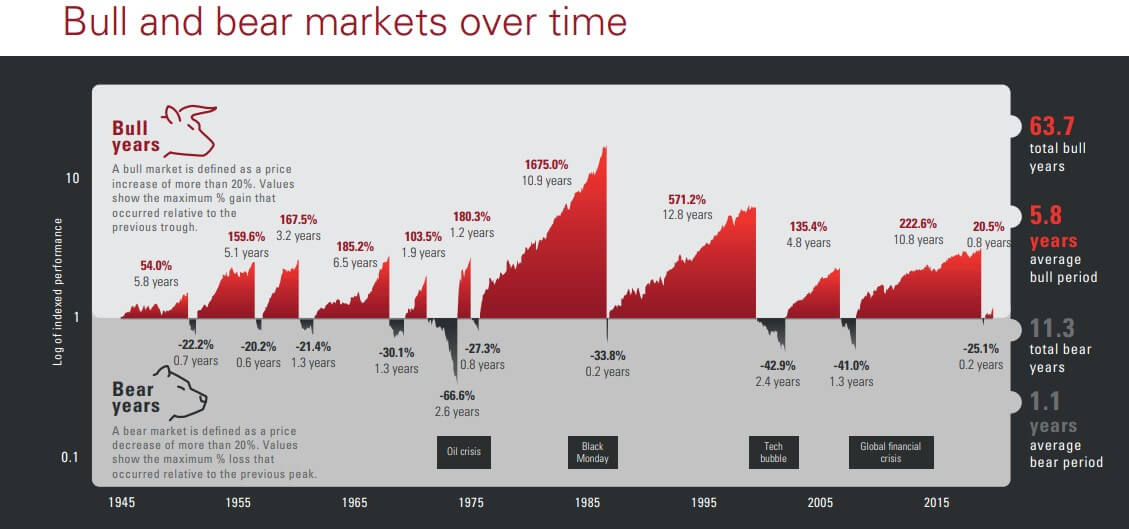
Stock markets around the world are entering what is known as a “Bear Market.” This means that they are now down 20% since their recent high. It’s called a Bear Market, because when things aren’t looking good (weatherwise) a bear retreats to shelter and hibernates.

The opposite of a Bear Market is a Bull Market, when markets are up 20%. It’s a bull because bulls are known to charge, and so prices are charging upwards.

This was an old chart which showed the length and size of Bear (in black) and Bull Markets (in red) up to 2020, produced by Vanguard. I’d be keen to see an updated one which would include the Covid crisis, but I’ve never seen one yet. Here’s the link to it for full info – https://www.vanguard.co.uk/content/dam/intl/europe/documents/en/bear-and-bull-chart-eu-en-end.pdf

The key takeaway is look at how much longer a Bull Market (upward market) lasts compared to Bear Markets. It doesn’t make it any easier, but it shows that this is normal.


Stock Market FAANGs

The stock market indices are the best indicator of how markets are doing. The S&P 500 (the 500 largest companies in the US) or the NASDAQ COMPOSITE (heavily focused on US technology and information services – think Apple, Amazon, Google etc) are arguably the best indicators. They’ve had  a very difficult 2022 so far.

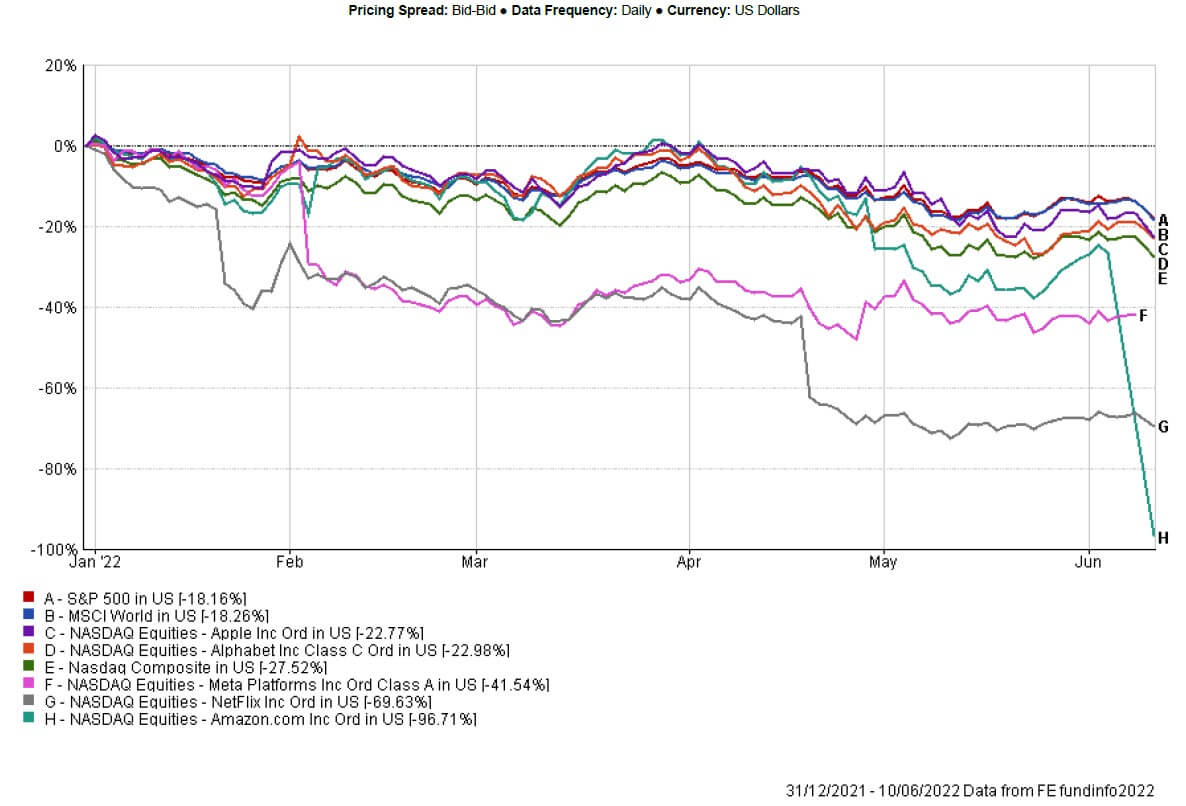
To bring some life to it, let’s look at the 5 companies we used to call the FAANGs. Facebook (now Meta Technologies), Apple, Amazon, Netflix and Google (now Alphabet) are 5 companies we all know very well and the majority of us use their products and services many times every day. It’s hard to imagine life without these companies. How has their 2022 been going?

It’s not pretty! *The S&P 500 and MSCI World are both down 18%. The Nasdaq Composite, labelled E above, is down 27.52% until 13th June 2021. At time of writing, the US market is still open and both are currently down a further 3%. This would mean the S&P officially entered a Bear Market today.
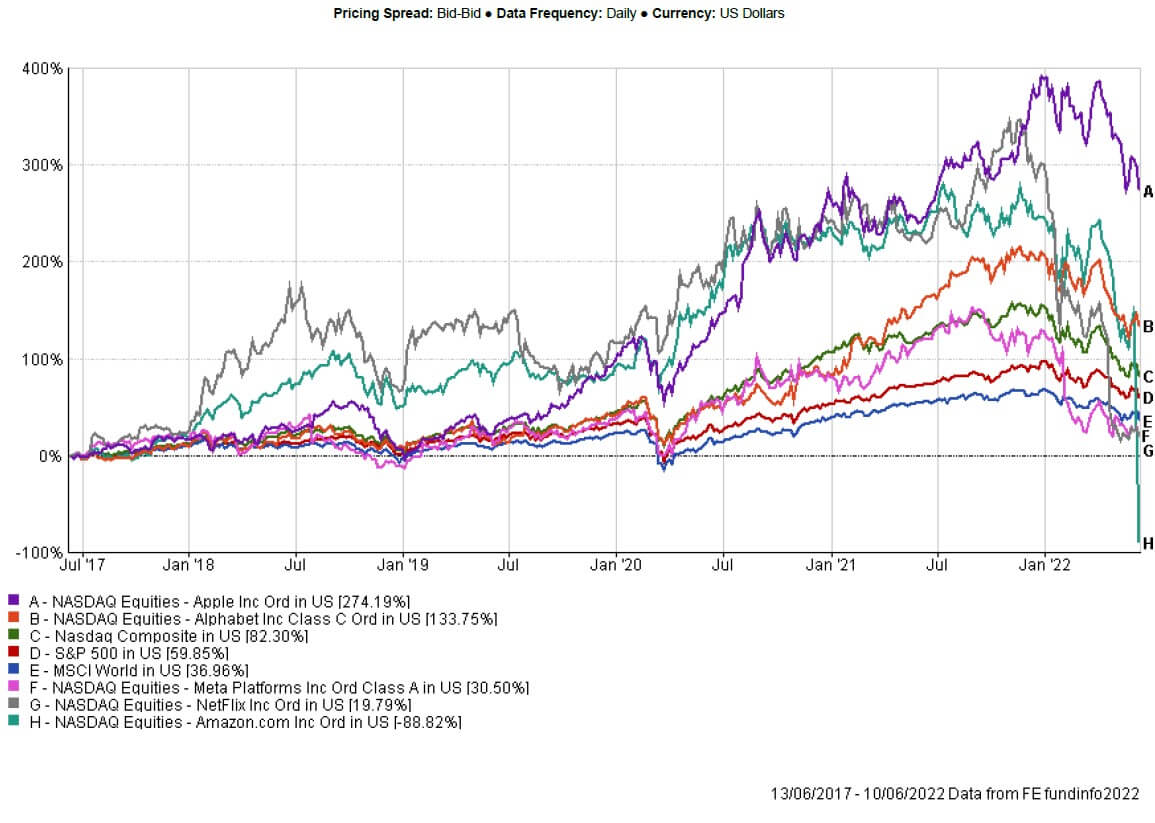


Apple, the biggest company (financially anyway) and Alphabet (Google) are down almost 23%. Meta (formerly Facebook) is down 41%. Netflix has dropped 69%.

Disclaimer: Amazon isn’t actually down 97%! That would be truly terrifying! On 3rd June, they did a 1:20 stock split. What that means is they simply divided each share into 20 shares, to lower the price of the shares to make them more affordable for people to buy. This result in the share price dropping from around $2000 per share to a new price of $109. The true share price is down almost 39% this year to date, not 97%!!!

Some of these figures are scary! There’s no easy way to say it. Our client portfolios are down between 5 – 10% depending on the risk taken. Riskier portfolios are down more than the less risky portfolios.


It’s About the Big Picture     

You probably think I’ve under-egged it when I say it’s uncomfortable. But the fact remains, not one of our clients has invested to make a 6 month return. Yes – it would be great if it was a nice positive number in these last 6 months. But that’s a pretty short time in investing. If we look at the big picture, for just 5 years, then the picture is somewhat different. Remember that most clients are investing for 10, 20, 30 maybe even 40 + years, so 5 years isn’t very long. But when we are comparing numbers with individual shares, the numbers can get very silly.


This shows an altogether different picture. In the last 5 years, an investment solely in the NASDAQ Composite would have made 82%, the S&P 500 almost 60% and MSCI World is 37%.  If you have been unbelievably brave (or arguably stupid), and risked everything on just one stock, then –

  • Apple would have made 275%, despite losing 23% in the last 6 months
  • Alphabet has made 133%
  • Meta/Facebook 30%
  • Netflix 20%
  • Amazon’s total return is unrealistic and unfair due to their stock split. It should be up 109%


An Investment Philosophy You Can Stick With

Successful stock picking requires a whole lot of luck.

Hindsight is a wonderful thing, so you could say that Apple and Google/Alphabet were obvious choices. But of the giants in the world of business, only 3 have beaten the indices over 5 years.  You need the heart of a lion and an iron stomach to put all of your money into one share. I would argue it’s stupid and reckless, but some people hold great conviction in their selection. You need the analytical skills of millions of analysts and computers to pick the right one. But the thing you really need is a whole bunch of luck. Luck to pick the right one. Luck on when you buy it. And luck on when to sell it.

There is no “star stock-picker” who has consistently turned up and picked the best stocks every time for a sustained period of time. Yes, there are stories of people who can do it for a year or two. But nobody who has been doing it for 30 or 40 years with total success.

If you did pick an individual stock, you would have missed out on the other star companies. In the same 5 years, Tesla is up 826%. Who is going to be the next star company? Who knows? Do a quick search online and you’ll find countless articles all naming the top 5 stocks to buy today, and almost every article names 5 different ones.

Individual shares are scary. They are off-the-chart risky. You could become a millionaire or bankrupt overnight. It’s that scary. You need an investment philosophy you are comfortable with, but most importantly, one you can stick with no matter what happens.

We believe in holding a well-diversified, global portfolio spreading money around thousands of different investments. We don’t pick which ones we think will beat others, because we’ve a  good chance that we would get it wrong. Our philosophy is steady long term growth. If you think you’ve found the next superstar, take money you can afford to lose, and go do it on your own. If you want to find out more without talking to us, revisit our Technical Tuesday videos on our Youtube channel here

We can’t and won’t advise on individual shares or companies.


So What Do We Do Now?

We stick with the plan. Simple as that. Nothing has changed. We knew this would eventually happen, and it will happen again. It will eventually bounce back. We don’t know when, but it will.

You still own everything you owned at the beginning of the year. You still hold the same number of units of the investments you had (remember our blog when Russia first invaded Ukraine and we spoke about this?) The units are just valued less at the moment. It’s like if you had your house valued every day, you only lock in a loss if you sell.

Some people might even see this as an opportunity to invest money they’ve been holding in cash because markets are down. They are getting more for their money. That’s why monthly savers benefit from declining markets. There’s a famous Warren Buffett quote – “Be fearful when others are greedy, and greedy when others are fearful.”

If you have concerns then remember that we are here to help you. Please lift the phone or email us. We will no doubt be doubling down on these investment related blogs and showing you more of the technical evidence which shows this is completely normal.

We’re hurting too, but this is where we demonstrate real value to clients. If you need reassurance, someone to lean on, or who knows, a pearl of wisdom which we might unwittingly reveal, talk to us. You aren’t in this alone.


*Year to date declines taken from FE Analytics on 13 June 2022

 Past Performance is not a guarantee of future return. Investments can go down as well as up, and you may not get back the full amount you originally invested.

 We do not  advise on individual shares

 This communication is for general information only and is not intended to be construed as individual advice.

 Modulus FP is not responsible for the accuracy of the information contained within the linked third party site / literature.

My Business Is My Pension

My Business is my Pension?

Quite often when asked about retirement planning, many business owners reply with “sure my business is my pension”.  This might seem reasonable enough but what, if any, are the potential snags?  Here are a few points to think about when considering using your business as your pension.  We will be covering these, and more, in our upcoming webinar in September.


If a business is going to be used as a retirement fund, then there are some things that need to be considered.


Is the business sellable?

Will someone want to buy the business? Is there something tangible to sell or is the main selling point the business owner and their relationship with clients (also known as goodwill)?


Will it really be sold?

If a business is sellable then will it actually be sold? Or if it is a family business, then will it pass on to the next generation and no value be realised for it?  How could value be extracted to provide a “pension” or income in retirement and how would this work in practice?  If part of a business is effectively gifted then this may be deemed to be a disposal of an asset for Capital Gains Tax purposes.


Are there other owners?

Does the business have other partners or shareholders who may not want to sell the business? Do they want to buy the rest of the business and if so, then do they have the funds to do so?  If the other business owners can’t or don’t want to make changes of any description then this could provide issues for considering using a business as a pension!


Is the business too reliant on the owner?

This does not just refer to business relationships (as noted above) but also in terms of the operational side of the business. Quite often a business can be reliant on the owner being a key person in it.  The owner might be the main designer, the top salesperson or even the face of the business (one that people recognise as being the brand).


For a business to be sellable, and work as part of a retirement plan, then it needs to be able to work independently of the owner.  If it isn’t, and the owner manages to sell the business then the new owners might require a handover period, a golden handcuff arrangement for a certain period of time (which could be several years).  This may well mean that the previous owner is tied to the business before being able to walk away completely. Whilst the business is part of the retirement planning fund, it may hinder the business owner from retiring (unless they have planned the tie in period fully).


What is the business worth?

Or rather the question is what does it need to be worth?  To help fund retirement then it would be useful to know how much the business owner will need to sell for so they can have a comfortable retirement. A financial plan with cashflow modelling is the key to answering this question. Financial planning will allow the business owner to run through various scenarios in relation to their life and future plans and help them to consider what they need the business to be sold for. If a business owner knows that they need to achieve a price of say £500,000 then would they want to hold off their life plans for a few more years to possibly try and sell for £600,000. The opportunity to enjoy the retirement that they want could be delayed or even lost.


What next?

If a business owner plans to use a business as a pension, then there are a lot of things to consider. One of the main things is to think of what they want retirement to look like.  A lot of thought and planning should go into the entire process as it may not be as straightforward as people would like to believe.  It will likely involve working with professional advisers such as accountants, solicitors and financial planners.  This can seem quite daunting, so to help explain some of the planning opportunities for business owners, have a read of our guide Financial Planning for Business Owners.  Also already noted, we will be holding a seminar in September on this topic so keep a look out for that (and if you want further details on the webinar then please drop us a line!).


NB. If this is something you are thinking about, everyone’s situation will be different and so you should seek independent advice, most likely from a financial planner, solicitor and accountant.


An Experience Economy, Making Memories, And A Beach Towel?

Possessions get forgotten about, whereas memories last forever. Or so I hear anyway…

We’re in the middle of our Regular Planning Meetings with all of our financial planning clients, and I’ve been experimenting in some of them. We spend some (most?) time talking about what it is that you really want to achieve? The stock answer is, stop working soon, or sooner, or as early as possible. Or to pay less tax. What do you expect, nobody likes the tax man.

I’ve been trying to focus a lot about the short term goals. What are we aiming for now, or next year? Not that there’s anything wrong with the first answers, just they’re going to get a bit stale, especially as many clients are at least 10 years away from an early retirement. What this has led to are some really interesting conversations.

Some of you are thinking of helping children. Moving up the property ladder into your forever family home. Some are thinking about expanding their business. Or how to exit their business. And some are thinking about big holidays in the future, like South Africa, Canada, or a few weeks on an executive coach trip around Germany.

And hopefully what’s come across in these meetings is that we want you to enjoy your money. That’s what it’s for. One client commented, it’s great we want to do this but it won’t help me make money. That’s one of the reasons we think we’re a bit different to your regular old Financial Adviser.


Think like a Business Owner, not a Financial Planner

I’m not a book reader, so I’ve been trying to get in to listening to podcasts this year. It started out with the Nextgen Planner podcast, to hear about what other financial planners are doing. Since then, I’ve branched out into other financial podcasts and then into business podcasts. My two favourite now our The Diary of a CEO by Steven Bartlett, and The High Performance Podcast by Jake Humphrey and Professor Damian Hughes.

Both of these podcasts focus on people who are “successful” in their chosen field, whether it’s business, sport, psychology, whatever. Now that John and I are business owners, and we are trying to grow the business, we need to start thinking like business owners. So this is something I’m trying to do while I’m out walking Archie every evening.

Two things have stuck with me recently which really describes what we want Modulus FP to be.

“Be Values Driven, not Profit Driven” – Joe Wicks

Firstly, on the High Performance podcast episode with Joe Wicks, something he said struck a chord. He said “Be Values Driven, not Profit Driven.” Joe Wicks could easily go against everything he has done, do a multi million collaboration with an exercise company or a ready meal company, and cash in. But that’s not him. That would go against everything he ever believed in.

If he sticks to his beliefs and values, and does it well, the profits will take care of itself, but he won’t lose himself while he’s doing it. He jokes that he was a 10 year overnight success. There’s been lots of hard work which goes unseen to allow him to “burst onto the scene” which lots of people think he did. Eventually, by avoiding the quick payday, he thinks he should get everything he ever wanted and more, while staying true to himself. He’ll be able to still look his team or his customers or his clients in the eye, even after he walks away.

“The Day I Sold My Business Was The Biggest Anti Climax” – Steven Bartlett

The second thing, is something Stephen Bartlett has said several times on his Diary of a CEO podcast. He said that the day he sold his business in a multi million pound deal was the biggest anti-climax he’s ever felt. He thought he would wake up the next morning on top of the world, money to burn and nothing to stop him. But he didn’t. He woke up and felt empty. He didn’t know what to do.  Steven felt as if he lost his identity overnight.

This is something which can happen to our clients too. You might not sell your business for multi millions. But you might be a manager of a team, or always involved in a big social circle at work. The day you retire, that stops. You might suddenly only have your partner, your children and a few close friends to talk to every day. All of a sudden everything you have known, stops. You need to prepare yourself for that reality. And in the episode I was listening to, Steven and his guest said this happens all too often when people sell businesses or leave their job or their sport.

If you’re a younger client, who maybe doesn’t own a business or have any intention of retiring for 20 years, you need to focus on short term goals to keep yourself motivated. To keep getting out of bed for. To keep your identity.

And this is something I’ve been trying to bring to my meetings.

Making Memories

Something which we’ve been thinking about here at Modulus is how can we recognise the trust and faith you’ve put in us? And so, we’ve come up with a beach towel.

Our mission is to help our clients live the life they want, by delivering the absolute value of financial planning. The most common thing which comes up, is you nearly all have travel ambitions. So to get you thinking about this, we’re giving all of our planning clients a beach towel. It is branded, but tastefully enough that it’s not in your face.

We want you to take this towel on your holidays, or your big trips, and send us a picture of it. You can be in the picture if you want, or you can drape it over something or hold it up over you. We want to see where we have helped you get to. We want to build a photo album on social media, possibly on our website too, of the memories and where the Modulus FP Towel has got to.

This is something which we’ve wanted to do since setting up, and to be doing it feels great!  As my client said, that’s going to eat into our profits. But we don’t care. It’s what we want to do, and if we follow our values, and do things properly, Joe Wicks says the profits will take of themselves.

We are going to get a scratch off map of the world, and see how far and wide you can get the towel. We’ll keep this on the wall in the office above our meeting sofas, and hopefully start to add our personality to the office.

Let’s all get out there and go make memories. The towel is already booked into South Africa, Canada, Germany, Croatia, Spain, Portugal and the Commonwealth Games.  It’s the memories you made that you remember, not the things you owned. It’s where you were, who you were with, and how you felt. We’re in an Experience Economy now, apparently driven by millennials who would rather own nothing and spend their money on experiences. Let’s go grab the life we want, instead of waiting for a day which may never come.

Early retirement and saving tax is all good, but it’s not what we’re getting out of bed for every morning. Let’s be specific on our goals, with both short and long term goals, to make sure we make the most of our lives.

If you haven’t received your towel yet, then you will do soon! And we can’t wait to see where it goes.

Comparison is the Thief of Joy

Social Media has an awful lot to answer for. It’s turned everything into a competition.

Have you ever been envious of someone’s holiday pictures? Your neighbour’s new car? A colleague’s clothes and jewellery? Your friend’s new house? Or maybe just the restaurants they are eating in? It’s become an unrealistic snapshot of a fake life, in which we all feel the need to show how brilliant everything is.

If your life isn’t picture perfect, then it can get you down. Even when you take what you might think is your best picture and only get 10 likes, you will end up wondering what went wrong?

It’s not just social media which has done this, but it’s definitely made things much worse. It’s a normal part of every day life now. But it’s not healthy.

Every minute you spend wishing you had someone else’s life is a minute spent wasting yours.

There is any number of motivational quotes and pictures out there. This one sums it up quite well.

When we have our first meetings with prospective clients, we nearly always get asked “Is that what you would expect for someone my age?” There’s no easy answer. Your life is completely different to the next client’s life. Some want to retire early and travel the world. Other’s have travelled all their life and just want somewhere they can relax and be with family. Others still are happy to keep on working. And so with each person’s different story and different prospective future, it’s just different. There is no one right answer

Theodore Roosevelt has been quoted as saying “Comparison is the Thief of Joy.” If you spend all your time comparing yourself to others, you’ll never truly enjoy your own life. You’ll always strive for better. To be better than whoever you compare yourself against. Whether it is a fair comparison or not. Even if you find yourself as the trendsetter of your circle of friends, you will begin to look at others. The ones with the sharper suits, or the shinier jewellery or the flashier car.

I know we all do it. I’ve been guilty of it too. But the key is don’t let jealousy creep in. Don’t fixate on “better.” Try not to one-up your friends and family. Just be happy with what you have. Knowing that you are living – or trying to live – your life the way you want to.

What defines success?

Lots of us buy the top branded watches or cars because we think they make us appear successful. The famous red-soled heel signals she has “made it.” Who defined success as owning expensive, materialistic things? The problem with this is that we go and end up taking on debt we don’t need. We have huge mortgages, expensive car finance deals, three credit cards with five figure balances. It isn’t healthy. And despite how it gives the impression that we are successful, these people are one missed pay cheque away from serious issues.

Something I saw online but can’t remember where to give credit, went along the lines of

“If you can choose between a £20k car and an £80k car, remember that both will get to you work, but the expensive one will keep you there.”

Just this week I was asked why should someone take advice from me, sitting on the other end of a virtual meeting in a North Face fleece?  It’s a valid question. Why should our appearance signal how well qualified or successful we are? Does putting on a suit immediately make me a better financial planner? Does a tie around my neck keep the knowledge in my head? We can only build our reputation through our interactions with people, not by the way we look.

Forget about what people think. We should only care what we think. We don’t need all of these expensive things. Often, a lesser priced similar item will do the same job, and we can put our money to better use. To use towards yours and your family’s future.

Invest in Yourself

Invest in yourself for what you want. It doesn’t matter. No matter how much you might think it does.

We hear of the stories about Mark Zuckerberg, who apparently wore the same t-shirt so that he never had to worry about what he wore and could focus on his business and helping his community (of Facebook users). There are many stories out there that claim the t-shirt cost anywhere between a $10 basics Walmart Tshirt, up to a designer $500 dollar t-shirt. But the moral is he didn’t care – he just wore what he was comfortable in.

So if owning the expensive things in life makes you feel better, then there’s an emotional need for that which makes it OK, provided you can afford it. But if you only do it because you think you need to show off or to fit in with your circle, then just stop. Reassess what you want. Do what makes you, and you alone, happy.

Don’t let comparison steal the joy in your life. It’s hopefully going to be a long life, but it needs to be an enjoyable one. Otherwise, what’s the point?

The Investment Rollercoaster

The thing about a rollercoaster is once you’re on, you ride until the end.

You’ve heard people tell you about their time on Oblivion, the Big One (formerly the Pepsi Max), or even our very own, Barry’s Big Dipper, and it always sounds great. “If they can do it, so can I.”

But it’s all well and good until you’re there, in the queue waiting to board. You hear the screams; the noises. You see the height and the speed. Suddenly it’s real. Suddenly it’s personal. And maybe you don’t quite get onboard…

Investing is just like getting on that roller coaster.

The Roller Coaster of Investing

We’ve all heard the stories of the great times people have had when they invested. They made good money, it wasn’t scary, and anyone can do it. But it might just seem different when you put yourself in that position.

When you’re going on a rollercoaster, you’ll look at the height, the speed, the turns, the loop the loops and you decide whether or not it’s for you. I’m going to liken that to your risk tolerance. It’s just how you view something, and there isn’t anything that I can say which is going to make your time on that ride any better.

Some people aren’t allowed on certain roller coasters. Whether it’s for physical or medical issues you just shouldn’t be on that ride. That’s your risk capacity. When we are advising an investment portfolio for you, we talk about if this goes down, will it affect the quality of your lifestyle? And if the answer is yes, then maybe it isn’t for you – there’s a gentler rollercoaster out there.

The Golden Rule of a Roller Coaster

The thing is, once you’re on, you strap in, you keep your arms and legs in, and you hold on tight.

Investing is exactly the same. No matter how scary it feels, you hold on tight.

You trust that the people who run the roller coaster know what they’re doing and have carried out regular maintenance. Think of this like when your financial planner reconfirms your goals, or checks your risk profile, or does the regular due diligence on the funds. We’re carrying out the all-important regular maintenance.

At no point halfway around the rollercoaster do you get to stop the ride and get off. If you do that, it’s probably going to be very unsafe to try and halt that ride and climb down from wherever you are. And again, investing is just like that. No matter how scary it gets, you only get off when you need to – not because you are scared.

Volatility – Measuring how Scary It Could Be

We speak about volatility to describe how much investments move (up & down). It’s pretty much always linked to risk. When things are volatile, you’re probably on a fairly big adrenaline bursting roller coaster. Your fight or flight response might kick in. The best thing you can do? Hold tight and ride it out!

Markets are more volatile right now. There’s no getting away from that. It means markets are going up and down a lot.

For the last few weeks, the daily movements in the market have been by 2 or 3%, rather than what we have become used to and think of as “normal” recently of maybe 0.2 or 0.3% daily movements. But it’s nothing new. Markets have always gone up and down. It’s how they work. Just like the thrill or scare you might get from that rollercoaster.

If you can strap yourself in, and try to enjoy the ride, you should be rewarded.

Real Market Numbers

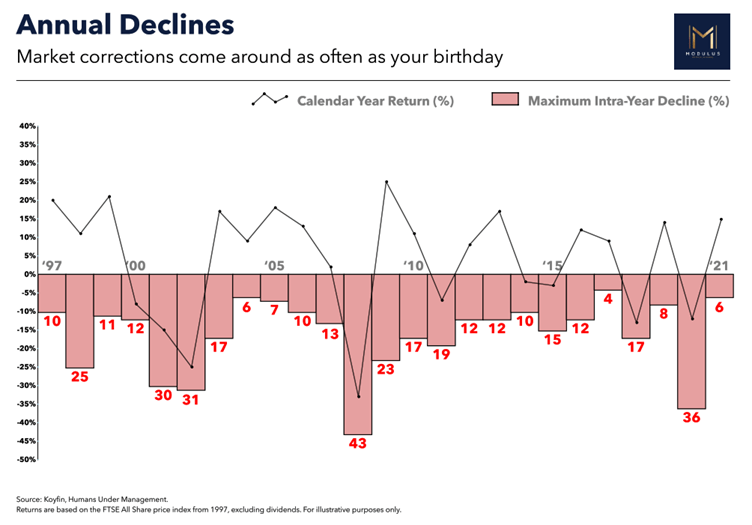
Here’s a graph which shows the calendar year return (black line) of the FTSE All Share every year going back to 1997 and the biggest drop during that year (red bar and number).

Look at 2020, the second last bar. The biggest decline between February and March (when Covid shut down the world) was 36% for the FTSE All Share.
You can see that almost every year, markets drop by at least 10% at some point every year. In the really volatile years, it can be over 30%. In 2001 it dropped 30%, in 2002 it dropped 31%, and in 2008 it dropped 43%. All pretty scary drops. But it’s normal.

The FTSE All Share year to date (1st January 2022 to 14th March 2022) for 2022, is currently down 6%.

The S&P 500 – the US index – is currently showing a year to date decline of 13%.

The NASDAQ Composite – the US Tech index – is currently showing a year to date decline of 20.5%.

The MSCI World – the index which represents the largest companies across all 23 developed countries – is currently showing a year to date decline of 8.7%

All pretty scary numbers. It’s not comfortable viewing when it’s your own money. But the key takeaway, is the fact that this is all very normal.

Long Term Investing

The last snippet of information I want to show is why we talk about long term investing. This is focused on the S&P 500 – the biggest US index.


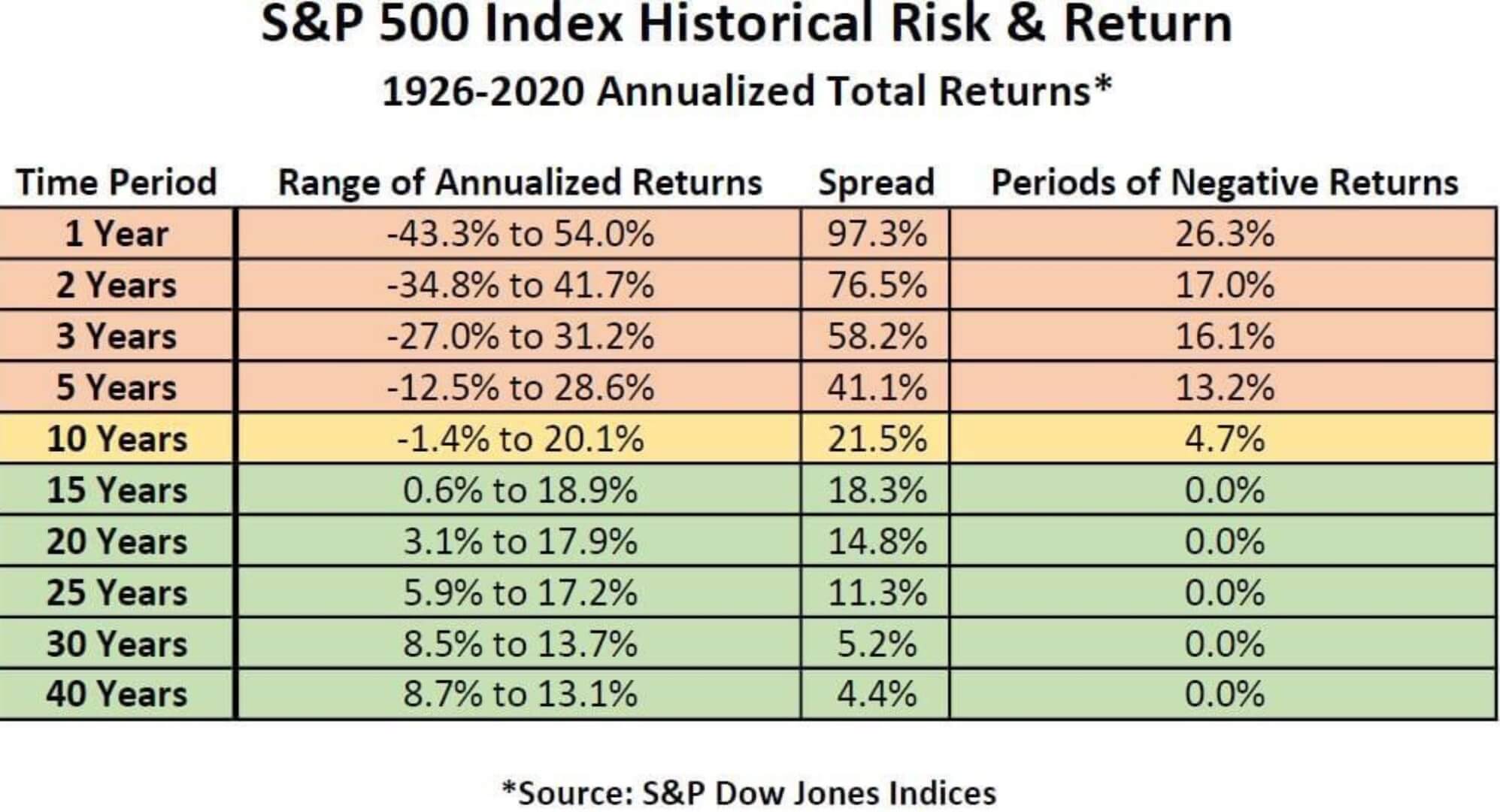
This shows the importance of investing for a long time.
None of us are investing for one or two years – we are all investing for 10 or 15 years plus. And the key columns here are the Range of Annualised Returns and the Periods of Negative Returns.

This data goes back as far as 1926, almost 100 years. The range of annualised returns over 1 year is a loss of 43.3% at worst, or a gain of 54% at best. That’s some difference. But if we look at a period of 15 years plus (meaning you are invested for at least 15 years) – there is no 15 year period where you lost money.

When holding for more than 10 years, there are periods when being fully invested in the S&P 500 could have lost you money. But it is a very low chance – 4.7% according to this data. That’s why nothing is certain in investing. There will always be a risk, if you want to get a return.


Trust your Roller Coaster Operator

We pretty much never have anyone invested fully in shares. At most, clients might be in what we call a 90% risk portfolio, so there are still some defensive assets. All of these figures are shares/equity only indices. If you think these are scary, take a look at investing in individual shares, or cryptocurrencies and you’ll realise we are still in the family friendly part of the theme park.

So, trust that the time we spent at the beginning of working together helped to select a roller coaster which your stomach can handle. Trust that we have carried out the maintenance and the safety barrier is down. Take a deep breath, hold on tight, and this roller coaster will eventually slow down. We don’t know when, but we do know that it will slow. Eventually. So do your best not to think about all the what ifs, buts or maybes. Hold on and try to enjoy the ride. And if it’s getting scary, talk to us and let’s try to find your happy place until this ride slows down.

*Year to date declines taken from FE Analytics on 14th March 2022

**Past Performance is not a guarantee of future return. Investments can go down as well as up, and you may not get back the full amount you originally invested.

Keep Calm and Carry On

Russia invades Ukraine…

A chilling headline if ever there was one.  Given the lives lost already and the potential for many, many more we sincerely hope that this conflict can be resolved quickly.  Not one of us knows however how long this will last.

We aren’t normally ones for commenting much on politics or the financial markets.  In fact, it feels insensitive and inappropriate to jump straight in to how this affects all of us and our money. We have always reiterated that there’s more to life than money, and it’s days like today when that seems more poignant than ever. We try to keep things light hearted, but that doesn’t feel appropriate right now. It’s not the time for silly quotes or making light of the main instigators in this. Those days will come, but not today.

And yet, we must talk about the money. Because the world continues to spin. We will never try to make a prediction about the economy or indeed time the markets. We won’t guess how long this might last, or how far it could go? However, given the level of anxiety in the markets we thought that it would be prudent to share some thoughts with our clients and the wider community. It’s OK to be scared. It’s that uncertainty which makes you human.

The Impact on Investments

Since the start of this year there has been increased volatility in the markets.  There are various reasons for this which we won’t get bogged down in, because they’re nearly always driven by sentiment. The Russia Ukraine tensions have been simmering, combined with the US tech market “correction” as evidenced by the NASDAQ and a reaction to increases in interest rates around the world.  It boils down to the fact that people get nervous and decide to sell their investments.  And there is always a reason for volatility and for people to think they should sell (when markets are skittish).

In the short term the stock market is a voting machine, a popularity contest of what is popular and what is not.  In the long term the markets are a weighing machine, counting the increased value of the products and services that the great companies of the world create over time.  This is paraphrasing the quote about the markets from the great Benjamin Graham (mentor to Warren Buffet).

We can always find a reason not to invest.  There will always be a reason why people think they should cash out of investments. There is always a reason for doing anything when rationalised in someone’s head. It is human behaviour to be nervous, particularly when dealing with finances.  It is emotional.  But it is the role of a good financial planner to be there for you.

Part of being a financial planner is turning to a client and saying “Yes, things are a bit crap at the moment, but we knew that a time like this would come.  Should we deviate from the financial plan that we are working on with you, Mr & Mrs Client? Of course not. The fundamentals of your financial plan are in place and the same values that we talk about every day hold true today, probably more than ever.  It is my job to be here to hold your hand and to make smart decisions about your long-term financial planning.  And my advice, right now, is to do nothing.”

The Worst Thing You Can Do

The way to turn a temporary decline in the value of your portfolio into a permanent loss is to sell your investments.  That is how wealth is destroyed. If you look at your investment accounts, you will see that you own units of each fund. That number doesn’t go down. You still own the same thing, it’s just valued less today than it was yesterday. The value will eventually bounce back, but the number of units won’t change (unless you invest more or make a withdrawal).

I saw an email today from an adviser who has told all clients that he is advising them to sell 50% of their invested assets and move to cash.  That was a blanket email to all clients and not based on anyone’s personal financial plan based on their circumstances.  Wow!

Now that email was sent today, when Global markets were already down.  Imagine how long it could take a client to come back to confirm that they want to proceed with this blanket advice.  Possibly a couple of days? So, markets might be down a bit further still and the client will have sold assets and made a permanent loss.  When does the adviser blanket advise for the clients to get back in – when markets are going up again? (Let’s forget for now about the extra transaction charges to get in and out). Does the adviser know when the market is at the bottom?  Timing when to get back into the market is virtually impossible.  Based on this logic you will sell low and buy high! Let me think about that one…


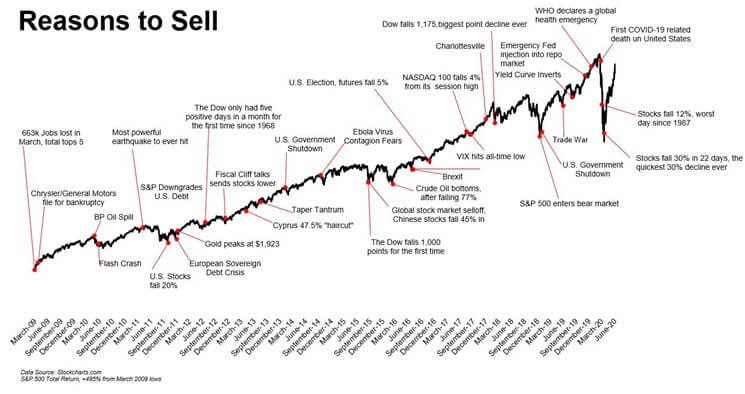
This image was shared today by a friend (thanks Stevie) and the original can be found here – https://theirrelevantinvestor.com/2020/06/10/there-are-always-reasons-to-sell/ .  There are various versions of this chart, but they all show the same thing.

There are always reasons to sell and there will always be volatility in the market.  But if you look at the trend, it is moving from bottom left to top right.  The secret to long term success is to keep calm and carry on regardless.

If you have concerns about your financial planning and investments, then give us a call as we are always here to listen and to help.


Footnote:

At the time of writing this blog (10.30pm on 24/02/2022) the US markets closed up for the day with the Nasdaq up over 3% and the S&P 500 up more than 1.5%.  It just goes to show that the one thing we know for certain about the markets is that we can’t predict what is going to happen! A sobering thought when you consider what this means.

In happier circumstances we would ask if the press would report how billions were wiped back onto the stock market! But right now, money isn’t the important thing. There are people being killed and families being destroyed. That is so much more important than money. There’s no point in having money, if you have nothing else.


Please note that past performance is not a guide to the future, the value of an investment and the income from it could go down as well as up. You may not get back what you invest.

This communication is for general information only and is not intended to be individual advice.

Modulus is not responsible for the accuracy of the information contained within the linked site / literature.


Contact

Get Connected.

Contact Us

Modulus Financial Planning look forward for you to contact us for more information about any of our products or services.

Modulus Financial Planning

Suite 12, Avonmore House,
15 Church Square, Banbridge,
BT32 4AP, Co.Down, Northern Ireland

Let’s Talk About Your Finances

Here for all your saving & investment, pension & retirement planning, tax & estate preservation and insurances.

CALL: 028 40 33 68 67

Modulus Financial Planning Ltd is authorised and regulated by the Financial Conduct Authority. We are entered on the FCA Register under reference 965916. Registered in Northern Ireland, Company Number NI673772.
The guidance and/or advice contained within this website are subject to the UK regulatory regime and are therefore targeted at consumers based in the UK.

The Financial Ombudsman Service is available to sort out individual complaints that clients and financial services businesses aren’t able to resolve themselves. To contact the Financial Ombudsman Service, please visit www.financial-ombudsman.org.uk.

Privacy Policy

Contact