
Blog by Modulus

READ OUR BLOG

Financial Planning for People in their 40s (or in fact at any age!)

Just as night follows day, it is an irrefutable fact that I am now firmly in my early 40’s! I often hear people complain about hitting the dreaded BIG 4 Ohhhhhh, but as I reached that milestone during that inconvenience that was the Covid lockdown, it passed without much fanfare! I will have to make up for that when I hit 50! In all seriousness though, many people use milestone ages to take stock of their financial planning.  We get lots of new enquiries from people who are turning 30, 40, 50, 60 or even older.  There is clearly something about hitting another zero on the clock that makes people think that it is about time they had a look over things, and we are always more than happy to help.


Quite often people in their 40’s are approaching their peak earning years so this is naturally a good time to take a comprehensive look at how things are sitting with their finances.  This doesn’t mean that people in their 40’s should simply sit down and look at how their workplace pensions are performing (or even just start finding the old ones).  It is a great time to think about and start figuring out what you actually want to happen with life, and this isn’t just in retirement.


Who really wants to think about retirement when you’re still trying to figure out what being a grown up is – or is that just me?


So, if you are in your 40’s (or in fact if you are any age) and you don’t have it all figured out then don’t worry because you’re not alone.  Here are a few financial planning considerations to think about, so you can feel like you’ve got your life together (at least financially).


What do you enjoy doing now? And that is after you have sorted out the rest of the things in your life like family, kids, work etc. What do you, (and your partner) like to do for fun?


If you had the time, then what would you really like to try and achieve?

Sometimes this is the hardest part of financial planning – figuring out what you are aiming for.  These can be simple things like getting up the mountains for walks regularly or even a few BHAGs (Big Hairy Audacious Goals) like trekking to the South Pole, climbing Kilimanjaro or mastering the game of golf (which is impossible!).  It took my long-suffering wife, Helen, and me a while to figure out that when we have stopped working, and the boys are off the payroll, then we would really like to spend a year living and travelling in Spain (and not the touristy parts).  This may or may not happen, as life can get in the way of the best laid plans, but it is what we would like to do if we can and we are planning towards that (just don’t ask me to start speaking Spanish in our next meeting!).


Whatever it might be, figuring out what might make you happy is the key to starting to take stock of your financial planning (call it setting your objectives, aims, ambitions or goals if you want).


Planning on how to get there!

The next step is working out how to get to where you want to be – creating a roadmap showing you the way.  This is where you look at everything that could impact all your future plans and start being intentional about your choices.  Working with your financial planner to create a financial plan is the way to start pulling this together.  And this is where you will begin to gain some context about where you are now and where you could be in the future, by making some changes and again being intentional about choices.


Here’s some things that we cover in your financial planning:


Retirement planning:

You need to have a clear idea about how much you’ll need to save to be able to live the life you want in the future . Knowing what you have already is so important as well because you need to make sure that it is doing what it should be – driving your financial plan. It’s important to consider the state pension (click to find out how much your state pension might be) and any other sources of future income, such as a private pension, rental income, savings & investments or potentially downsizing.


Protection:

Having a great looking financial plan is great. You can see what will happen if you stay on the same track or if you make some planned changes. But what about when the unexpected happens.  For most people the biggest threat to the success of their financial plan is their ability to work. What would happen if your ability to work was taken away from you suddenly.  What happens to your family and their security if you died? Let’s be real, no one really wants to think about this.


In your 20’s every person has Superman Syndrome – “I am invincible and it won’t happen to me!”. But from your 30’s onwards there is generally more to lose and whilst people might occasionally think about these things, very few take any action.  So taking the time to consider what would happen if…. , and then following it up is very important when thinking about your financial plan.


Debt management:

Have a plan to paying down debt. If you have high interest debt (bad debt), such as credit cards or high interest loans, then it is important to reduce them as quickly as possible. Review interest rates and make sure you are getting the best deal possible.  Transfer credit cards to a 0% Interest Card if possible.


After you have cleared the first of these bad debts (usually start with the smallest amount or the highest interest rate) then keep the monthly payment at the same level and pay down the next one.  It is like building a snowball –  once you get some positive momentum it becomes easier.


Once you have cleared down the bad debt you have the option to funnel some more money towards –

    • Reducing down the level of good debt (long term low interest debt like a mortgage) or
    • Saving / investing to help provide for your future or
    • A mixture of both – it all depends on what life you want to live


Tax planning:

Review your tax situation to ensure you’re taking advantage of all the tax reliefs and allowances available. This will include ISA and pension contribution allowances. Depending on individual circumstances, it may even mean the use of other tax-efficient investment wrappers such as Lifetime ISAs, VCTs, EISs, Investment Bonds or Trusts.If your spouse / civil partner doesn’t work then you might be able to transfer some of their personal allowance (up to £1,260) to yourself so that you save £252 in income tax.


The thing here is to be aware of the various tax efficient allowances and reliefs that are available because it can have a big impact on your financial planning and if you don’t use them then they’re usually lost.  And who really likes giving more money to the government?


Estate planning:

If you died then what do you want to happen with everything you own? Writing a Will means that your wishes are clear and the people you want to benefit will (beneficiaries).Also consider setting up an Enduring Power of Attorney (in Northern Ireland) as this will mean that there is someone who can make certain financial decisions on your behalf if you are unable to (possibly due to a loss of capacity e.g. car accident).


Also make sure that any life policies are held in trust.  A life policy in trust means that the right person will get the money that is needed at the right time (and not having to wait for probate on your estate).  You are basically gifting the proceeds of the life policy to the trust so that it doesn’t form part of your overall estate when you die (and means that it isn’t liable to Inheritance Tax).  Also make sure beneficiaries are named in the trust so that the right people get the money.


There are definitely some things that you need to think about to ensure that your financial planning is on track in your 40’s (or indeed any age!), but the main thing that I want you to take away from this is to just start.


Start thinking about what you want from life and let’s start the process of getting you there.


And remember, it’s never too late to start planning for your financial future, even if you’re still figuring out what you want to be when you grow up.


Investment Markets can go down as well as up, and you may not get back the full amount you originally invest. This post is for information purposes and you should seek personalised advice in relation to your tax, financial and investment planning needs.

The January Effect

As some of you know, I actually did a Finance degree before starting out in financial planning. Oddly enough, it seems to be quite rare to meet a financial planner who has a degree in anything remotely financial. Most I meet seem to have a degree in Geography, History or Politics.

In hindsight, I think I know why. Very little of my degree was of any relevance to Financial Planning or Personal Finance. We had to know about the relevant models of portfolio theory, the equations for pricing stocks and bonds and knowing “when to get in” and “when to get out” of the market. It was very focussed on becoming a trader or going into investment banking. At no point were the words pension, ISA or even tax year mentioned. After 4 years at university, I still didn’t have a clue about any of that.

But something we had to look at in a project was the phenomenon known as “The January Effect” in investment markets.

The Theory

The “January Effect” is a theory in investing that suggests that the stock market tends to rise during the month of January. According to this theory, the market experiences a seasonal boost in trading activity and stock prices during the first month of the year, and this is thought to be due to a variety of factors, including portfolio rebalancing and investor optimism.

One reason for the January Effect is portfolio rebalancing. Many investors will adjust their portfolios at the beginning of the year, buying or selling to realign their holdings with their risk profile and investment objectives. Those who don’t believe in timing the market pick a date in the year, often January, because it’s a good time to review your finances.

Finally, investor optimism may also contribute to the January Effect. At the beginning of the year, investors are often filled with hope and optimism about the future, which can translate into a rising market. This can create a self-fulfilling prophecy, as investors start buying stocks, causing prices to rise, which then encourages more buying.

Does It Exist?

Despite the widespread belief in the January Effect, there is debate among financial experts about whether it actually exists. Some studies have found that there is indeed a seasonal pattern to stock market returns, with January being a particularly strong month. Other studies, however, have failed to find any evidence of the January Effect, and some experts argue that any seasonal patterns in the market are simply the result of statistical noise.

There have been several studies conducted on the January Effect, but the results have been mixed. Some studies have found statistical evidence to support the theory, while others have not.

In our study, we found no consistent evidence of it – I think January was a good investing month in 1 of every 3 years. We found more evidence of an April effect. We couldn’t think of any reason for it, but knowing now that there is a tax year, perhaps it holds for the same reasons? Rebalancing portfolios, contributing to ISAs and Pensions and feeling good about the upcoming year. Who knows?

January 2023

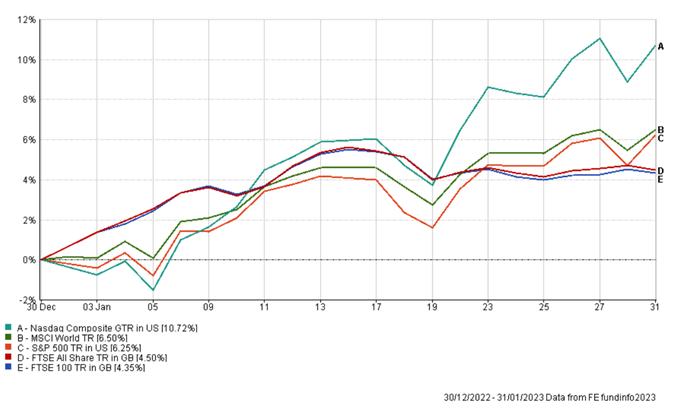
This January, investment markets rose. It could be because of the January Effect, it could be a bounce because 2022 wasn’t so good, it could be optimism, it could be declining inflation, it could be interest rates nearing a peak, it could be down to anything.  It could even be all of the above.

As you can see, the UK (FTSE 100 and FTSE All Share), the USA (S&P 500 and Nasdaq Composite) and the world market as a whole (MSCI World) all had a pretty good month in January.

Will it continue? Who knows. Why did it happen? For a variety of reasons.

The key is, if you’re still invested, you will have benefitted from this. If you’re trying to time the market and wait for a “good time to get in” I hope you got it right.

Avoid the Theories

Regardless of whether the January Effect is real or not, it is important for investors to remember that trying to time the market based on seasonal patterns is generally not a wise strategy. The stock market is notoriously difficult to predict, and even if the January Effect does sometimes exist, there is no guarantee that it will happen every year or that it will continue in the future.

Instead of trying to time the market, investors should focus on building a well-diversified portfolio and holding onto them for the long term. By doing so, investors can reduce their risk and potentially achieve solid long-term returns, regardless of short-term market fluctuations.

As ever, if you want to discuss anything about this, please do give myself or John a shout.


Investment Markets can go down as well as up, and you may not get back the full amount you originally invest.


Modulus in the Media – Childcare Costs

This article was written by Jack Gilbert of New Model Adviser, which featured comments from Dale Kirkpatrick…..


In August 2021 I joined the young parents club.

This new group offers members wake-up calls at 1.43am every day, anxious waits in half-broken plastic chairs at your local A&E and your best clothes decorated in a blend of vomit and excrement.

But for all the huge challenges, I have found parenthood hugely rewarding. Our daughter, Evelyn, is forever smiling and has already brought so much joy to her two weary-eyed parents.

I have learned many lessons this past year, but one of the biggest is that parenthood is immensely expensive.

There are the nappies, the clothes, the shoes, the first buggy, the second lighter buggy, the swimming lessons, more nappies, the first car seat, the second car seat, the toys… the list never ends.

This will not be news to the other members of the parent club. But in my short experience I can tell you that the costs of parenthood are rising at an alarming rate and, as inflation increases, the government’s support for young families is reducing every day. This is the cohort, sorry, one of the cohorts, that this government has forgotten about.

The humongous costs also mean childcare has become an issue that financial planners need to address with younger clients.

The nursery run

Of all the outgoings parents of young children face, nursery fees are by far the biggest. Our nursery in southeast London does an amazing job of looking after Evie, but its costs are rising each day.

Last month it sent us an email saying that after chancellor Jeremy Hunt’s Autumn Statement failed to provide any further support for nurseries, it was ‘left with no option’ but to increase its fees next March.

With energy bills rising for businesses, this is hardly a surprise. But the new fees, which are up about 10%, make for interesting viewing.

Number of days Monthly fees under two Over twos Over twos funding Over threes (15 hours funding) Over threes (30 hours funding)
Five days £2,166 £2,028 £1,711 £1,650 £1,364
Four days £1,768 £1,654 £1,338 £1,291 £1,006
Three days £1,326 £1,241 £924 £894 £609

These costs are on the high side and reflect the London premium. But there are other more expensive nurseries (as well as some cheaper ones).

According to the government’s money guidance service, Money Helper, the average monthly cost of nurseries across the UK is £1,143. I suspect this figure has not been updated to factor in the 10%+ inflation we have seen this past year.

The Early Years Alliance surveyed 1,265 of its childcare provider members in October and found that seven in 10 nurseries will increase fees next year and one in 10 nurseries will close if the government does not provide additional financial support to cover energy bills in 2023.

The government does provide parents with some support for nursery fees. Once your child reaches their third school year of nursery, you get 30 hours of free childcare a week – not including school holidays.

And as long as one parent doesn’t earn more than £100,000, you can get £166.67 each month for each of your children from the tax-free childcare scheme. This scheme, introduced by former chancellor George Osborne in 2014, does help, but with monthly bills now reaching £2,166, this equates to less than 8% of the total cost of a full-time nursery space, reducing the fees to £2,000 per month.

Let’s put that figure into perspective. £2,000 is more than many private school fees – King’s College School in Wimbledon, for example, charges £1,697.50 a month for first forms (when spread over 12 months).

This price means both parents will have to earn at least £33,000 each just to cover nursery fees. If one parent earns less than that, the family will be in the red each month from nursery fees alone.

This means many teachers, nurses and other key workers will be forced out of the workforce because the cost of a nursery is more than their monthly salary.

Dale Kirkpatrick, director and financial planner at Modulus Financial Planning, said he was talking to an increasing number of clients about childcare fees.

As the government’s tax-free childcare scheme is removed if one parent earns above £100,000, Kirkpatrick says he has been advising some of his clients to increase their pension contributions or give some of their pay packet to charity to stay below this threshold.

Kirkpatrick, a father of three young children, was shocked by how expensive childcare fees are.

‘For us, [nursery fees] are basically double our mortgage, and they are going to be more than that next year when my wife goes back to work. It is our biggest expense, but we don’t have any family nearby.’

What other support do parents get?

Aside from tax-free childcare, the only other support available for middle-income parents is child benefit. This gives you £21.80 per week for your first child, but there is an earnings limit.

You only get child benefit if you or your partner earn less than £50,000. If you earn between £50,000 and £60,000 there is a tax taper – the high-income child benefit tax charge – so you lose 1% of the benefit for every £100 you earn above £50,000. At a £60,000 salary, you get zero child benefit.

This tax charge, also introduced by Osborne, has had its thresholds frozen since 2013, meaning millions of households have lost government support or been forced to pay back tax on the support they do get as earnings rise (at a slower pace than inflation).

A freedom of information request by Quilter found 630,000 people paid the high-income child benefit charge this year.

Ian Browne, a pensions expert at Quilter, said it was ‘perverse’ that the government has not raised the thresholds and by freezing them the government is hitting ‘middle- and low-income households’.

Indeed, if you are in a situation where your partner has not returned to work because the nursery costs exceed their salary and you earn £60,000, then you get zero support from the government.

A salary of £60,000 is comfortably above the national full-time average of £38,131, according to the Office for National Statistics, so it would be tempting to ask whether those on such incomes really need the support.

But in the context of rising inflation, every penny helps. Once you consider higher housing, food and energy costs, every penny of support lost adds to the problems for the squeezed middle.

This experience of childcare costs is being left by many young planners today.

Tom Morris, a director and financial planner at Ovation Finance, is a father juggling the costs of two children and is helping some of his clients deal with the same financial struggles.

‘We have a few young professionals in that squeezed middle – late 20s and early 30s,’ he said.

‘It’s at pre-school where the costs really come in, and it is something [parents] often stumble into. For a lot of people, this period is a hand-to-mouth existence.

‘A good way to think about this period is as an investment in your career because that makes it more palatable. Having children comes with a cost and if you want to continue your career, your take-home pay and disposable income are not going to be what they were – so think of it as an investment in your career.’

Morris said he had no idea why the government’s 30-hour free childcare support comes in when your child is three and not before.

How does the UK compare with other countries?

Looking at the international picture, the UK does not fare well when it comes to childcare costs.

Among the OECD nations, the UK ranks joint third-most expensive, behind Switzerland and New Zealand, with childcare costs accounting for 22% of a couple’s net income.

Source: OECD

Like with so many of our public services, people often look to the Nordic nations for examples of good practice, and their governments spend a lot more on childcare than the UK government does.

According to OECD data, the UK spends 0.1% of its GDP on childcare costs, compared with Norway’s 0.6% and Sweden’s 1.1%.

Evidence that the government is not spending enough can be found in the number of nurseries that are having to close because of rising costs, lack of funding and difficulty retaining staff, many of whom can find better-paid and less-exhausting jobs elsewhere.

According to Ofsted figures, the number of registered childcare providers fell by 5,400 (8%) over the 12 months to 31 August, Nursery World reported. With thousands of nurseries closing their doors, it shows how the government is not supporting nursery businesses and their workers, as well as parents.

Matt Arnerich, director of brand and communications at childcare tech platform Famly, said the situation is not functioning for parents or nursery workers, who themselves are not being paid enough.

‘Childcare in the UK is too expensive for parents, it bankrupts providers and puts staff below the poverty line,’ Arnerich said.

‘We need to rethink who foots the bill in the UK for such an important public good. If the government really cared about getting parents back to work and giving children a better start in life, they would divert more funds to the sector. Instead, parents must choose between work or staying home, and staff subsidise vital early support with their tiny pay packets.’

The squeezed middle

I must count myself as one of the luckier ones: I earn a good salary, as does my wife, who works in the NHS.

However, my experience of being a parent has opened my eyes to how financially difficult this period is for so many young parents in the middle-income category. Things are even tougher for those on lower incomes, who face a dire situation. As for single parents, I have no idea how they cope.

The government seems oblivious. The word ‘parents’ did not feature once in Hunt’s Autumn Statement in November.

Credit cards and debt is the only way millions of young parents will be able to survive the next few years. The young parent club is one the government has ignored.

There’s More To Life Than Money

There’s More To Life Than Money

Christmas and the New Year is the time when people take time to relax, reset and plan for their future. Hopefully, as part of our ongoing service and regular reviews, our clients feel like we help you to keep on top of this. But there are areas of your life which we don’t keep fully up to date on, which if everything could be in one place, then it would be really helpful. And so, we introduced our Life Planner.  All of our clients should have (or at least have been invited to download a copy of) this.

This is an editable PDF where you can record absolutely everything that would help someone step in to take over the organisation of your life. Whether it’s your partner or your children, tell them where you keep this, and then everyone can sleep soundly knowing that you have prepared for the worst, to make things a little easier at what will obviously be a very difficult time.

We’ve thought long and hard about this so here’s an overview of what’s included:

  • family, friends and work contacts who should be notified
  • your pets’ information (because they are part of your family too),
  • contact details for everyone who might need to know, from your doctor to your gardener to your window cleaner
  • professional contacts such as us, your accountant or your solicitor
  • information about your accounts for internet, electricity and the twenty other direct debits you pay
  • details about clubs or memberships you might pay for every year
  • details about your bank accounts and ongoing direct debits
  • information on your investments, pensions, or debts
  • overview of insurance policies, from home and contents, to cars, pet or life insurance,
  • a place to record the locations of your personal documents such as wills and power of attorney, ID and property deeds
  • any plans you might have made for your own funeral
  • information about property, cars or collectables you might own
  • a space for any additional notes or wishes

We think we’ve covered most areas in here, but if there’s anything we’ve forgotten about or you think we should add then let us know.

Our thinking is this is an editable PDF, so once you have completed it, it should be easily updated if and when things change. We may produce some physical copies of this if there is demand, but we think they would get messy as you make changes. We also like the idea that the online document could be kept behind password protection as there’s going to be a lot of sensitive information included.  If you have any issues protecting the Life Planner with a password then please let us know and we will be happy to help.

If you want to either send a copy for us to keep, or simply tell us where you keep it and the password, then we can help your loved ones if they can’t access it or never even knew about it. But by all means, we know this is personal, so don’t feel compelled to tell us.

We’d love to hear what you think about this, and if you have any other suggestions on how we can improve, we’d love to hear them too.

Retreat to Nature

Guest Blog by Sisters By The Sea

Sisters by the Sea is a local wellness brand inspiring conscious living through their public and corporate wellness day retreats. On retreat you will experience self-care tips, tools and practices that inspire a nourishing present + future. SbtS also offers Conscious Collections designed in-house, available to buy online + in-store. Follow them on IG @sisters_bythese fb @sistersbythesea.co email hey@sistersbythesea.co and visit www.sistersbythesea.co

We have a special guest blog in our Life’s Little Luxuries section for this special Christmas edition of The Modulus View.  John has known local sisters Kellie and Aisling for over 35 years, having gone to primary school with them both!  They are incredibly passionate about self-care to help with the body, mind and soul and have created Sisters by the Sea (SbtS) to help people discover this for themselves.  Given the time of year and with everything that has been happening in the world, some may be feeling stressed and there is no better time to take some time out for ourselves.


In a busy world filled with many distractions it is becoming integral that we each carve out time daily away from devices and busy schedules to reset and rejuvenate. At Sisters by the Sea (SbtS) we recognise the health benefits for both the mind and body when we retreat to nature. 


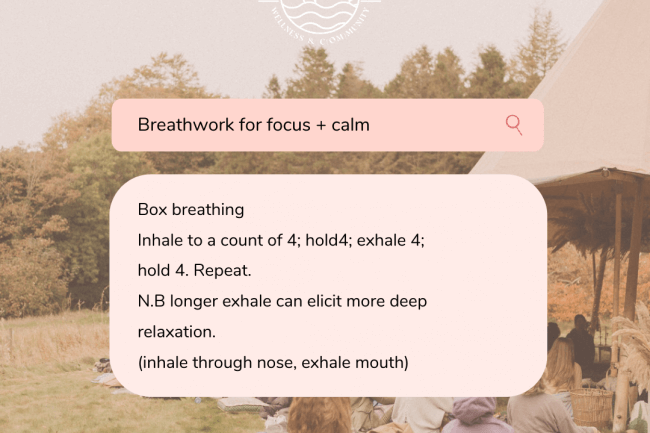
When we tap into somatic tools and practices such as breathwork, yoga and walking meditations in nature, the benefits are then heightened again. We strengthen our parasympathetic nervous system and we experience a sense of ease, calm, vitality and presence – our nervous system’s become nourished! 


When we breathe deeply in nature our mind and body become less acidic and more alkaline. We blow off more carbon dioxide which is acidic and our pH level goes up. An alkaline body has extensive benefits for all of the systems throughout the mind and body promoting health, clarity and productivity. 


Whether you live in a city or in the countryside, find a green space and try two of these somatic tools that we have provided here. Then ask yourself how did I feel, and how do I feel now. 


We can guarantee that when you retreat to nature you will go home feeling taller than the trees. 

Here are two exercises to start thinking about this:

Could You Qualify For R&D Tax Credits?

Guest Blog by Andrew Smythe and Julie Stewart of Amplifi Solutions.

If you have any further questions about this, it would be worth discussing with your accountant or directly with Andrew to see if you could benefit from this.

What is R&D?

When a business identifies a product gap in the market or a problem with an internal process they may start to investigate different ways to rectify it, such as trying to create a new product or fundamentally change a process, both these actions could end up extending the knowledge within a certain field. This is R&D.


R&D Tax Credits Explained

Initially introduced in 2000 by the Government to encourage and reward R&D within limited companies or PLCs, R&D tax credits offer an additional tax reduction of up to 24.7p (or up to 33p if you are surrendering a loss) for every qualifying pound spent on R&D.


SME Scheme

-Less than 500 employees

-Turnover of less than €100m

-Enhanced reduction of 130% on all qualifying R&D expenditure or an additional tax deduction of 24.7p (up to 33p if you are surrendering a loss) for every qualifying pound spent on R&D.


RDEC Scheme

Over 500 employees

Turnover of > €100m or Net Assets > €86m

Have notified grants

Enhanced reduction of 13% on all qualifying R&D expenditure or an additional tax deduction of 9.7p (11p if you are surrendering a loss) for every qualifying pound spent on R&D.


Qualifying Activity

HMRC classifies R&D as a project that seeks to ‘advance science or technology’ and tries to overcome a ‘level of uncertainty’.


Simply put, if a business is taking a risk in trying to develop something that will advance the scientific or technological knowledge in their field, and they have undergone a process of trial and error, then they could qualify. This includes:

New products, services and processes

Changes to products, services and processes

Project failures or successes


Qualifying R&D Costs

R&D tax credits cover R&D costs from the start until the end of a project’s “uncertainty” or the trial and error phase.


Allowable costs include:

People: Salaries, wages, employers, NICs & pension contributions

Subcontractors: using third parties to help solve the technological uncertainty

Consumables: raw materials consumed in the prototyping and testing process (eg chemicals, flour, electronic components, etc.)

Utilities: Heating, lighting and power

Software: Software licences used to deliver your R&D project (eg AutoCAD; SolidWorks)


EXAMPLES OF R&D

When you are testing or developing a new or modifying an existing product or process, your projects could qualify for R&D tax credit support. Below are some qualifying sector activity.


Manufacturing

  • Creating new products or product ranges
  • Modifying or updating aspects or features of an existing product, such as its performance, size, finish or eco-friendliness.
  • Developing new manufacturing equipment, tools, jigs or moulds
  • Updating the manufacturing infrastructure by the customised adoption of technology such as automations or robotics
  • Improving manufacturing processes such as waste, heating, safety and quality assurance


Engineering

  • Creating engineering drawings and models, potentially with the use of Computer Aided Design (CAD) and Building Information Modelling (BIM) software
  • Designing or adapting engineering systems such as refrigeration, HVAC (heating, ventilating and air-conditioning), waste, plumbing and fire protection
  • Developing construction or installation techniques, equipment or methods
  • Modifying or designing new mechanical fittings, routings and equipment sizing


Software and Hardware

  • Designing new workflow, marketing, finance, healthcare etc. solutions and platforms
  • Developing data, security and encryption software
  • Creating unique algorithms or coding designed to integrate two or more platforms
  • Bespoke adaptation of off-the-shelf solutions
  • Creating new computer components or SMART devices

New Model Adviser – Top 35 Under 35 2022

As the New Model Adviser website needs signed up to, here’s the important bit for us….

Citywire New Model Adviser’s Top 35 Next Generation Advisers is awarded to some of the best young planners in the profession.

Now in its seventh year, the list comprises those planners who are striving to better themselves through qualifications and training and giving a great service to their clients. This year’s list had a host of amazing achievements from helping clients retire early to launching their own firms.

It also contained some questionable first album choices.

Dale Kirkpatrick

Director, Modulus Financial Planning

Having co-founded Modulus Financial Planning 18 months ago, Dale Kirkpatrick has been very busy. His roles and responsibilities have ranged from running and managing the business to marketing and operations, looking after the technology as well as the company’s finances.

He has also overseen the switch of client technology systems and launched a new webinar, all while continuing with his role as a chartered financial planner.

One of the firm’s aims is to improve financial education, so Kirkpatrick regularly makes free videos and content about financial advice for those who want or need it. Through this content, Modulus has covered a lot of topics, including investing, tax wrappers, financial planning, and protection.

What has been your biggest investment mistake?

I have taken a punt on cryptocurrencies, as much as to show clients just how volatile they are. While I am down a healthy percentage, it was never much money, and it has demonstrated my point that it is a volatile, risky asset.

Another New Budget With More Tax Changes

Who is the most hated Tory politician this month? It seems like Jeremy Hunt and Matt Hancock are currently battling it out for the title. I have to say, I think Matt Hancock is still leading that race. I just don’t think his appearance in the jungle is helping him…

Anyway, this week we got another budget (technically just an Autumn Statement) but still. Here’s a very brief few key points on how it might affect you.


Income Tax

Your personal allowance has been frozen until 2028. While the tax headline rate doesn’t increase, any payrise you get (inflation or a new job etc), will mean you pay more tax. Remember a year ago or so how we discussed Stealth Tax? Add this one to it


Additional Rate Tax Threshold Reduced to £125,140

From the start of the new tax year, you will be an additional rate tax-payer (paying 45%) on income over £125,140. This brings lots of people (an estimated 250,000) into the highest tax bracket who have never been there before. Don’t forget that you lose £1 of your personal allowance for every £2 over £100k that you earn – this is called The Tax Trap. The effective rate of tax on income between £100,000 – £125,140 is 60%. You also lose entitlement to childcare tax relief if you have income over £100,000.

Therefore, the ability to make charitable donations or pension contributions to bring adjusted income down to £100,000 could be more important than ever now. At this level, the tax calculations get quite complex – definitely speak to us or your accountant if you find yourself caught by this.


Dividend Tax Allowance reduced

You can currently earn £2,000 from dividends tax free – this is especially useful for business owners who pay themselves a mix of salary and dividends. In April, this will drop to £1,000 and then in April 2024, will drop further to £500. This is a significant decrease and one which will have a big impact on many business owners (as recently as the 2017/18 tax year this allowance was £5,000).


Capital Gains Tax Allowance reduced

You can currently make a capital gain of £12,300 before you need to pay Capital Gains Tax. This will reduce to £6,000 in April 2023 and £3,000 in April 2024. This will likely be felt most by those with General Investment Accounts or people looking at selling buy to lets or second properties.

Trusts already are only entitled to 50% of an individual’s CGT Allowance so this will reduce to £3,000 and then £1,500.

A bit of a shock this one!


The Good News?

The State Pension is going to increase by 10.1% in 2023 – great news for pensioners!  The same level of increase will also apply to State Pension Credit as well.

After more media hysteria about big changes to pensions– nothing changed. Phew

Also, every household in Northern Ireland is going to receive £200 to help towards bills. This was initially only going to those of us who use oil, but I think they’ve decided that’s too difficult so everybody is going to get it. When and How we get it is another question entirely? Do we need to wait for a functioning Executive? If so, we might have it by 2030 if we’re lucky….


What Now?

Hopefully (really and truly I’m crossing my fingers) this is the end of tax alterations and adjustments for a while. It’s been hard to keep up and I still find myself just double checking what is still in place and what has been scrapped.

There are things we can do to reduce tax and its impact, but it needs to be part of the bigger financial plan. At the same time, the cost of living is only going up and I fear it will continue over Christmas and into the New Year, so we need to make sure we can all heat the house and put food on the table, before we start thinking about doing things to reduce tax.

Speak to us or your accountant if you want to discuss any of this.

Hold on a minute lads, I’ve got a great idea!

Harold Wilson once famously said that “a week is a long time in politics!” Well given what has happened with the Government and their hokey cokey tax policies in recent times, truer words have never been spoken (certainly not by a politician anyway!).


The Prime Minister, Liz Truss (or the Human Hand Grenade as she is sometimes known because of her ability to blow things up – Dominic Cummings is often credited with that one apparently), has had more changes of mind than a 6-year-old writing a Christmas list for Santa.


“Kami” Kwasi Kwarteng was ousted last week and replaced by Jeremy Hunt. This was clearly a self-preservation move on the part of The Truss (another nickname for the PM – one she is reported to have used for herself).


Mr Hunt (let’s not use a nickname here) today announced that he is effectively scrapping all the measures announced (& originally endorsed by Radon Liz – yet another nickname, one used by opponents as she is apparently stiff – on issues I presume!).


But we are here to talk about financial planning, not how The Self Preservation Society* in Downing Street have shifted in the wind and might still shift further!

So, today’s announcement means that Dale’s Blog a couple of weeks ago and my blog last week are effectively redundant!


The only meaningful changes that the Government are proceeding with are –

  • Cut in NI increases (reversing the 1.25% rise)
  • Cut in Stamp Duty (for first time buyers up to £425k & for the first £250k of a property’s value for everyone else)


For more about these changes that are proceeding please read Dale’s Blog – How Might The “Mini Budget” Affect Your Budget?.


By pulling these planned reforms it means that –

  • The Basic Rate of Income Tax will remain at 20% (at least that makes our pension calculations a bit easier!)
  • The planned cuts to Corporation Tax will not go ahead. That means that if your company makes more than £250k then Corporation Tax will be 25%.
  • The repealing of the controversial IR35 legislation is scrapped as well! This is of particular interest to those who were contractors and are now treated as employees.
  • The freeze on alcohol duty rates is also scrapped (so that Bailey’s will cost a bit more!)


Some questions that might be being asked may include – how will markets react? Will Sterling stabilise? Will interest rates rise or fall? Will Liz keep her job?


The short answer to these questions is that we don’t know, and we certainly won’t be making any predictions as to what will happen either (not even about Liz keeping her job – who really cares about this one really!).


What we do know is that with the economy things will change constantly.  The markets will react, as is human nature (for more please read last week’s blog – I’m from the Future!).  We can’t know exactly what will happen and we won’t try and guess either!


The important thing to remember is to stick to the plan.


At the end of The Italian Job, Charlie Croker said “Hold on a minute lads, I’ve got a great idea!”.  Our great idea is to remind you to keep calm and do nothing!  Call us if you want to talk about things or ever just book some time in our diaries directly.


PS – for a list of nicknames of Prime Ministers please click here


*For those wondering that is the song at the end of The Italian Job

I’m from the Future!

Given what is happening in the world right now, specifically in the UK, we felt it a good time to drop a few words with our thoughts.


One thing you won’t hear from us is a prediction.  We do have some opinions, (in fact at times we can be very opinionated – especially about car parking) but we won’t ever make a prediction on the markets or indeed the economy in general. This is because the markets are not something that anyone can predict with any certainty. Indeed, some economists will make some sweeping statements about what they think will happen with markets and the economy.  If they get this wrong (and they often do), then they aren’t really held to account.  They are a bit like the weatherman in that they are one of the only groups of people who can be wrong regularly and keep their jobs! I am joking here of course because much like the weather, the economy and the markets are in constant flux, they constantly change.  Predicting what will happen next is often an educated guess, but it is a guess nonetheless because no one really knows what will happen.


Look at what happened recently with the ill-fated mini budget (23rd September 2022). The day after the Bank of England raised interest rates to 2.25%.


Kwasi Kwarteng (or Kami Kwasi as the papers apparently call him – I learned that at a quiz last week), made some sweeping announcements about plans to cut tax in the UK.  This was pretty much unprecedented and the reaction to this was staggering.

  • GBP fell dramatically against the Euro and the Dollar (but there has been some recovery since then)
  • The FTSE 100 also fell, continuing this trend through for almost a week before making some gains
  • The Bank of England stepped in to try and stabilise markets
  • Lenders started pulling mortgage deals to new borrowers
  • Some fixed term mortgage rates went as high as 6% for 2-year deals
  • Mr Kwarteng then announced a U turn on his plan to abolish the 45% rate of income tax (due to internal pressures within his own party!)
  • On 10th October, he declared that he is bringing forward his plan for rebalancing the government’s finances (how he plans to fund the £43Bn of tax cuts) from 23rd November to 31st October (in a bid to try and stabilise markets & before the next review of Interest Rates on 3rd November)


Phew! That is a lot of information to process in a very short space of time, in a small country like the UK.  There is a lot going on in the world right now, with a great deal of uncertainty.  And that will always be the case.  There is always something going on that will make it less attractive to invest or indeed to remain invested. It’s OK to be nervous.  What we will always say is that there will always be something.  In recent times – Covid, the invasion of Ukraine and the UK economy to name a few.


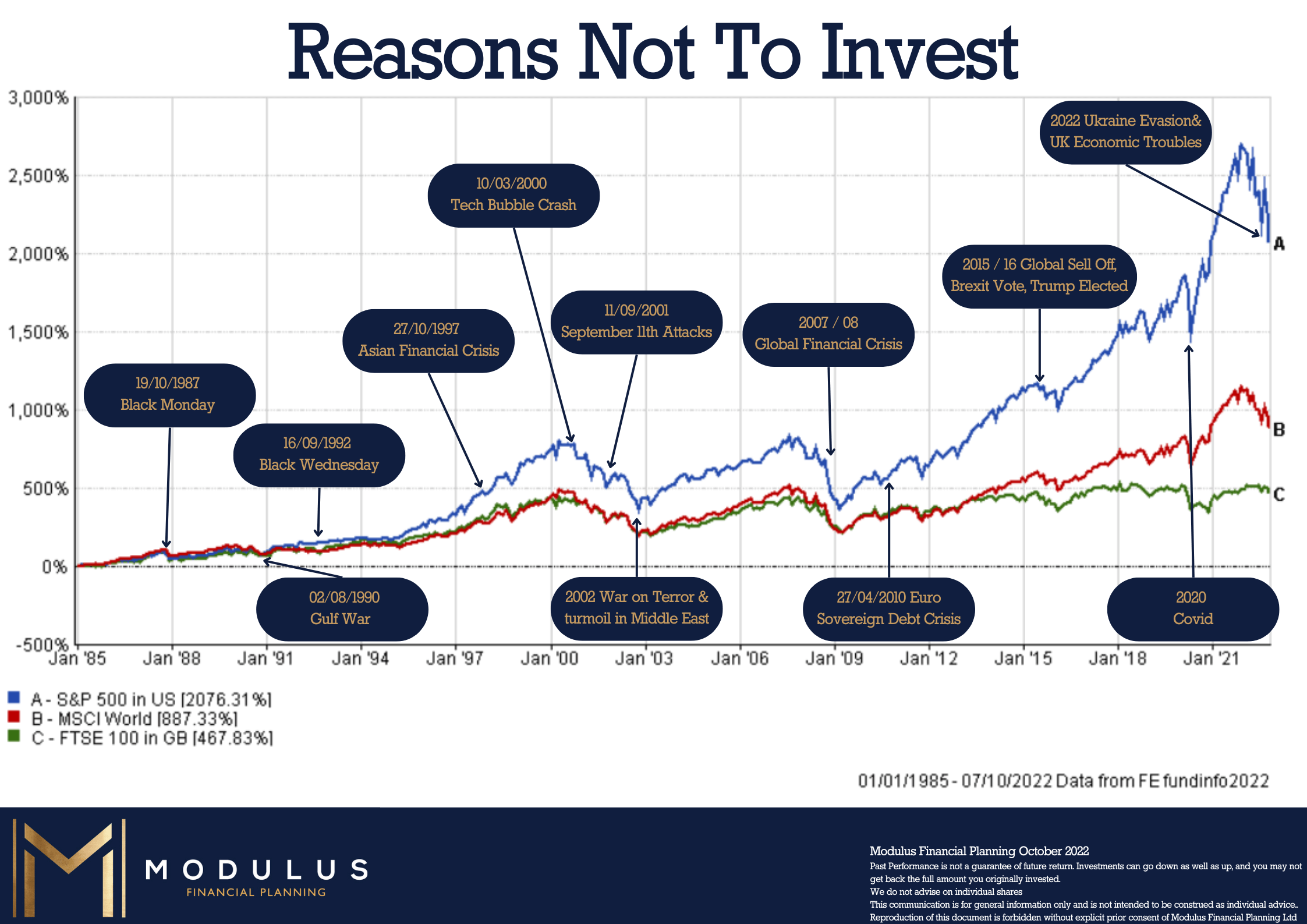
If we go back further in time, then we can see that since 1985 there have been numerous reasons not to invest or remain invested (see below).

This image shows the movement of the S&P 500, MSCI World and FTSE 100 since 1985 along with events that have affected the markets – reasons not to invest.


The following happened between 1985 & 2022 –

  • Back to the Future was released (1985)
  • Numerous wars
  • 9/11 Attacks
  • Multiple recessions including a meltdown of the Global financial system
  • Britain voted to and then left the EU
  • There was a global pandemic which shut down most of the world
  • Donald Trump would be voted in and serve as president of the most powerful nation on earth
  • There was a sequel to Top Gun – 36 years later!
  • A TV actor became president of Ukraine and stood with his people against the might of the Russian


Imagine I had told you all of this would happen back in 1985! You would probably call me a lunatic and remove me from your Filofax contacts!  You certainly wouldn’t have changed your views on your financial planning because of it.  And, in the very off chance you had believed me, then you may have decided to keep your money under the mattress and have lost out on fantastic returns over this period.


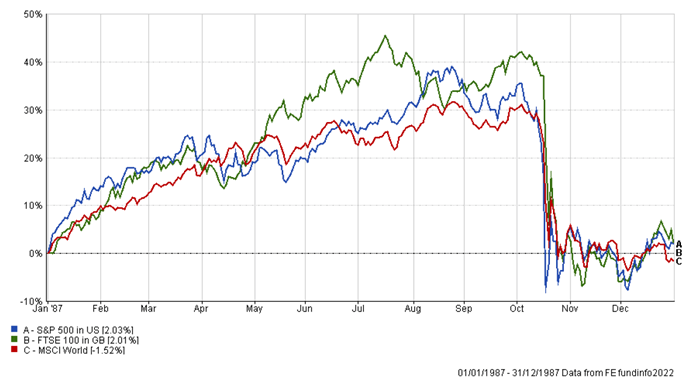
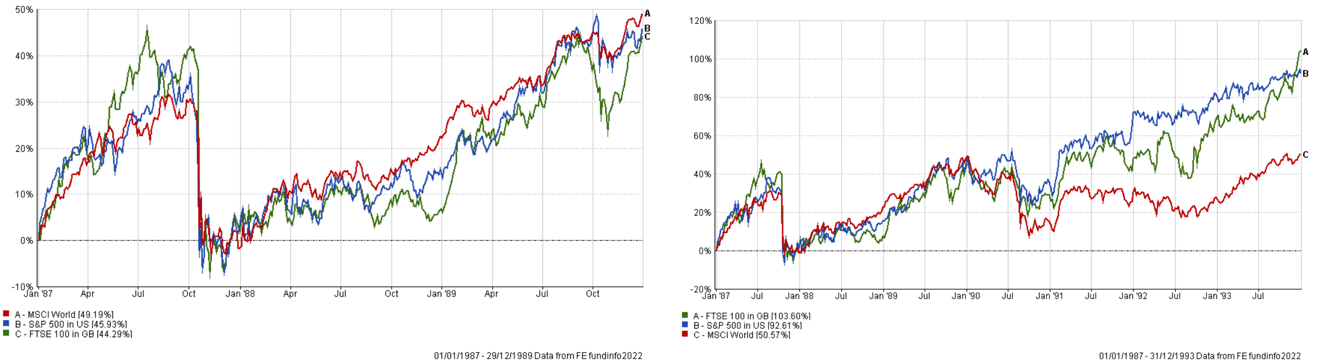
Looking at the chart above, the thing to notice here is that even though there have been periods when the markets have declined and indeed been flat for periods the overall trend has been upward over time.  The short term can seem scary because of volatility – here is a look at 1987 when Black Monday occurred!

If you saw this in isolation, then you may be worried about the volatility over the course of the year (remember volatility is the temporary decline / movement in the markets but that risk is the chance of permanent loss).

But if we look at the 3-year view and then out to the 7-year view, things seem a little bit more settled.  In fact, Black Monday seems like a bit of a hiccup over 7 years.  If you look at this over the space of 30 years, then such events are literally small blips on the chart.


Over the short term the stock market is a voting machine. It is a popularity contest to a degree (or even an unpopularity contest at times).  People often vote quickly with their hearts and react to short term events.  In the long term the market is like a weighing machine, measuring the output of the products and services that the great companies of the world produce and sell.  When it comes to investing as part of a financial plan then it can take a strong will to go against the popular crowd at times.  It takes courage to stick to the plan at times and to filter out the noise that is blaring all around.


So, what should you do about what is going on with the markets and in the economy in general?  Well, nothing really.  Review your financial plan when it needs to be reviewed.  If you are worried in the short term, then call your financial planner.  It is at times like this when a financial planner should be telling you to keep calm and carry on.  Making reactionary changes could mean you turn a temporary market decline into a permanent loss.  Be patient and stick to the plan!


“The stock market is a device for transferring money from the impatient to the patient” – Warren Buffet


And if you’re worried about what the papers and various commentators are saying about the economy then always remember the sage words of Marty McFly!


“Since when can weathermen predict the weather, let alone the future?”


Past Performance is not a guarantee of future return. Investments can go down as well as up, and you may not get back the full amount you originally invested. 

We do not advise on individual shares

This communication is for general information only and is not intended to be construed as individual advice.

Details correct as of time of writing 10th October 2022

Contact

Get Connected.

Contact Us

Modulus Financial Planning look forward for you to contact us for more information about any of our products or services.

Modulus Financial Planning

Suite 12, Avonmore House,
15 Church Square, Banbridge,
BT32 4AP, Co.Down, Northern Ireland

Let’s Talk About Your Finances

Here for all your saving & investment, pension & retirement planning, tax & estate preservation and insurances.

CALL: 028 40 33 68 67

Modulus Financial Planning Ltd is authorised and regulated by the Financial Conduct Authority. We are entered on the FCA Register under reference 965916. Registered in Northern Ireland, Company Number NI673772.
The guidance and/or advice contained within this website are subject to the UK regulatory regime and are therefore targeted at consumers based in the UK.

The Financial Ombudsman Service is available to sort out individual complaints that clients and financial services businesses aren’t able to resolve themselves. To contact the Financial Ombudsman Service, please visit www.financial-ombudsman.org.uk.

Privacy Policy

Contact