Blog by Modulus

READ OUR BLOG

I Got Engaged! Now What?

Written by Kirsty Burrows


I’m Engaged!!!

James and I have been together almost 8 years now. We met well over 10 years ago but it wasn’t until after a Valentines Special Country Night in the Banville Hotel, Banbridge when sparks appeared in Dominos. While waiting on a pizza, James asked me to go out for a kebab with him on Valentines Day later that week.

You just don’t get stories like that anymore with the invention of dating apps like Tinder.

Fast forward 8 years and James asked the big question after sending me on a wild goose chase around the country collecting clues to reveal his destination. I finally tracked him down in Newcastle where he was patiently waiting at the Slieve Donard Hotel. If you’re reading this James, I look forward to going back every year to celebrate our anniversary…thanks in advance!

After being together for so long I was taken by surprise, and we now both seem very unorganised for our future. James, a dinosaur who was yet to set up online banking, and myself, who still lives at home and has a parcel arriving every other day.

Step 1 – A Joint Bank Account

We opened a joint bank account (Yes – James actually has online banking now) and we have worked out a savings plan for our wedding and future home.  Unfortunately, the delivery van doesn’t visit as often now.

If you are in this position, bank accounts I would suggest looking into are the “challenger” banks like Monzo or Starling for being easy to open. Whatever you do, shop around and see who’s offering the best bang for your buck!


Step 2 – What Type of Wedding Do We Want?

Since the proposal we (I) jumped into wedding planning, but have slowly crawled back out. There was a lot to take in…

Luckily, I have many friends who have recently got married to keep me in line.

“Venue (and date), photographer, Band….and the rest will fall into place…” or so I’m told.


Step 3 – Budgeting

Budgeting for this is fairly difficult, especially when you have no idea of the going rate of vendors, not to mention all the hidden costs. If you mention something is for a wedding, the price seems to double.

Again, I recommend recently married friends to give you the realistic costings as well as online wedding budgeting spreadsheets and wedding fairs.

And don’t speak to Dale or John about how much it is going to cost because that’s just depressing…      


My top tips so far:

  • Don’t rush into anything
  • Enjoy the juicy hugs
  • Don’t do a half marathon and then go straight to a wedding fair after!
  • Never turn down an offer for a kebab….you just never know what it will lead to?


Fun Financial Fact:

I’m aware very few of you will be planning for a wedding, but you might have children, grandchildren or other relatives in the position. One of the tax advantages is that you can make special wedding gifts each year tax free.

You can give up to:

  • £5,000 to your child
  • £2,500 to your grandchild or great grandchild
  • £1000 to any other person

This is a great opportunity to make a small dent in your potential Inheritance Tax bill whilst donating to a loved one’s future. Remember, these can be made on top of your annual gift allowances.

In theory, a Mum and Dad can give their Son or Daughter the usual £3,000 gift allowance each, the carried forward unused gift allowance from last year, plus the wedding gifts. So that totals £11,000 from Mum and £11,000 from Dad, which is £22,000 moved out of your Estate.


So far, that’s all I’ve got but I’ve another year or two of going through the process. If anyone has any top tips – please, I’m all ears.

Corporation Tax Increases. What does it mean for Business Owners?

As of April 2023, the government increased UK Corporation Tax rates for limited companies. Having been at a flat rate of 19% on company profits, it is now effectively a banded tax rate. The effective rates are now:

Profit Band Marginal Rate
£0 to £50,000 19%
£50,000 to £249,000 26.5%
£250,000 plus 25%

As with all things tax, there is a much more complicated calculation and so the above table gives a headline guide rate. The official calculation is to tax all profits at the flat rate of 25% and then apply the Marginal Small Companies Relief (MSCR) but that’s much too complicated for this.

For example, a company with profits of £100k would have had a Corporation Tax bill of £19,000 before these changes. Now it is calculated as:


£50,000 x 18%                  = £  9,500

£50,000 x 26.5%               = £13,250

Corporation Tax Due     = £22,750


This gives an effective rate of Corporation Tax of 22.5% on all profits.

Here’s a summary of tax due on profits between £50,000 and £250,000.


Total Profits £50,000 £100,000 £150,000 £200,000 £250,000
First £50k at 19% £9,500 £9,500 £9,500 £9,500 £9,500
Remainder at 26.5% £0.00 £13,250.00 £26,500.00 £39,750.00 £53,000.00
Total Corporation Tax Due £9,500.00 £22,750.00 £36,000.00 £49,250.00 £62,500.00
Effective Rate on Total Profits 19.00% 22.75% 24.00% 24.63% 25.00%


As profits increase, the effective rate of overall Corporation Tax increases until profits of £250,000+ where the rate is 25%.

In summary, this means that many companies will face higher Corporation Tax bills.

Combine this with the reduction of the dividend allowance, the freezing of the personal allowance and reduction of the capital gains tax allowance, and it doesn’t look just as appetising to be a business owner.


So What Can You Do About It?

There are two main things to consider when planning your personal and business finances.

  • Your income Strategy – is a small salary and a large dividend still the best option?
  • Pension Contributions – Make an employer pension contribution

Let’s look at both in a bit more detail.


1. Your Income Strategy

The first thing to remember here is the order of taxation. By that I mean the company pays Corporation Tax before it can pay out dividends on the after-tax profits. Whereas, salary or a one off bonus is paid by the company before it pays Corporation Tax and is therefore an allowable expense.

So all you need to remember is that salary/bonus comes off the bottom line for calculating Corporation Tax, whereas for dividends, you must calculate Corporation Tax first and then declare dividends from what remains.

This is where you must speak to your accountant to agree what’s best for you and your own situation, as there are many differences to be wary of. But let’s look at a simplified example.

Your single director and shareholder company has profits of £100k and a potential subsequent Corporation Tax bill of £22,750. This means that after tax, the company could pay a dividend of up to £77,250.

Remember Dividends are personally taxed at 8.25% for Basic Rate Tax and 33.75% for higher rate tax payers.

Assuming you have used your full personal allowance with a small salary of £12,570 per annum, that means your annual dividends would work out as

Tax Due

£1,000 of Dividend Allowance                    @ 0%                     £0

£36,700 at Basic Rate Dividend Tax           @ 8.25%              £3,027

£39,550 at Higher Rate Dividend Tax        @ 33.75%            £13,348

Total Dividend Tax due                                                               £16,375


This means that your annual profits of £100k allowed you a dividend of £77,250, which was worth £60,875 in your pocket after Dividend Tax (which is payable through Self Assessment in January of the following tax year – so make sure to save the amount due for tax).

If you took the same £100,000 as salary, you would wipe out the company profits, and so too the Corporation Tax bill. However, you must remember that there is the complication of National Insurance Tax on both the Employer and Employee. All tax would be taken through PAYE.

This calculation becomes very complicated and so here’s a link to the UK Tax Calculators website which does it for you – https://www.uktaxcalculators.co.uk/tax-calculators/business-tax-calculators/dividend-vs-salary-result/

The end result is that if it’s taken as Dividend, you pay 33.09% tax in total (across both corporation and dividend tax) whereas if it’s taken as salary of £88,976 (due to Employers NIC bringing the cost to £100k) the total tax paid is 39.34%.

And so in this example, a dividend is still better for the sole director and shareholder, but not by as much as it used to be.
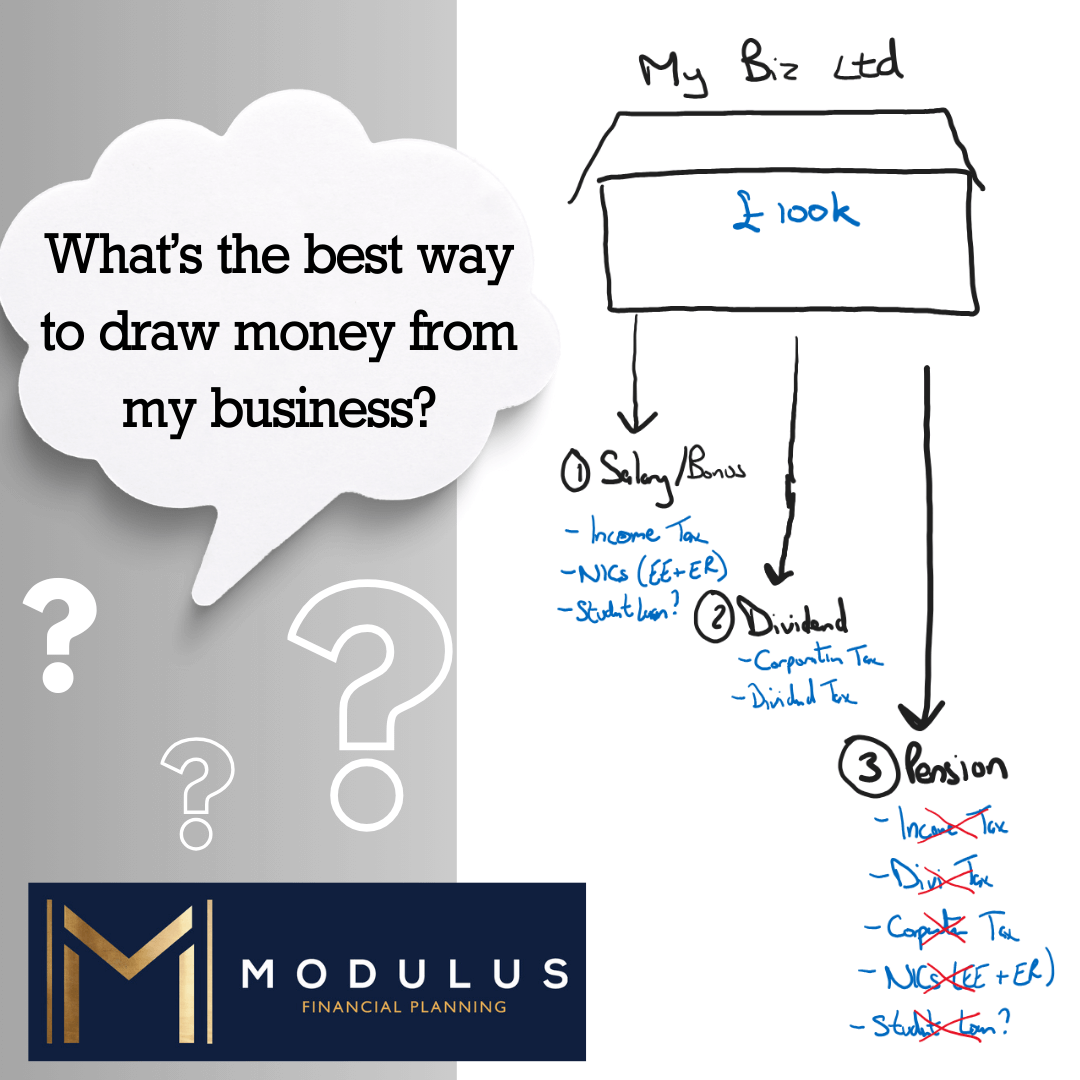
There are of course many considerations to think of which will change this, such as Student Loan repayments, Pension contributions on salary, P11D benefits and/or car allowance etc.

The other thing to consider is if you are applying for a mortgage in the near future as you need a track record for dividends to be considered.

This is why it’s so complicated and must be discussed with your accountant as well as your financial planner.

2. Employer’s Pension Contribution

Your company can pay an employer’s pension contribution into your pension and it is normally an allowable expense for Corporation Tax purposes.

For example, for the same company with £100k of profits, you could use your full annual allowance for this tax year of £60k. This would bring company profits down to £40k, reducing your Corporation Tax bill from £22,750 to just (£40,000 * 19% =) £7,600.

This would then leave £32,400 (£100,000 – £60,000 – £7,600) which could be paid to you as a dividend as above.

Assuming you had only taken a small salary of £12,570, your additional benefit would therefore be £60k into a pension and a net dividend of £28,731 which means of your £100k profits, you received £88,731 and only £11,269 went to Corporation Tax and Dividend tax.

Don’t Forget About Pension Carry Forward

Depending on how much you have contributed to your pension in the three previous tax years, you might be able to pay even more than your £60k allowance into your pension.

The maximum pension contribution you could pay is £180,000  (this year’s full annual allowance of £60k and the three previous annual allowances of £40k per annum) which in the case of this example would be more than the company’s £100k profits.

Of course, if cash is available you may decide to post an artificial loss if your accountant agrees. Alternatively, you simply use up this year’s total profit and then do the same next year if your company is likely to have similar (or greater) profits next year.

Even if you don’t pay the full allowance available, it is worthwhile to pay contributions to bring profits back below £50k to make sure your company only pays 19% on Corporation Tax rather than 26.5% on any profits over £50k.


This has been a technical blog and I know not everyone enjoys a tax calculation as much as me…. but the overall thing to take away is that there are still things you can do, but planning ahead with your financial planner and accountant is more important than ever.

At the end of the day, we want you to live the life you want, so we must maximise both your tax saving but also your take home pay to let you enjoy the lifestyle you want.

The correct answer will likely be a combination of pension and take home pay (whether that is dividend or bonus).


If you want to discuss anything about this blog or your own personal situation, please feel free to call or email us, or if you’d prefer a more structured conversation then book yourself into our diary.


The Devil is Always in the Detail

The Devil is in the Detail: How to Avoid Budgeting Mistakes and Save Money

These days when the word Budget is mentioned most people will think of a politician, grinning like a Cheshire cat whilst holding a red briefcase outside Downing Street.  And let’s be honest – it is usually a mixed bag in terms of what comes out of the Budget, but always remember that the devil is in the detail (and not all the headline grabbing stuff is as good as it seems!).


I am not however writing about the Government’s budget but rather your own.  And the devil here really is in the detail!


Managing your finances is crucial to helping you achieve your personal goals and objectives. A planned-out approach your budget will help you track your expenses, save money, and work towards your future. Whether you’re aiming to buy a house, travel the world, or simply build an emergency / rainy day fund, having a budget in place can make a significant difference.


So – what do we need remember when thinking about a budget?


Understanding Your Income and Expenses


Step 1: Calculate Your Income

Start by working out how much actually comes into the pot each month (after taxes).  If you are a salaried employee, then you will need to look at your payslip.   If you have other forms of income, such as rental income, investment income, savings income etc then you will need to consider if you will need to pay any tax on these at the end of the year.


Doing this will give you a clear picture of the money you have available for budgeting.


Step 2: Check your spending

The stock line here is to record all your expenditure; this should include your bills, groceries, travel costs, entertainment etc.  The easiest way to do this is to look through bank & credit card statements and pull these figures out (as most people no longer really use cash).  There is no point looking over a single month’s spending – that is too short of a timeframe.  Look over at least 6 months, but preferably 12 months statements. This gives a true reflection of the shape of spending over the year and takes into account things like holidays, annual subscriptions (e.g. insurances) and ongoing maintenance costs.


Note – make sure to record cash withdrawals, as this is money that has been spent as well. You will need cash throughout the year so factoring this into your budget is important.


If you need somewhere to record these details then have a look at our Annual Budget Planner


Setting Goals and Objectives


Step 3: Define Your Goals

You may have some short term and some long-term goals in mind when thinking about your budget.  Short term goals might be things like a family holiday, buying a new car or paying off a credit card.

Your long-term goals might include things like moving house, planning for when you stop working, weddings for kids etc.

The thing about goals is that unless they are planned out then they are just wishes.  Makre sure you have SMART goals in mind –

  • Specific – For example – going on the holiday of a lifetime
  • Measurable – How much do you need to be able to do this?
  • Achievable – Is the goal attainable and not impossible to achieve?
  • Realistic – Is it within reach and relevant to your life / business / financial plan?
  • Timebound – When do you want to achieve this goal?


For more about goal setting have a look at our blog – Be SMART at this time of the Year


Creating Your Budget


Step 4: Categorise & Prioritise

Your expenses can really be divided into 3 sections –

  • Essential / Living Costs

    these are the things you need to spend for everyday living. This will include things like food, electricity, heating, clothes etc.

  • Lifestyle / Discretionary Costs

    these are costs for the things you like to have. These will be things like eating out, coffees, nice shoes, regular holidays etc.

  • Luxury / Ad Hoc Costs

    these are the bigger, one-off expenses every few years. These will be things like changing your car, a child’s wedding, a holiday of a lifetime etc.


Some of these costs will be slightly different each month, like electricity or food bills, but when you consider them over the course of a year then they average out.


Prioritising essential expenses (as noted above) is important because these are the things that you need to pay for each month or year to be able to live.  The next step will be to plan out what you want to spend on lifestyle costs like eating out etc. If you want to achieve some of those short and long-term goals, then there will have to be some level of sacrifice along the way. Here is where budgeting really starts to take shape.  Set a monthly limit each month as this will help avoid overspending.


Step 5: Pay yourself first

If you have worked on your SMART Goals then you will have as idea of what it will cost to help you achieve your goal.  You will also have a realistic timeframe and so you can start the process of working towards that.  You know what you will need each month to cover essential costs and you have set a limit for your lifestyle.  You will now be able to set funds aside for your goals.  The trick here is to pay money towards these goals at the start or end of the month – basically just after you get paid.  Pay yourself first.  Paying yourself first means that you are less likely to spend the money you need to help you achieve your goals!

Step 6: Review regularly

Regularly review your budget and track your spending to ensure you’re staying on track. If you notice that it is a bit tough towards the end of the month then it means you are being disciplined and that your plan is more likely to succeed.  Remember to celebrate progress towards your goals as well.


Tips for Successful Budgeting


Emergency Fund:

You need to be ready for the unknown so having a readily accessible slush fund for emergencies is essential. Aim to save at least three to six months’ worth of living expenses in an easily accessible account to cover unexpected events.


Debt Management:

Focus on paying off high-interest debt like credit cards to reduce financial strain and save on interest payments.  If you have a few of these then work on paying off the one with the highest interest as quickly as possible. Make sure to keep making at least the necessary minimum payments to the debt so that you don’t incur late / missed payment charges and impact your credit score.  Once you pay off the first of these then add that monthly payment to the next highest interest debt and keep working at this until your high interest debt has gone. Also look at 0% balance transfer credit cards, if possible, to help reduce the amount you are paying in interest.


Conclusion

By following these steps and maintaining discipline, you’ll be well on your way to achieving your financial goals.


Remember, the journey to financial success begins with a well-planned budget.

Moving House: Cardboard Boxes, a Broken Wrist and Smart Tips

I have moved house. When I say I, I actually mean my family and I have moved house. A few weeks ago I said to the team here how I had thought this was meant to be a lovely experience. Moving to your dream home and planning your future – a happy time. Well, that statement was met with vicious laughter from Dale (imagine cartoon villain), who moved house 4 years ago. He informed me, through guffawing, that moving house is one of the most stressful things you can do – ever! I said surely not. But then again, I can’t really remember the last move we made. It was 11 ½ years ago when we had much less crap and only a 6-month-old baby to take with us.


So here, in this very public forum I would like to say that – Dale was right! Yes, you read correctly – Dale was right!


So given that I have managed to survive the past few weeks I thought it would be good to share some of the valuable lessons that I have learnt (and am still learning!).


1 – Get your finances in order as soon as possible

If you are getting a mortgage or trying to port your existing one, then plan in advance. Speak to a mortgage broker or your existing lender in plenty of time. Porting is when you transfer your existing mortgage from your current house to a new one. We were porting our mortgage over and to say that it was a slow process would be an understatement. Some banks / lending institutions insist on posting forms out (how dare they consider emailing it over). They may also insist on the forms being returned via post with wet signatures. If you are up against a deadline then this can be an incredibly slow and frustrating process.


If you have applied for a mortgage, then quite often, that rate is secured for the duration of the application process. Given that rates can rise (often quickly in recent times), then this is quite handy.


Quick question – what do mortgage advisors, financial planners, Big Joe down at the pub and your aunt Mabel all have in common?


Answer – none of them really have a clue what interest rates are going to do! They can all guess and make predictions about what they think could happen – but no one knows for certain. Before summer people were predicting that rates could fall and then they went up. Next thing you know interest rates went up, but mortgage rates fell slightly. It can be a bit confusing, and whilst a mortgage advisor can guide you, ultimately the choice to go fixed or variable rate is yours alone.


2 – Get the house ready to sell (but not too much!)

Having the house looking good for pictures is a must. But painting the whole place from start to finish maybe isn’t the best use of time or money. If there things that are essential / necessary then get them sorted. Do remember though that the people buying our house will likely come in and decorate to their own taste. Don’t waste too much time.


Tip – for house viewings in colder months consider lighting the fire, playing some chilled music and baking some bread (if you’re so inclined). It all adds to the experience!


3 – Packing

Where to start and what to do! Get some boxes and start preparing well in advance. There are lots of things that you aren’t going to need before you move so that is the place to start. Make sure that things are well labelled with details of where the box goes and who owns it! Keep it organised and things will go a bit more smoothly (well that is the theory anyway!).


Strong cardboard boxes are a must. You should be able to order these online, at a local cardboard factory or via some removal firms.  Bubble wrap and a tape gun are also handy to have as well.


Also be ruthless when getting rid of things – you really don’t need that keyboard from when you were 16! If items are in good condition, then why not donate to a charity shop because someone might get some use from them.


If you use a removal company (highly recommended) then check if you need to empty drawers in a chest of drawers. We only found out that we didn’t need to do this after the vans had been loaded up. My fault for assuming that they had to be empty and not asking the question.


Bonus tip – don’t break your wrist 2 weeks before you move! This could happen on a football training day when you’re acting as a stand in goalkeeper, make a good save and land awkwardly. This may sound oddly specific but believe me it happens.


4 – Dismantling furniture – screw it

If you need to dismantle some furniture, then a cordless drill, screwdrivers and Allen keys will prove invaluable.


You’re going to have screws, nuts and bolts that are easy to lose, so food bags are your friend here. Remember to tape them to the furniture they belong to so. It makes them easy to find. Hint – secure with masking tape so you don’t damage the furniture.


Tip – check if your furniture fits where you are moving to. Also have a plan in your head so you can direct the removal company team when they arrive (my wife was great at this).


5 – Moving furniture and the rest of the heavy stuff

Get a removal company in to help!!!! This honestly will be some of the very best money that you spend when it comes to moving home.


Moving house is heavy work and moving day can be pretty stressful – even with the help of a removal company! My advice is to try and be organised as best you can. If you are cleaning the property before you finally leave, then wait until everything is out. You could even do it room by room when emptied. Better still you could bring a cleaner in for the day and let them at it when everything is out!


6 – Unpacking

I will complete this section if we ever manage to get unpacked! Honestly, be prepared to work and live around boxes for a while. This is especially true if you are getting work done to your new house (like painting, new carpets etc). There is no point unpacking to have to box stuff all back up and move it again.


When unpacking try not to feel overwhelmed – one room at a time and you will get there, eventually.


Having some essentials to hand like toiletries and clothes for the first couple of days is a good idea. Also, preparing some pre-cooked dinners (for reheating), or the number of the local takeaway will help until you’re settled in.


7 – Celebrating

After the whirlwind of packing, unpacking, and playing Tetris with furniture, you’re finally in your new home.


It won’t have been easy. It most certainly will have been stressful. But remember that it will all be worth it – otherwise why would you be doing it! Take some time to chill out and celebrate what you have managed to achieve!


Some final practical tips

– Read the electric meter when you leave your new home and when you move into your new one. It makes life a lot easier when you are dealing with electricity supply companies.


– Heating – if the new house needs heating oil or gas connected then try to get that sorted asap.


– Contact your internet and / or TV provider to get a date for leaving and install arranged.


– If you need a cooker wired in or the gas connected, then try to book an electrician or gas engineer in advance. Helpful as you ’ll quickly get tired of take aways.


– Home insurance – arrange for this to change on the day that you move.


– Register with your local authority / council so that you are paying the appropriate taxes / rates on the property.


– Change your address with / on –

  • Electoral Register
  • Driving Licence Authorities
  • Banks
  • Insurance providers
  • Pension and investment companies
  • If you think of more then please let me know!


All in all, I am guessing that this should take a couple of years! I joke of course but if it does then never worry. You’re under no pressure to have the place looking like a palace a week after moving in. Remember that in the middle of all the chaos, you’re building a new chapter of your life. Hopefully some of these tips will help you face the cardboard jungle and come through unscathed!


Happy moving!


Just to prove the wrist story please see evidence below!


Do Your Spending Habits Reflect Your Values?

We all have different values, and these values often reflect in our spending habits. For example, someone who values experiences over possessions might be more likely to spend money on travel, concerts, or dining out. Someone who values health might be more likely to spend money on gym memberships, health supplements or alternative medicine. It might be cars, shoes or coffee. It will be individual to everyone, and when you think about it, you’ll likely know straight away what your “thing” is.

There is no right or wrong way to spend your money, but it is important to be aware of how your spending habits reflect your values. If you are not happy with your current financial situation, it might be helpful to take a closer look at your spending habits and see if they are aligned with your values.

Costs are Going Up

There’s no hiding it. We are all feeling it. The Cost of Living is on the up. It’s been well documented and all of a sudden everyone is an expert on inflation. Except for one of the mainstream red top newspapers which asked when prices were going to come down because inflation was lower than expected. They didn’t understand that falling inflation still means prices are rising, just less quickly.

According to a recent FCA Study – Financial Lives 2022, 54% of UK adults are increasingly anxious or stressed about the current increase in cost of living.

Furthermore, between July 2022 and January 2023, 56% of UK adults had either stopped saving, reduced saving or withdrawn from their savings to meet daily expenses. Around 1 in 8 (13%) or 6.2 million adults cancelled an insurance policy to help them afford the costs.

According to the Office for National Statistics, the average UK household spends £500 per month on non essential expenditure, such as leisure, clothing and gifts.

We are all looking at cost saving measures, and reducing savings is an easy starter because we aren’t giving up our lifestyle. Cancelling insurances is a bit more serious. It could be something you later regret should you actually need to claim on it. Eventually, we may have to look at something which impacts on our lifestyle, and that’s non essential expenditure.

Or, we go the other route, and look at ways to get more money into our pocket. As we all know, this is easier said than done.

The Importance of Saving and Investing

While it’s important to spend money on the things we love, it’s also important to save for our future. Saving and investing can help us to achieve our financial goals, such as buying a house, retiring early, going on that big holiday or sending our children to university.

However, saving and investing can be difficult, especially if we are not motivated by our values.  We need to find ways to connect our financial goals with our values.

Align your Values with Your Money

With your financial planning, the only way you’ll care is if it is aimed at achieving what you want. We can create a clever tax efficient financial plan to let you retire at 50 – no problem. But if you turn around and tell me you don’t want to retire, you just want 3 nice holidays a year and to give money to your children, then we’ve wasted everyone’s time. This is why we can’t even begin work until we know about you and what matters most to you. It’s the only way it can work and for you to continue working on it.

It must be meaningful to you.

Our spending habits reflect our values. If we make it meaningful, like saving for your family, then you’ll do it. We need to connect our financial goals with our values. By doing this, we will be more likely to stick to our financial plans and achieve our goals.

Understanding your values is essential to help create a financial plan that is aligned with them.

Speak to us if you want any help.

Summer Sizzle (& frugal fun)

Hola, Bonjour, Guten Tag, Hello and Welcome are just some of the greetings that you will hopefully hear this summer if you are off on your travels.  And for those that aren’t then I am sure you will hear a bit of – “What about ye?”, “How’s the form?”, “Any craic?” and “Are ye well?” (we really are a friendly bunch across this island – although when you think of it most local greetings come in the form of questions!).

We’ve been pretty blessed with some great weather (& the odd rain shower has managed to keep our farming community happy as well!).  The good weather has certainly made it easier to keep a smile on faces and to, hopefully, strike a bit of work life balance.  If, like me, you have kids who are in clubs etc then you are possibly never done running the roads. Maybe you’re like Dale, and you have younger kids, then there will have been plenty of BBQs and trips to the park.  If your kids are grown up or it’s just you and your partner, or just yourself, then hopefully there have been plenty of BBQs again (a constant summer theme at our house), walks and a bit of relaxing in the sun (possibly with a cool beverage!).

Getting time to relax in the sun is so important – we all need to strike a balance between work and home life.  Too often many of us will miss out on time with family and friends because we have this gnawing feeling of guilt when our minds cast back to work.  It is hard to switch off, I completely get that. Whilst on holiday I checked emails a bit but because of the great team we have at Modulus I knew that if there was something that needed attention then I could forward the client request on, safe in the knowledge that it was being taken care of.  So a support network is huge when trying to achieve a work / life balance.

Strike A Work-Life Balance

Summer always presents the perfect opportunity to realign our priorities and find a healthy work / life balance (& the good weather recently certainly helps).

Here are some tips to make the most of your valuable time:

  • Time – a valuable commodity: Set dedicated hours for work and create boundaries.If you are under serious pressure and need to spend some extra time working then consider when you will do this and just as importantly, how long you will do it for.
    • Can you get up early?
    • Can you work a bit later at night (when the sun has gone)?
    • Will you need to work on a Saturday morning?

Set a deadline for the additional time that you will spend working.

Parkinson’s Law states that “it is a commonplace observation that work expands so as to fill the time available for its completion”.  Basically it means that you’ll make the task last longer if you don’t set deadlines!

Whatever your reason for carrying out some extra work it is usually going to be important – no doubt about it.  It will be a lot about how you prioritise things – only you can do that.

Top Tips for Improving Your Life

  • Unplugging for Inner Peace: When it’s time to unwind, maybe set the phone (or other electronic devices) down and give them a wee holiday of their own. Let them enjoy some “me time” while you enjoy some time with family and friends.


  • Nurture your Personal Passions: Take time over the summer to do some of the things that you want to do like exploring hobbies and interests beyond the confines of work. It could be going to watch a sports game, playing sport (or trying to play golf), photography, gardening, or learning to strum a tune on a guitar (around a fire after a BBQ). It doesn’t matter what it is as long as you spend time doing things that that bring you joy and allow you to recharge.


  • Send that text or make the call: How many people in your contacts list have you said to, “Ah sure we should really grab a catch up over coffee / walk / drink soon?” And then you never do it. Take some time to do it. You never know how much it might impact someone else’s or even your own life.


  • Mini Breaks for Macro Smiles: Plan short getaways or day trips to get some real headspace. Rediscover nearby beaches, parks, or scenic spots. Spending some time in our beautiful country, with family and friends should help to make some great memories and bring some balance back into life. Pack a picnic, bring a bat & ball or just a ball, some buckets and spades and get out there!  When was the last time that you kicked a ball or played a family game of rounders?

It Doesn’t Have To Cost Money

Do it on the cheap!  We are blessed with some exceptional beauty here in our small corner of the world. So much so in fact that people are actually coming on cruise ships and aeroplanes to see it for themselves. Take some time to explore Northern Ireland’s Free Treasures:


  • Historic Gems: Immerse yourself in the rich history of Northern Ireland by visiting iconic sites like the Giant’s Causeway (don’t go through the visitor centre unless you want to pay to see it), Dunluce Castle, or the walls of Derry/Londonderry. Maybe contact a local tour guide if you want to learn some more about the history and stories that they hold (this won’t be free but it won’t be overly expensive either).


  • Botanic Beauty: Spend a leisurely day at Belfast’s Botanic Gardens (I definitely spent a few days in Botanic Park and then the Botanic Inn later on). The Botanic Gardens are supposed to be class though with the vibrant flora, the Palm House and Tropical Ravine.  There is loads of space for picnics and you are right beside the Ulster Museum which is a must as well.


  • Just drive: Jump in the car and head out on a scenic drive along the Causeway Coastal Route or over to the Mournes. There is so much to see and it doesn’t cost a fortune. And there are always loads of places to park up for that picnic! Think about stopping at Castlewellan Forest Park.  It costs a few quid to use the car park or you can just walk on in! Long walks in the forest around the lake, a BMX bike track and the Peace Maze (pictured) – sure what more could you want?


So, let’s use the summer, and the joy it brings, by finding some harmony between work and life.  Cherishing down time with family and friends and spending time enjoying the natural wonders of Northern Ireland.

The best memories can often arise from the simplest pleasures with loved ones

Oh – and don’t forget the sun cream!!!


Protection Is The Elephant In The Room

This time of year, we get lots of emails from insurance providers with their annual protection claims stats. And they are sobering. That’s the only word that I can think of. The amounts are huge, but when you think of the reason behind the numbers, that’s scary. They aren’t just statistics. They are people and their families.

In 2022, Legal & General, one of the biggest players in the protection market paid out a record £883m in protection claims. This breaks down as them paying over £2.4m worth of claims every day.

Aviva paid out individual insurance product claims of £683m.

Royal London paid out 99.4% of all their claims which came to more than £631m. Of this, £132m was for critical illness and £2.5m was the amount of income protection they paid out.

LV paid out £126m in their individual protection claims which supported more than 8,000 claimants and their families.

This is all just last year – 2022.

So hopefully this disproves the first theory that “it never pays out” because that just isn’t true. It’s what we tell ourselves to stop ourselves paying the monthly premium.

Protection and Life Insurance is something nobody likes to discuss, but that doesn’t mean it’s not important. One of the very first things anyone should do when they are reviewing their financial situation is to make sure they are protected against disaster.

“But it won’t happen to me…..” – Almost Everyone

Protection is the Elephant in the Room

We (as in financial advisers and planners as a whole) have arguably shied away in recent years from talking as openly and publicly about insurance. Everyone hated the sleazy insurance sales man in the sharp suit and fancy watch who did the rounds and sold you a policy. And how many said, “I’ll give you a discount if you introduce me to two of your friends or family”? And as a result, when we say we’re financial planners at a wedding, everyone runs.

I don’t blame you really.

The industry has brought it upon itself, and it’s our job to change that perception. Hopefully, we’re making a small ripple in that vast ocean of untrustworthiness. I think the only people who are trusted less are politicians and car salesmen. I’d like to think that one day, our industry will be considered a profession, with recognised professional standards and a reputation to match. But that’s for another blog.

However, it doesn’t take away from the fact that we always need to have a back up plan before we start looking at planning for your future.

“Every one has a plan ‘til they get punched in the mouth “   – Mike Tyson

Why Do I Need Protection?

In a non-exhaustive list, some of the times you need to be thinking about protection are when you:

  • Get a mortgage, or take on a bigger mortgage
  • Have a child/children
  • Have a partner or family who relies on your income as the breadwinner
  • Get or change a job
  • Leave a job and you lose workplace benefits
  • Take on debt like a business loan for example
  • If you have a potential Inheritance Tax liability to cover

There are three main types of insurance we suggest everyone at least considers. Any financial planner should tell you they have all three. I know both myself and John do.

  1. Life Insurance – a policy which will pay out a lump sum (£100,000 for example) if you die.
  2. Critical Illness Insurance – a policy which will pay out a lump sum (£100,000 for example) if you are diagnosed with a specified critical illness
  3. Income Protection – a policy which will pay you a monthly income (£2,000 per month for example) if you are medically unfit to work

Each policy has many more options, variables and add-ons which we won’t go into detail here, but if it’s something you’ve been mulling over, it’s worth asking the question.

We can bolt on life cover to critical illness policies, at little to no additional cost. In fact, sometimes it’s cheaper to add it in,

Speaking of cost and premiums….

How Much Does Protection Cost?

The annoying answer is – it depends….

I took out all of my policies before I was 30 and I pay around £100pm in total for my policies.

One of which is a decreasing mortgage cover which pays out on Life or Critical Illness. Secondly, a Life or Critical Illness policy which would pay out £200k should anything happen to me, and finally, an Income Protection policy which would pay me £2,000 per month if I couldn’t work for more than 3 months.

I’ve set these premiums to remain the same throughout the policy. That’s the catch I see with most of the DIY options and TV and Radio Advertisements. They quote a price of something like “from just 50p per day (based on a 30 year old, non smoker with no health conditions)” but often these increase every year, and end up getting expensive.

The issue with this is people start to cancel them because they become too expensive, at a time in their life when they are potentially most likely to benefit from them.

Some of the factors which affect price are:

  • Age – the older you are, the more expensive it is
  • If you have any medical issues or a history of medical issues
  • Lifestyle – things like smoking (including vaping) or a high BMI or if you take part in “hazardous pursuits” such as motor racing or climbing or sky diving
  • If your family has a medical history – particularly things like cancer, heart attacks or stroke before the age of 60
  • If you work in a “riskier occupation”
  • And of course the type of policy, the level of cover and the options you select

There is lots to think about and lots of options, and we really would strongly advise you to speak to us (or other advisers are available).

We want this to be your worst financial investment

What I want you to leave with is this. I want this to be the worst financial investment you ever make. Because that means you spent all of the money on the premiums and never saw any benefit of it.

Some policies now offer add-ons such as 24/7 online and phone support with doctors or nurses to get a second opinion. This is something which we have actually looked to use recently when we couldn’t get an appointment with our GP. Arguably now, you still do get some benefit if you don’t claim.

But, if you do need to make a claim, it very quickly becomes the best investment you ever made. Imagine, if you needed to claim. Everything might seem bleak and your future uncertain,. But with the right planning, you can  take comfort in knowing you will have the money available to you to pay off the mortgage, provide for your family and put food on the table. And so you have provided two of our most basic human needs – shelter and food.

No amount of tax relief or investment returns or fancy savings strategies will ever be able to compete with that.

Speak to us if this has struck a chord with you or could benefit someone you know. Whether it’s a quick call or you book an online meeting for a general overview. We can talk through your options and steer you in the right direction – that’s what we’re here for.


*As ever, none of this should be construed as advice. Everyone’s situation is different and you should speak to a professional adviser about your own personal situation

**All statistics are as reported in linked articles. We have not verified the validity of these statistics

Make the Milkshake Thicker

As businesses grow, there’s one thing at the back of every business owner’s mind: “Can we handle the extra work?” And that’s the catch 22 – do you get more work and solve the issues then, or do you spend time improving the processes now so that when the work comes, it’s easily manageable? We’ve all worked in different places, for different owners and managers, and I’m sure we’ve experienced both sides of this. I know I have.

I’ve always been interested in businesses solving problems, and continuing to develop and solve the next problem, and then the next… Now that I actually am one of the business owners and the day to day functioning relies on us, it can be hard to find the time to look at something objectively because it works and gets the job done. But that doesn’t improve us. That just creates more of the same. The same outcomes, the same obstacles, the same bottlenecks.

So what do we do?

It’s the same for your own financial life as well. However you run your personal finances, you are comfortable with it which makes it easy, and you might not think there’s any benefit from speaking to someone. But an outside, independent opinion is always worth looking for.

Example 1: The McDonald’s Milkshake

There’s a fairly famous product development story about the McDonald’s Milkshake. Without reinventing the wheel, you can read the whole story here, but the story is that you need an outsider to reframe the problem.

McDonalds’ staff noticed that the Milkshake was a customer favourite, so they started introducing new flavours or adding more flavour to what they had, but it didn’t improve sales further.

So McDonalds brought in a man called Clayton Christensen. He watched and built the typical customer persona of who buys the McDonalds Milkshakes. He looked at why they bought the Milkshake, and it was nothing to do with the taste.

Most Milkshake Customers purchased in the morning when they were alone in the car, with a long boring commute ahead of them and only one spare hand. This made eating a bagel difficult with only one hand, a donut didn’t last long enough and fruit or anything else didn’t fill them.

So they chose the McDonalds Milkshake because it is easy to suck up with one hand, it was tidy so they didn’t have to worry about spilling it on their work clothes, it’s thick so takes a long time to consume and it takes longer to digest so it kept them feeling fuller for longer.

Christensen suggested the milkshake was made even thicker, with some chunks of fruit to make it take longer to consume

The results – sales increased by 7 times!

Example 2: Houston Airport Baggage Collection

Houston Airport kept receiving passenger complaints about the length of time they had to wait to receive their luggage.

Airport managers worked on streamlining this, improving processes and reduced the wait time to just 7 minutes. Still, the complaints continued. So they brought in outside consultants to look at the issue with fresh eyes and perspective, to see if they could answer it. They concluded that to improve the wait time any further would detract from the customer experience. They could throw the bags from one place to the next instead of carrying them, but then things might get broken.

The outside consultant reframed the problem.

It wasn’t the length of time it took to get the bags out which was the problem. The problem was that passengers had to stand about and wait for 7 minutes with nothing to do.

And so the solution was to park the planes further away, meaning passengers either had to walk further or get a shuttle bus to the terminal. Waiting times therefore reduced because passengers were occupied by the walking and not standing around. And the complaints stopped.

We can question the ethics of this move but it solved the problem. It was about addressing the passengers occupied versus unoccupied time to improve their customer experience.

We see this all the time with the wait time for webpages to load. If it’s blank, it annoys us. If there’s picture and text blocks which load or animations, we are less annoyed.

It was never about the baggage handling process. The passengers just hated waiting about with nothing to do.

Reframe the Problem and Bring a Fresh Perspective

“To reach intelligent answers, you often need to ask really dumb questions.” – Rory Sutherland

Whether you are looking to develop your business or improve your personal finances, when you are busy working in it, it’s hard to step back and take a fresh, big picture view.

Rory Sutherland wrote in his book, Alchemy, about how big companies made their processes too smooth, that everything seemed so simple that customers didn’t value the product or service. The solution was to make things slightly more difficult, so that the client valued paying for their help.

Henry Ford, the man behind the Ford Car Company, has a very famous quote that if at the time he asked customers what they wanted, they “would have asked for faster horses.” Cars weren’t even a thing back then.

We experience this all the time when running the business. But we also experience this when we are helping clients.

Addressing your financial needs

How many times do we meet clients who are complaining about the tax they pay. The simple solution is a pension contribution but they don’t want to lock money away. Or earn less, but they can’t afford to do that to live their current lifestyle.

Another more complex problem which consumes people is a potential Inheritance Tax issue. We can go and treat the symptoms, set up trusts, do fancy planning and buy protection policies. But the simple solution is to go and spend your money. Those flights you take every year – go business class. If you use trains – go first class.

It’s hard to take this view when you are running around fire-fighting and you’re busy.

Bring in the outsider’s view. The objective, independent view who can see the bigger picture because they aren’t emotionally attached to the problem.

They bring reason, they reframe the problem, and they often offer the simplest fix which you were to involved to ever see.

Make the milkshake thicker. Make the walk longer. Pay the pension contribution. Go and spend the money!


Get in touch with John or myself if you want a fresh, independent outsider’s view on your personal finances.

Help to protect you from the Scammers!

In the modern, digital age it is becoming increasingly harder to spot what may or may not be a scam.  People who want to steal your money are using increasingly sophisticated methods of trying to try and do this.


Always remember that no one at Modulus Financial Planning will ever ask you to confirm or send through any bank details or passwords via email.


We will never ask you to allow us to access your computer or personal devices.


If someone claiming to be from Modulus contacts you, and you are suspicious then please get in touch with us directly and speak to Dale or John as Directors of Modulus to confirm the reason for contact.  Use the FCA register to confirm our details and contact us.  We would prefer you to call and speak to us for 5 minutes rather than you potentially become a victim.


If you are worried about potential scams, then you can access the FCA ScamSmart website (https://www.fca.org.uk/scamsmart) which has practical advice on avoiding scams.


Some practical tips from us –

  • Never allow cold callers of any description access to any of your personal information or devices.


  • Never believe a cold caller who tells you that your accounts have been compromised. Contact the appropriate bank / institution and they will confirm if a breach has occurred.


  • If you are worried that someone who has contacted you is trying to scam you but can’t be sure, then contact their employer / parent company to confirm their identity and reason for contact. If they are being genuine then they won’t mind you checking.


  • If someone offers you an unbelievable deal offering you 10% returns on a risk free investment, that just seems too good to be true, then it usually is – so beware. If it walks, swims, and talks like a duck then it’s likely to be a duck.


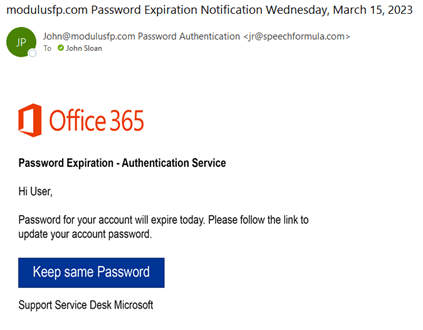
  • If you receive an email from us and it seems a bit off then it is likely a scam of some description (unless it is one of Dale or John’s bad jokes – they’re always off!). We will never send an email asking you to reset a password by clicking a link.This email might look like it has been sent from John’s email address, but it hasn’t.  The actual email came from an external address – jr@speechformula.com.  I checked out the owner of this email address and it seems that they are a legitimate company, so it is highly likely that their email was cloned.  We have contacted them to make them aware of the issue (I would like someone to do the same for me).Remember that if in doubt then delete the message and contact our offices directly.

 

  • If you believe that any of your personal details, passwords etc have been compromised then please contact our offices to inform us. We will assist with trying to ensure that your financial planning arrangements are not accessed by a third party.


  • If you advised that a family member, friend, or adviser is trying to take advantage of you then turn to someone you trust implicitly. If you don’t have someone like that you can speak to, then contact an independent solicitor, financial adviser or accountant, who is registered with the appropriate body (Law Society, FCA, Chartered Accountants Ireland etc).  They will need to speak with you in depth about your concerns so be prepared to meet them as it may take a bit of time (it won’t take a short phone call).


No one intends to be the victim of crime or a scam but it can happen, all too easily.

Scammers are working harder than ever to get at your money.

Always be careful about your personal information and remain vigilant.


Tax Year End is Approaching

Another tax year has almost passed again. It’s been a busy one for tax changes and if recent media speculation is to be believed, it’s going to go out with a bang when the chancellor delivers another statement.

But as we approach the end of the tax year, here’s 5 things you should think about to improve your personal finances.

  1. Income Tax and Personal Allowance for High Earners

Has your income crept above the £100k mark – whether that’s because of a bonus, or a new job or significant pay rise? Do you know you start losing your personal allowance now?

For every £2 you earn over £100k, you lose £1 of your personal allowance. And so if you earn over £125,140 you don’t earn any money tax free.

Not only that, but if you have children, once you earn over £100k, you no longer qualify for the 20% help from the childcare account. Even if you earn £100,001 and your partner is unemployed. It’s gone – tough. But your next door neighbours could both be earning £99,999 and they still qualify. Seems unfair, doesn’t it – but what can you do?

You have two main options:

Option One – make a personal pension contribution. The gross amount of your personal pension contribution is taken off your earnings total.

Option Two – make a charitable donation.

Example: If your total earnings are £110,000, your personal allowance will be reduced by £5,000 and you won’t qualify for help with childcare. If you make a personal pension contribution of £8,000, your pension will claim back a further £2,000 of tax relief. This brings your gross pension contribution up to £10,000. This is then taken off your earnings, bringing your adjusted earnings back to £100k – so you keep your full personal allowance and tax free child care help.

The added benefit is when you complete your self assessment, you will get a further £2,000 of tax relief and so the £10k pension contribution will effectively cost you £6,000, as you have received tax relief at your highest rate of 40%.

A charitable donation works in the same way, but without the additional tax relief. You would need to pay £10k out of your pocket, to a charity of your choice.


  1. Use Your ISA Allowances

You have until 5th April to use up as much of your £20,000 ISA allowance as possible. If you don’t use it, you lose it. This simply shelters the money from tax. If you have plans for the money in the next couple of years, you should consider holding it in a cash ISA. If not, however, why not consider a stocks and shares ISA?*

It can go up and down in value, but by investing for a long time (at least 5 years minimum) you should have a really good chance of beating both cash returns and inflation. If you fancy it, get in touch.

If you already have an ISA open, you can top it up (subject to your £20,000 annual allowance). Realistically, this should be done – at the latest – a  few days before the end of tax year to be sure it is in your account in time.

If you have a Lifetime ISA – your allowance for it is £4k, which the government tops up to £5k. It’s too good to miss out on. Remember, if you use your full LISA allowance, you only have £16k remaining for your Stocks & Shares or Cash ISA.

If you’re saving for your children in a Junior ISA, you can contribute up to £9k in this tax year.

These are all “Use it or Lose It” allowances.


  1. Review Your Cash Savings accounts

If you’re saving for something which you plan to buy in the next few years – like a house move – you should be keeping your money in cash. This is likely going to be in a Cash ISA, Cash savings account or possibly something like Premium Bonds? But what is the best way to go?

If it’s an old cash ISA, you probably had a bonus rate which is now gone. You might not even be making 0.2% at a time when you could be making up to 3%!

Consider this: You have a Personal Savings Allowance of £1,000 which can be earned from interest if you are a non or basic rate tax payer before tax is payable. This decreases to £500 if you are a higher rate tax payer.

If your savings account pays interest of 3%, you would need to have £33,333 in the cash savings account already before you had any benefit of tax-free interest in a Cash ISA. If you are a higher rate tax payer, you need £16,666 in a cash savings account before the Cash ISA has any tax benefit.


  1. Review your Pension Contributions

If you haven’t already done so, review your pension contributions. The minimum contributions through auto enrolment probably won’t be enough to provide the retirement lifestyle you are looking for. If you can afford to do more, do it! You are the one who will benefit in the long run, and the minimum contributions really aren’t going to provide for the comfortable retirement you probably want.

Make sure you are getting the full matching contribution from your employer if they offer it.

If you can afford to increase your monthly contribution, explore the option of doing it through your workplace scheme via salary sacrifice to get an added bonus from saving National Insurance Contributions.


  1. Beware of the High Income Child Benefit Tax Charge

If you, or your partner, earn over £50k and are claiming Child Benefit, you need to be careful. There is something called the High Income Child Benefit Tax Charge, where those who earn over £50,000 per annum lose their child benefit. For every £100 you earn over £50k, you pay a charge equal to 1% of your child benefit received. Once you earn over £60k, you aren’t entitled to child benefit. This is equally true if mum earns £60,000 and dad earns nothing, they will lose all child benefit, whereas if mum and dad both earn £49,000 each, they can still claim full Child Benefit. It’s a completely fair system – isn’t it?

Consider making an additional pension contribution to get around this. For example, if you are set to earn £52,000 this year, you could make a gross pension contribution of £2,000 to bring your Adjusted Net Income below the threshold, and then you won’t lose any.


  1. Tax Annual Exemptions and Allowance are reducing

The Government have hit us with new lower tax allowances coming into effect on 6th April 2023.

First, the Capital Gains Tax Annual Exemption which currently stands at £12,300 will decrease to £6,000 overnight. This means that if you sell a rental property or second house or shares not held within an ISA or Pension for example, you will realise a gain. The first £12,300 this tax year isn’t taxable, but as of 6th April, only the first £6,000 won’t be taxable.

Secondly, the Dividend Allowance is reducing from £2,000 to £1,000. If you are a business owner, you might have your husband or wife on as a shareholder – beware that their allowance will decrease.

Finally, the bracket for Additional Rate Tax is reducing from £150,000 to £125,140. If you earn over this, you will begin paying more tax at the rate of 45%.

If this affects you, please speak to an adviser as there may be things you can do which help you get more into your pocket and save some tax


*Please note that past performance is not a guide to the future, the value of an investment and the income from it could go down as well as up. You may not get back what you invest.


^^This communication is for general information only and is not intended to be individual advice.


Contact

Get Connected.

Contact Us

Modulus Financial Planning look forward for you to contact us for more information about any of our products or services.

Modulus Financial Planning

Suite 12, Avonmore House,
15 Church Square, Banbridge,
BT32 4AP, Co.Down, Northern Ireland

Let’s Talk About Your Finances

Here for all your saving & investment, pension & retirement planning, tax & estate preservation and insurances.

CALL: 028 40 33 68 67

Modulus Financial Planning Ltd is authorised and regulated by the Financial Conduct Authority. We are entered on the FCA Register under reference 965916. Registered in Northern Ireland, Company Number NI673772.
The guidance and/or advice contained within this website are subject to the UK regulatory regime and are therefore targeted at consumers based in the UK.

The Financial Ombudsman Service is available to sort out individual complaints that clients and financial services businesses aren’t able to resolve themselves. To contact the Financial Ombudsman Service, please visit www.financial-ombudsman.org.uk.

Privacy Policy

Contact