Blog by Modulus

READ OUR BLOG

The Four Phases of Retirement

As we’re financial planners, we spend a lot of time talking to people who want to plan for their retirement, whether that’s in the next few years, or 20 years away! Something we stress is that it’s OK to plan financially for retirement, but you also need to psychologically plan for retirement.


Dr Riley Moynes, author of The Money Coach, did a TedX talk on the Four Phases of Retirement, and explains it better than most.


Note. He talks very slowly and methodically, so I recommend at least speed 1.25x, if not 1.5x. It’s only 13mins at normal speed.


I’ll let you watch the talk for yourself, but here’s the basic key points and phases.


The Four Phases of Retirement

With current life expectancies, you should expect to spend about 1/3 of your life in retirement. There will be a long time for things to change.


The 4 phases:

  1. The Vacation Phase – where you wake you when you want, do what you want and go where you want for as long as you want. You might go on one big campervan holiday or do 5 cruises – but the key is, you can do what you like. This might only last the first 1-2 years.
  2. The Loss Phase – when we feel loss and lost. We lose our routine, our identity, our relationships from work, our sense of purpose and for some, our sense of power – especially if you were a business owner or manager. This phase quite often leads to divorce, decline (physically) and sometimes depression.
  3. The Trial and Error Phase – trying to figure out what you are going to do with your time. You might join clubs, volunteer, sit on boards of charities or businesses as a Non Exec Director etc.
  4. The Reinvention Phase – you figure out exactly what you want to do, which gives you purpose and accomplishment and the drive to get out of bed in the morning.

If you make it to phase 4, these retirees are the ones who reportedly enjoy retirement the most.

But watch the video, where he expands on each and see what you make of it.  Listening to someone who has been through it, and experienced it, might be better than listening to me or John telling you to plan psychologically plan for retirement just as much as financially.


And if you want to talk to someone who can financially help you plan for retirement, we might just be able to help. Give us a shout now to get planning for yourself

Volatility: It isn’t as scary as it seems!

Investment markets have been pretty good to those investing in the global equity markets over the past couple of years. After a period of sideways markets (let’s just say flat) and soaring inflation, the S&P 500 (the world’s premier stock market in the opinion of many), rose by 24% in 2023 and another 23% in 2024.  Not everyone is invested completely in the S&P 500 (for a number of reasons), so not everyone will have gotten these returns.  However, if you had been invested into a globally diversified portfolio with exposure to 100% equities then you could have received returns of c. 15 – 18% in 2024 and 10 – 15% in 2023. 

Most significantly, the last two years saw no extended periods of significant declines. 

In 2023, the largest decline was -10% between July and October (in terms of the S&P 500). In 2024, the worst was a 21-day decline of only -8% between July and August (again in terms of the S&P 500). 

While this was a welcome respite from the normal market rhythm, the financial media would likely have been dismayed!  Bad news sells, while positive stock market returns do not it seems! More seriously, there’s a danger that investors will forget the important lessons learnt from past declines. 

To prepare you for the possibility of more significant declines in the coming year, we outline a few points below that you should keep in mind when others are losing theirs. 


What You Should Know 

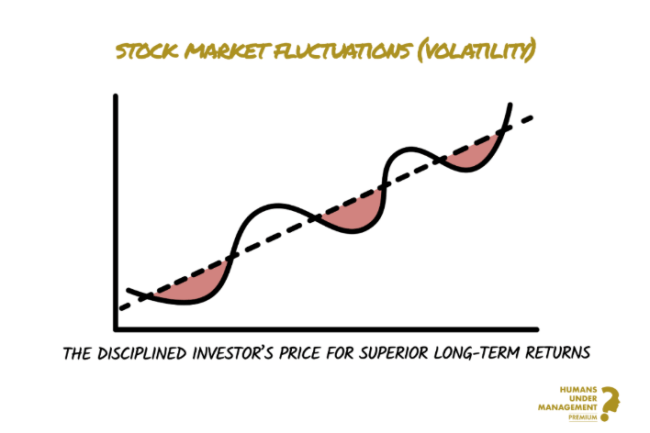
It is a well-known feature of the stock market that values do not move in a straight line but instead fluctuate up and down while keeping to a generally upward trend over time. We refer to this as “volatility.” Dale often compares volatility to rollercoasters, comparing the Barry’s Big Dipper to the Crazy Caterpillar – two rollercoasters, one “scarier” or more volatile than the other.

*Image borrowed from Humans Under Management 

A market correction is defined as a 10% drawdown from a previous market high. While it may sound like a significant number, these events occur far more frequently than most investors believe. Indeed, they come around as often as your birthday, with years like 2024 being the exception. 

Since the turn of the century, the average annual decline has been approximately -16%. While this may surprise you, it’s worth noting that about three in every four years still ended with a positive return. 

We also know from market history that we expect a decline of more than -30% approximately every five years (on average), as we last experienced in 2020 in Covid. The market rebounded so quickly after this though, that portfolios produced close to a 10% return in that same year 


How You Should React 

We know that stock markets generally provide positive returns about three in every four years. The one negative year is what earns you the other three positive years. It’s the price of admission for profiting from the collective ingenuity of the hundreds of companies working for you while you sleep. We encourage you to see the temporary declines as the reason for the stock market’s permanent returns. You can’t have one without the other. 

Unfortunately, we cannot consistently predict when these fluctuations will occur or when they will reverse. If we could, we wouldn’t need to work because we’d be rich! To be a successful long-term investor, one must accept this with humility. 

Market declines will consistently occur throughout your investing life, and your mindset during these times is a choice that will shape your financial future. We advise you to confront them with confidence rather than fear while being mindful of the opportunities they present. 


Time Heals 

Ultimately, what happens in the next year is relatively unimportant to your 30-year plans. If you’re investing long-term, the odds are stacked in your favour. You’re almost guaranteed to win. 

After two years of minimal volatility, if we experience a decline in the coming months, be encouraged that you are busy earning future returns. Additionally, if you’re still saving, declines are your best friend, allowing you to buy more units of shares at reduced prices (basically you are getting a discount – a sale if you will). 

While we don’t know where the market will be at the end of 2025, we’re pretty confident about where it will be in 10 years: much higher. Time is the enemy of market declines, and most investors have plenty of time. 


Don’t Be Put Off Investing Now 

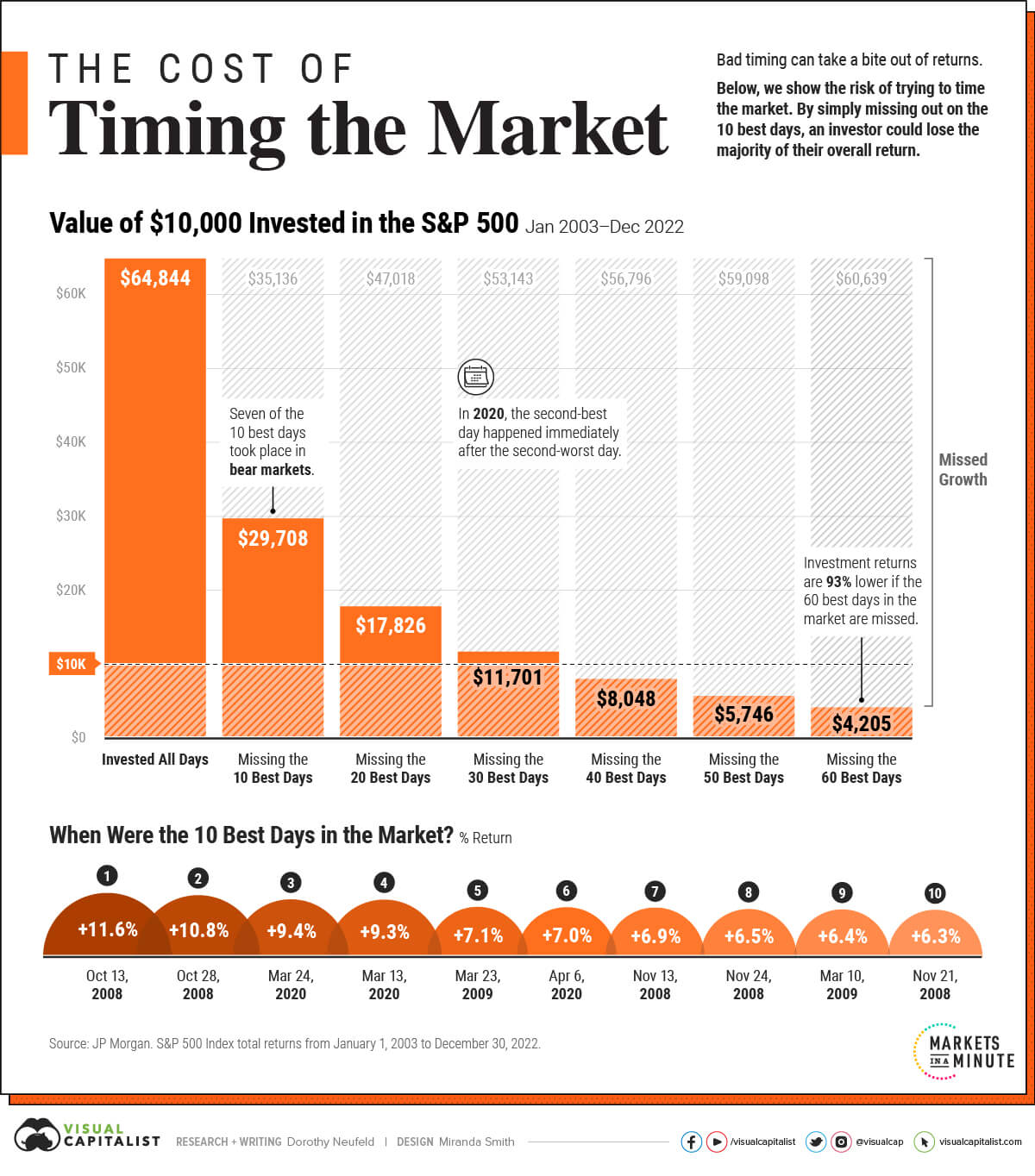
Some inexperienced investors will say to themselves, “I’m going to wait until the market stops going down.” This is very hard to do, and it will potentially cost you in terms of your returns.  

The below graphic was produced by Visual Capitalist, which shows the impact of missing out on the best investing days, which quite often immediately followed the very worst.  Look very closely at the 10 best days, they were all in 2008-09 (The Recession) or 2020 (Covid).  


**Image and Research from The Visual Capitalist 


If you want to have a word with either John or Dale, send them an email or give them a call. It’s during these more “scary” investment times when we understand you might be nervous or feeling unsure. You might remember our first few meetings with you when we warned you investments can go down as well as up, but for some that warning might have been several years ago. 

So far, the news has made this year seem scarier than it has been, probably because it’s being dominated by Trump and what he will do next?  While there have been media headlines about markets dropping, they have also had some good days too, proven by the fact our 100% share portfolio (the most volatile portfolio we would normally recommend) has only fallen by about 2% since the beginning of 2025. In essence, any returns which were made in Trump’s initial weeks and months, have been lost, and we are pretty much back where he began.   

But this is only a very small snapshot in time.  

“Time in the market beats timing the market.”  – Kenneth Fisher 

Most people are not investing for the next week, 6 months or even year. Most people are investing for decades, multiple decades in fact. So, if we look through a short-term lens, volatility can seem scary. If we stand back and look at the bigger picture it really isn’t that bad.  And we know that is easy for us to say, but we have skin in the game ourselves here. The key is to hold on and accept that this is a natural part of the investment process and experience. If you can embrace it then you are much more likely to have a positive investor experience in the long term. 


# Remember: Past performance is no guarantee of future performance. Investments can and will go down as well as up and you may not get back the original amount of your initial investment. Please seek professional advice when considering investing money. 


Don’t Get Lost in a Tax Maze

It’s that time of year again when we start looking at end of tax year planning (for those who haven’t already made the full use of their allowances).

With proposed changes coming down the line for pensions and inheritance tax, you could be forgiven for being a bit more confused and simply do nothing. So to help you feel a little bit less lost in the tax maze, here’s five essential tips to consider as the tax year comes to a close:

  1. Make the Most Of Your ISA Allowances

Make sure to use as much of your full ISA allowance of £20,000 that you can. This is an opportunity to save money tax free. It can be into a Cash ISA – like  a bank account – or a Stocks & Shares ISA.

If you’re eligible, consider contributing to a Lifetime ISA (LISA) with a £4,000 allowance which will use up £4k of your £20k ISA Allowance. To find out more about what a Lifetime ISA is, here’s our handy guide.

And finally, if you have children or grandchildren, you can contribute up to £9,000 into a Junior ISA (JISA). Remember however, you can’t withdraw from this and it will automatically become there’s at age 18.


  1. Pension Contributions

Contributing to your pension can provide significant tax benefits.

Here’s a few groups of people who might get even more benefits out of it now rather than solely being for the benefit of their retirement

  • If you earn just over a tax bracket, eg. £50,000, a pension contribution can help reduce your income tax rate bringing you back to Basic Rate Tax only.
  • If you (or your partner) claim child benefit and your income is between £60,000 and £80,000, a pension contribution will bring your adjusted earnings down, which could help you reduce your High Income Child Benefit Tax Charge, making you eligible for more child benefit.
  • For those earning over £100,000 and claim childcare account benefits, a pension contribution can bring your earnings back below the £100,000 magic number. This could help avoid the tax trap.
  • For anyone earning over £125k who pays the additional rate of tax, your personal contributions benefit from tax relief at your highest rate. So a if you contribute, £10k into a pension, the fund will reclaim tax to bring this up to £12,500. Then through your tax return, you will reclaim a further £3,125 of tax relief and so your total pension contribution of £12,500 cost you only £6,875.
  • If you are a sole trader, self employed or in a partnership, a pension contribution will reduce your income tax liability for your self assessment next January.
  1. State Pension Gaps

This is your last chance to buy any gaps in your state pension. I know we said this last year too, but then they extended the window for it.

Ensuring you have a full state pension can provide a valuable source of income in retirement. You can find out more here – https://www.gov.uk/voluntary-national-insurance-contributions 

Log on to your .gov.uk account (or use the HMRC which I actually quite useful) and check your state pension and NIC record. It will show you if there are missing or incomplete years and tell you how much you need to pay to get a full year. Depending on the years, a full year seems to cost between (£900-£1,000) but if you have par tpaid some of the year, it might not be anywhere near as much.

And don’t forget, you only need 35 years of full NIC Contributions, so if you have a few gaps form your time at university, it’s highly likely that you will make up for them during your working career so it shouldn’t be an issue.

If you’re in any doubt, please ask John or myself about this. It could be some of the best money you spend.


  1. Annual Gift Allowance

Take advantage of the annual gift allowance of £3,000. This can help reduce the value of your estate for inheritance tax purposes.

Inheritance tax is front and centre right now for lots of people, so this gift allowance might be more useful now. You can use this year’s allowance and last year’s f you didn’t use it, so each person can make a gift of £6,000.

There are one of wedding gift allowances too and Normal Gifting where you gift out of excess income which can also be beneficial to clients with potential IHT issues.


  1. Capital Gains Tax (CGT) Allowance

Make use of the CGT allowance of £3,000. This can help you minimize the tax you pay on any gains from the sale of assets or property. There is no tax between spouses, so you can split asset ownership in some cases, using both of your allowances.

However, if you are thinking of doing this with property, just check with your solicitor as the fee to switch ownership now might not make the saving of an additional allowance that worthwhile.

This allowance used to be much more beneficial when it was around £12k, but if you can, it is still worth using up.


2024 Market Review

Past performance is no guarantee of future performance!

A statement used as often in investment management as the phrase “what’s the craic” is said in a bar on a Friday night.

However, past performance really is the only thing that we have to look at in order to try and understand the markets and how they performed.

So here is a review of the markets in 2024 by our Investment Partners at EBI.  It does get quite technical towards the end (so be warned), however we think some of you will actually really appreciate this.


EBI 2024 Annual Market Review

Raising Your Profile as a Business Owner: Do Awards Matter?

As we are now firmly in the middle of the festive season, many of us will be looking back over the past year – thinking about the successes and challenges, whilst planning for 2025.  In terms of looking forward it is always important to consider how marketing will play a part in building any business. An effective way of raising public profile is by entering business competitions and awards*.

We work a lot with business owners, helping ensure that their business is funding both their current and future lifestyles. As business owners ourselves, we understand the how hard it can be to stand out in very competitive markets.

This year, we experienced first-hand the value of awards recognition when we entered, and were named as one of, Citywire’s New Model Adviser Top 100 Financial Planning Firms (the only firm in Northern Ireland to be awarded this accolade in 2024).

This experience has been for our team. We have gained experience in the process, a lot of confidence and have enhanced our profile a good bit.


Why Should Business Owners Enter Awards Competitions?

  1. Increased Public Exposure Awards offer a platform for your business to be recognised and showcased to a wider audience. Whether the competition is industry-specific or broader, the exposure can elevate your profile in front of key stakeholders, peers, and potential clients. Being named as a NMA Top 100 Financial Planning Firm, has allowed us to reach a larger audience. It gave us the opportunity to share our story, our values, and the impact we aim to have on clients’ financial futures.
  2. Building Trust and Credibility Winning or even being shortlisted for a respected award is a great way to demonstrate credibility. For clients, this external validation reassures them that they are dealing with a reputable, forward-thinking business.For us, being recognised by Citywire means that both current and prospective clients have that bit of reassurance that they’re working with people who are working at a high level and delivering trusted financial planning advice.
  3. Motivation Competitions celebrate success. Success is built around a team. Recognition of this will help boost morale, motivate your team and show them that they are valued.Being named as a NMA Top 100 Firm was an excellent way to close out the year, knowing that we are being acknowledged by industry experts and peers.  Always remember to celebrate the win as well!
  4. Networking Opportunities If there is an awards ceremony then it is a great chance to meet with peers and colleagues, which is a brilliant for looking at opportunities and networking.
  5. Marketing and Differentiation Winning or being shortlisted for awards provides a fantastic marketing opportunity. It is another touchpoint for engaging with your current and potential clients. It can help to set you apart from competitors and shows that you are a leader in your field.  Since our NMA Top 100 recognition, we’ve seen the impact of sharing our achievement across our networks. It has opened doors to new conversations and helped us to increase our profile immeasurably.

Looking Ahead to 2025

The experience of entering and being named as a Citywire New Model Adviser Top 100 Financial Planning Firm, has shown us just how valuable awards competitions can potentially be for business growth.

Competitions can be a powerful part of your strategy for growth, helping you stand out and be recognised for the hard work and dedication you put in every day.

We’re here to help business owners plan for success—financially and beyond. If you’d like to discuss how you can maximise opportunities in the year ahead, we’d love to hear from you.


Wishing you a wonderful Christmas and a prosperous New Year!


*Please note that there are some “awards” that you can enter where, if you pay a sponsorship fee or purchase a publicity package, then you are an “award winner”. We aren’t talking about these “awards”, we are talking about awards where the entries are judged by a panel of industry experts and peers.

Don’t Pay Attention To New Year Predictions

At this time of year, every financial company whether they are an investment company or a marketing company will be penning their predictions for 2025. A quick online search and you’ll be presented with countless predictions, each contradicting the last. But how much should we care, if at all?

Predictions of “Uncertainty”

If you remember back to this time last year, we were all thinking about 2024 as the year of the election. I remember the phrase “Geopolitical Turbulence” being the go-to as 64 countries took to the polls. After 18 months of not very much happening in terms of investment markets, and then in November 2023 markets started to rally, which coined the Santa Claus Rally, we were being warned for uncertainty in 2024. A prediction that the late surge was going to be short lived.

Someone define “uncertainty” for me because I believe nobody can predict the future. And so doesn’t that mean pretty much everything is uncertain?

2024: The Quickest review of a year you might ever see

During 2024, we’ve had the war of Russia & Ukraine rumbling on and the trouble in the Middle East; Donald Trump’s soap opera life between court trials, an attempted assassination and then winning the election; the return of the Labour Government and their much anticipated first Budget; the return of Oasis and their “dynamic ticket pricing model” scandal; the Taylor Swift tour sweeping the globe; the introduction of Breakdancing to the Olympics; another McFly member won I’m a Celebrity and a blind comedian winning Strictly Come Dancing.

How did they fare?

Every prediction was nothing but a guess. The people making these predictions had no clue what was going to happen.

The first time some tells you they know what it is going to happen, is your first sign to run for the hills.

So what happened in the investment world? Well while “experts” predicted another uncertain year where “Cash would be King” and locking in for 5% was in your best interests, a globally diversified portfolio produced double digit returns.

The UK market grew to record highs with the FTSE 100 breaching 8000, the tech sector drove the NASDAQ Composite to its record high breaching 20,000 and the S&P 500 set record highs breaching 6000.

Even Bitcoin hit its record high breaking US$100k for one Bitcoin.

So in hindsight, as ever, cash was not king. And while the year was uncertain, that didn’t mean bad for investors like you and me.

What does 2025 look like?

I’ve no idea… but the “so called experts” are now predicting another year of uncertainty.

Nobody knows what will happen and if they did, they would be very rich. They also wouldn’t bother telling you or me because then they could make more money.

But no matter where we are in life or what is happening, there will always be a reason not to invest. These experts and the media need to drive sales and so they peddle these stories to whoever will listen or read.

The only thing you should be thinking of is what is happening in your life and is in store for your future? You can drive or change your own future, but you cannot change or control global politics or macroeconomics.

Planning for 2025

If you need cash this year or in the next couple of years, keep that in the bank account. If you don’t think you need it for anything in the next 5 years’ plus, then start thinking about investing it.

Inflation will always beat cash in the long term. They use interest rates to combat inflation, and so that is one of the long term certainties we have. The others being death and taxes.

The only way you can beat inflation in the medium to long term is to invest in a diverse portfolio of assets.*

Will markets go up at some point next year? Probably. Will they go down at some point next year? Probably. It’s what they do, and they always have done. It isn’t anything new.

It is this “volatility” of going up and down which helps us all to grow our savings and pensions. And the sooner you stop fighting this and learn to accept it, the more you can get on with living your life.

We set up your financial habits of regularly saving and investing, and then you go and start doing the other things which you want to do in your financial plan. Maybe that is your trip to Australia, or hiking the Inca Trail, or buying the Tesla or building the outdoor BBQ kitchen area in your garden. Maybe you’re getting married or having a baby, or maybe you’re just looking forward to becoming grandparents and being able to hand the baby back before going home. Possibly you’ve called time on work and now you have an empty calendar and a life without the alarm clock to adjust to. Or maybe you’re just about to open the doors to your new business and can’t wait for what is to come? But what’s important is you do what you want or need to do, knowing you have a portion of cash for it, and a portion invested for funding your future.

That’s where you will make the memories for your life and let the day to day of money management take care of itself. Focus on what you can control and stop worrying about what you can’t.

And so that’s why we won’t be predicting the future for you. Investments will do what they always have done, and always will do.

If you want to start planning, the period between Christmas and New Year is a popular time for reflection and planning for your best life.  We’ve created our Life Planner if you want to do it yourself but if we can help you, please get in touch and either myself or John would be very happy to talk.


* Remember: Investments can and will go down as well as up and you may not get back the original amount of your initial investment 


How Does The Budget Affect You?

Hopefully you don’t feel too let down by the Budget after all of the hype it seemed to be getting.

The Highlights (or Low-lights) of Rachel Reeve’s Budget

Here’s some of the highlights which will likely impact your financial planning

  • There’s an increase to Capital Gains Tax rates and Stamp Duty Land Tax if you are buying an additional property
  • Business Owners will now be paying more Employer’s National Insurance Contributions
  • The biggest changes of all are around Inheritance Tax, including how pensions, Agricultural property and farms and Businesses will begin to fall in to the scope of Inheritance Tax
  • Some light at the end of the tunnel with an indication that Income Tax and National Insurance Contribution thresholds will begin to rise with inflation again from April 2028.

What is slightly comforting is that it lacked a lot of the rumours around pensions, in particular changes to income tax relief contributions and tax free lump sums.

Anyway, here’s a summary video of it all:

We’ll be doing some more detailed breakdowns over the next few weeks as we get to know the full details, especially with the implications on Inheritance Tax for pensions, farmers and business owners


The Biggest Loser?

I just feel sorry for the large business owner who is having to increase your national minimum wage and pay the extra Employer’s NICs; you have a fleet of private jets; are under contract to complete on your 3 new holiday homes; you have stuffed your pension full to pass on to your triplets who are about to begin Private Schooling next September; have a chain smoking habit and taken a fancy to a nice watermelon ice vape for breakfast, oh and you have a massive farm which you bought 20 years as an inheritance tax planning ploy and now don’t know whether to pass it on with IHT, or sell and crystallise a massive capital gain?

But how many of that kind of person can there be?


Ethical Investing: Why Embrace ESG Investing in a Changing Climate

Recently, I attended the Nextgen Planners Goodstock Ethical Investing Conference in Edinburgh.

Now don’t get me wrong, I am not a full blown “eco-warrior.”  I have no ambition to buy a farm and live off grid in a self-sufficient manner. And I don’t have any intention of joining the Just Stop Oil protests. We heard from people who have done these things, but I won’t be following suit.

But what is obvious is the effect on the world that people are having. With climate change and extreme global weather events becoming more evident every year, it’s never been more important to think about what we can do to minimise our impact on our environment. And rather than sit and protest on roads or throw paint on planes or soup on Van Gogh’s Sunflowers, some thing we can do (with no legal recourse) is to think about how we invest our money.

There is a line between the right thing to do and legal laws. In my eyes, the activists cross this line.

We Have A Problem

What was evident is that we have a problem.

Firstly we have a language problem. There are so many labels and names and acronyms that it puts people off.  Whether it’s green, deep green, green-washing, ESG, sustainable, Impact, responsible… The investment industry has come up with so many terms and words that it’s become a bit of a mess. No wonder it’s complicated.
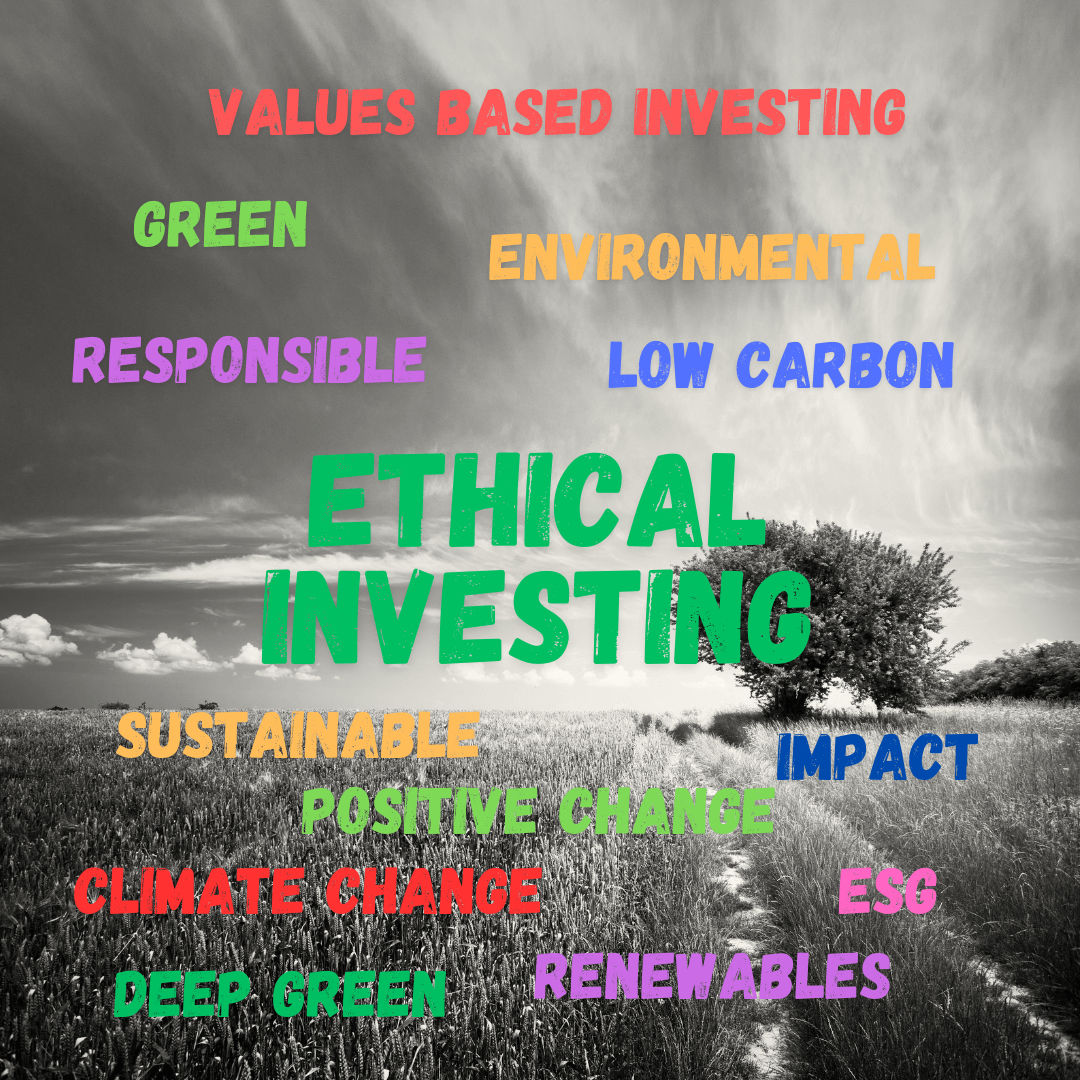
ethical investing word cloud

We also have a climate problem. There were some very interesting stats thrown out which I can’t back up with evidence here, so take them as you see them.

  • Apparently the top soil we have today around the entire world won’t be fertile enough to grow anything in 30 – 60 years depending on how we treat it. Now if we do look after it, it can regenerate. Our modern day mono-culture practices of farming where each field has only one crop doesn’t help. If we allow fields to grow many different plants (re-generative farming if you have watched the latest series of Clarkson’s Farm) can help the problem resolve itself. Or in China, they are trying to reforest parts of the Gobi Desert in their Great Green Wall movement.
  • Experts predict we use up so much resources that oil and natural gas will be non-existent in around 50 years. We are working on renewable energy and even today we see solar panels and wind turbines everywhere now, but we need to go further. Elon Musk is probably the most famous here for trying to bring in Solar Roof Tiles.
  • Due to our urbanisation and destruction of certain environments, we are increasing the speed of animal extinction. The top 10 animals in danger of extinction include the Polar Bear, the Asian Elephant, the Giraffe, the Tiger and Cheetah and the Red Tuna. If this happens, our children are going to be missing out on many of the key animals they learn about.
  • Something which maybe won’t surprise you, is Europe is leading the way on this. Probably not surprising since the US seems to play the “Hokey Cokey” continually stepping in and out of their environmental and sustainability promises depending on who’s sitting in the White House.

With all of these stats, the timeframes are all relatively soon. Just 30 – 60 years.

The scary thought is I’ll still be working in 30 years as will some of our clients. In 60 years, I would be in my mid 90s, so hopefully I’ll be finished with work by then.  But this is definitely an us problem, and not a problem for the next generations.

Each presenter had various stats that people are looking for this kind of thing now. As recently as last year, there was a survey they reported that almost 60% of investors would choose to invest in some sort of ethical fund if they had the option.


What are we doing about it?

Without wanting to impose our own beliefs on anyone, one of the things investors can do is to use the influence of shareholder voting rights. Through investing, we own shares in businesses and therefore have a vote at each company’s Shareholder AGM. When these funds which have millions, if not billions, of all of our money, they need to use that vote to hold corporates and companies to account, to develop their sustainable practices to try to help this issue. Two of the biggest fund managers who have been criticised for not doing this as recently as a few weeks ago are Vanguard and Blackrock 

Lots of us have money invested, whether it’s savings or our workplace pension. If this money can be used for good, as well as to grow for our own futures, then why shouldn’t we?

There are lots of things we could do, but one such practice is investing in ESG Portfolios.  You can go further if you wish, but the further down the line you go, you reduce the diversification of your portfolio and therefore increase the volatility, which can cost you returns. This is where Sustainable and Impact investing come in. See my video from a few years ago about the Spectrum of Ethical Investing.

We believe ESG (Environmental, Social, and Governance) investing is a good way to align our portfolio with our values without impacting returns. There has been lots made of this recently, as the ESG overlays meant not being as heavily concentrated on the Magnificent 7 when they took off towards the end of last year. Consequently, ESG portfolios also didn’t fall by as much in the last few months when these companies also fell back. The trade off of AI is the energy the computer systems and data houses required to power it.

When anyone looks at investment strategies, they will find evidence for almost anything they want if they take a short term outlook.

What is ESG Investing?

ESG investing considers Environmental, Social, and Governance factors when making investment decisions. It’s about more than just profits—it’s about making a positive impact. Let me break down each part for you:

Environmental (E)

This focuses on how a company impacts the planet. Think about energy use, waste management, pollution control, and protecting natural resources.

Social (S)

The social aspect looks at how companies manage relations with employees, suppliers, customers, and communities. It includes labour standards, health and safety, human rights, and community involvement.

Governance (G)

Governance involves a company’s leadership, executive pay, audits, internal controls, and shareholder rights. Good governance means transparency and accountability. Unilever shines here, with executive compensation tied to sustainability goals and clear, honest reporting.

ESG for the long term

Given the growing threat of climate change, incorporating ESG factors into our investment strategies isn’t just the right thing to do—it’s should be smart finance. Companies that address climate risks tend to be more sustainable in the long run. And if we’re investing for the long run, if all of these companies have deadlines and targets to meet in 2030 and 2050, then this should help long term portfolio returns.

Big funds are leading the way on this. Take the Norwegian Government Pension Fund, also known as the Norwegian Sovereign Fund. As of August 2024, this fund is worth over $1.7 trillion and has shifted heavily toward sustainable investments. They’ve poured billions into renewable energy and moved away from companies that fail to meet their ESG criteria. In 2022, they allocated a whopping $11 billion to green bonds and renewable energy projects, showing their commitment to a sustainable future.

Wrapping It Up

Incorporating ESG considerations into your investment strategy isn’t just about feeling good—it’s about making wise financial decisions that should impact our long term future both financially and as Planet Earth.

One of our key values at Modulus FP has been to choose positive change if we can. To leave the world the way we found it without affecting your day to day life.

There will always be trade offs. We believe if we can help in this way, then we don’t need to feel guilty about taking planes around the world or driving SUVs. We’re not thinking of getting a Glastonbury-esque compost toilet installed nor are we asking you to.

ESG investing is an answer to doing what we can, which takes minimal effort and doesn’t affect our daily routine.

If you want to go one step further then great, but that’s your decision and not for us to impose upon you.



Cash in your business? Options to help it grow or take it home

Lots of businesses accumulate cash.

As a business owner, you too may have accumulated some in your business account over time. You might be saving for a rainy day, planning for a future investment or business acquisition, or simply you’re having a profitable year.  But too often we speak with business owners with close to 6 figures or more sitting in their business current account earning absolutely nothing!

We have clients, and we speak with accountants who have clients, who accumulate cash in their business, who don’t know what to do with it and don’t want to take it out to pay the tax.

Whatever the reason, you may be wondering what to do with it and how to make the most of it?

Here are some considerations to think about. Before rushing ahead with any of them, please speak to both ourselves and your accountant first!


Can you take the cash out?

The first question to ask yourself is whether you need or want to take the cash out of your business?

This will depend on your personal and business circumstances, such as your income, tax situation, and future plans. You might want to squirrel away some cash so that you can move quickly if a property or a new business venture was on the horizon. But if the business doesn’t need the cash, what then?

There are several different ways to move the cash out of the business and into your own name, each with its own advantages and disadvantages. The two main ways are pension contributions or dividends.

Pension

You can make employer contributions to your personal pension from your business account. This can be a tax-efficient way to save for your retirement. It should qualify for corporation tax relief on the contributions so it will save the business money and you won’t have any income tax and national insurance to pay.

However, you will not be able to access the money until you reach the minimum pension age, which is currently 55 but will increase in the future.

So while it helps you from a tax point of view now, it doesn’t necessarily help your lifestyle now.

Dividends

You may be able to pay yourself dividends from your business profits. This can be a flexible way to take the cash out, as you can decide how much if you are the Director and Shareholder.

However, you will have to pay income tax on the dividends you receive (and Student Loan Repayments if you still have one). The company will also have to pay Corporation Tax on the profits before you can declare the dividend as well.

You will have to pay dividend tax, which is currently 8.75% for basic rate taxpayers, 33.75% for higher rate taxpayers, and 39.35% for additional rate taxpayers. The paltry £500 dividend allowance isn’t going to soften the tax blow for you.

The advantage of this, however, is that you have the remaining cash after tax in your hand today to put food on the table, fuel in the car or go on that holiday.

There are things we can do to minimise the tax impact, but it would mean tying the money up for at least 5 years – if you’re interested in this, give us a shout!

But what if the cash needs to stay in the business?

If you decide to keep the cash in the business, you may want to look for ways to make it work harder for you.

This will depend on your risk appetite, time frame and liquidity needs.

Business bank account(s)

You can keep the cash in a business bank account that pays interest. This can be a safe and easy way to earn some income on your cash without taking any risk.

However, the interest rates are less than 5% and linked to Bank of England Base Rate, so if interest rates fall, your savings account rate will likely reduce too. Long term, you are unlikely to beat inflation.

You will also have to pay corporation tax on the interest income.

We can help you to try to maximise your return while keeping the full FSCS protections available to you.

Two accounts are easy to track and manage, but more than two can become a headache, especially when you have to individually apply to each one and jump through each of the banks’ compliance and anti money laundering requirements.

Please ask us about this if we can help.


Corporate General Investment Account (GIA)

You can invest the cash in a corporate GIA, which is a type of investment account that allows corporates to invest in share portfolios. This can be a way to potentially achieve higher returns on your cash depending on the performance of the assets. However, it comes with the usual investment risks as the value of the assets can go up and down, and you may not get back the full amount you originally invested.

You will also have to pay Corporation Tax on any capital gains or income from the investments. As with any investment, this needs to be cash you don’t think you will need for at least 5 years.


The answer is probably not “All or Nothing”

As you can see, there is no one-size-fits-all answer to what to do with cash in your business.

You will have to weigh up the pros and cons of each option and decide what suits your needs and goals best. Likely, the correct answer will be a mix of the different options.

As always, you should definitely speak with your accountant and your financial planner before proceeding with any of this!

The 8th Wonder of the World

Compounding: The Eighth Wonder of the World!

Compounding has been coined as the ‘Eighth Wonder of the World’, attributed to Albert Einstein no less.  Strong words, but compounding is a powerful concept and it’s not just about growing wealth; it’s about setting the foundation for long-term financial freedom.


This will sound geeky, but compounding is probably the most exciting aspect of investing, especially when you look at it in terms of the long game – your financial plan. It’s essentially the process where your initial investment earns returns, and then those returns are reinvested to earn even more. Over time, this cycle, compounding, can help build wealth substantially, which ultimately provides security and financial freedom.


Some figures will help to illustrate the true power of compounding. Imagine you invest £10,000 with an annual return of 5%. After the first year, you’ll have £10,500. Now, instead of taking that £500 gain out, you let it compound. The next year, you’re not just earning on your initial £10,000 but also on the £10,050, which brings you to £11,025.00. This process continues, and after 30 years, without adding any more money, your initial £10,000 investment would grow to £43,219.42.


Now, let’s consider if you added an additional £1,200 (which works out as £100 per month extra), to your investment every year. With the same annual return of 5%, after 30 years, you wouldn’t have £43,219.42, but a whopping £121,746.00.  That works out as an increase of £78,526.62 for £34,800 of extra payments into the investment. That’s the real power of compounding at work!


The late, great investor Charlie Munger, wisely advised, “The first rule of compounding is never to interrupt it unnecessarily.” This is a golden rule for investors: the longer you allow your investments to compound, the greater the potential for growth.  Of course there may be times were accessing funds, and therefore breaking the compounding cycle, is necessary.  However good forward planning can help to alleviate the possibility of this happening to a degree (retaining a cash buffer, planning for future expenses such as a car purchase, having separate pots for education etc).


Warren Buffett, Charlie Mungers former business partner and one of the most successful investors of all time, has often highlighted the importance of compounding. He once remarked, “My life has been a product of compound interest.” A simple phrase which highlights the impact compounding has had on his wealth-building journey.  Indeed, such has been the compounding success Buffett has had, he still remains in the top 10 richest men in the world, after having given away $55 Billion to charitable foundations.


Einstein said, “Compound interest is the eighth wonder of the world. He who understands it, earns it … he who doesn’t … pays it”.  Remaining invested and not interrupting it (if possible) are the keys to understanding and earning it.  Similarly, understanding that debt utilises the power of compounding, for the benefit of the lender, is important to remember. To ensure you don’t over-pay it means you basically have to interrupt the lenders compounding (by paying down debt a bit quicker if possible – as we have seen earlier – an extra £100 each month can make a massive difference in the grand scheme of financial planning.


Compounding is the patient investor’s best friend and, when understood, can be the cornerstone of a successful long-term investment strategy.


Start early, stay consistent, and watch as compounding turns your financial goals into reality.


To finish up here are some practical tips for anyone looking to harness the power of compounding in their investment journey:


  • Start Early – The sooner you start investing, the more time your money has to compound. Even small amounts can grow significantly over time.


  • Regular Investing – Make regular contributions to your investment portfolio, no matter how small. Consistent investing can have a big impact due to compounding and pound coast averaging.


  • Reinvest Dividends – Instead of taking the dividends and income as cash, reinvest them. This increases the amount of money that is compounding.


  • Be patient – Compounding requires time to work its magic. Resist the temptation to withdraw your investments early.


  • Understand Interest Rates – Paying debt at higher interest rates can significantly reduce the amount of money you end up with – be it debts such as mortgages, personal loans, credit cards etc


  • Utilise Tax-Advantaged Accounts – Make use of tax wrappers such as ISAs and pensions. These allow investments to grow tax-free or tax-deferred, enhancing the compounding effect.


  • Monitor and Review – Keep an eye on your investments to ensure they are performing as expected, but avoid the urge to tinker too often. Review once a year with your financial planner!


Contact

Get Connected.

Contact Us

Modulus Financial Planning look forward for you to contact us for more information about any of our products or services.

Modulus Financial Planning

Suite 12, Avonmore House,
15 Church Square, Banbridge,
BT32 4AP, Co.Down, Northern Ireland

Let’s Talk About Your Finances

Here for all your saving & investment, pension & retirement planning, tax & estate preservation and insurances.

CALL: 028 40 33 68 67

Modulus Financial Planning Ltd is authorised and regulated by the Financial Conduct Authority. We are entered on the FCA Register under reference 965916. Registered in Northern Ireland, Company Number NI673772.
The guidance and/or advice contained within this website are subject to the UK regulatory regime and are therefore targeted at consumers based in the UK.

The Financial Ombudsman Service is available to sort out individual complaints that clients and financial services businesses aren’t able to resolve themselves. To contact the Financial Ombudsman Service, please visit www.financial-ombudsman.org.uk.

Privacy Policy

Contact